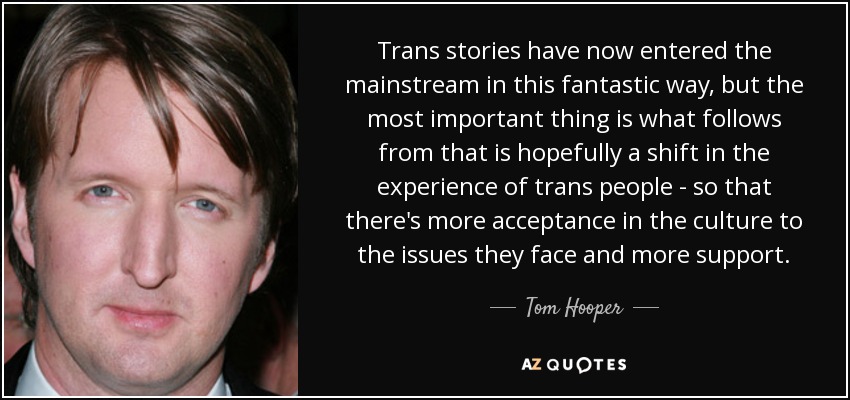
Trans stories have now entered the mainstream in this fantastic way, but the most important thing is what follows from that is hopefully a shift in the experience of trans people - so that there's more acceptance in the culture to the issues they face and more support.
Certainly I'm participating in an already established and awesome tradition, but it's a tradition that sort of shoots up and through the mainstream in short bursts and pulses and then gets diluted. Walt Whitman and Emily Dickinson shot up and then got sucked back down underground under more entertaining and less radical versions of body and self - poetry and prose that posited bodies in more perfect union with good citizenship.
I think conspiracy theories have gotten more and more close to the mainstream because what you've got is a fragmentation of the media, where the media becomes much more polarized today, left and right.
Non-mainstream people seem to balk at the idea of 12-step. A lot of us think 12-step recovery means sitting in a church basement full of Republicans and Christians who drink to much.
I agree that a lot of mainstream corporate sold hip-hop is self-hating.
My hope is to get young people to think about ways that they can translate hip-hop's great cultural movement into political power that can change the conditions for America's young, so that young people upon graduating from high school who don't have economic means to go to college can realize other options beyond joining the military and fighting in wars that enrich corporations like Halliburton which should feel guilty about profiteering off of a war that is being fought on the backs of those locked out of America's mainstream economy.
For me, the part of reporting that's the most rewarding and energizing is just hearing directly from people whose voices haven't often been heard, or incorporated into mainstream media. That stuff is really, really gratifying, and so to realize that you could make a career of that part of it, that appealed to me.
And it's always the same kind of artist, I think, who has more enjoyment being slightly on the outside of things, who doesn't want to be sucked into the tyranny of the mainstream. Because once you get sucked into that, you're dead as an artist.
The fact remains that books that really put gay people in the center, and especially books that do so in a way that is sexually explicit, tend not to get a great deal of mainstream attention: they don't tend to sell well, and they don't tend to win major awards. This makes the occasional exception, like Alan Hollinghurst, all the more remarkable.
It is ludicrous to believe that he meant nuclear weapons can be used. It is truly fearful to see how the mainstream media in the west can construct an adversary and that there are so few dissenting voices.
Americans should know that Iranians are just as decent, human and rational as other human beings. Sadly, the mainstream media in the U.S. regularly fails to recognize and reflect this.
The radical is simply being given more room in the mainstream. And I think young people - I'm talking about the very young millennials - they are bored by so much so fast and have such fast big brains, that they won't digest lazy uninteresting work in the way my generation might have. This is a great opportunity for those on the fringe to be less on the fringe perhaps.
I'm interested in the way the whole cultural landscape can shift over time. Okay, this will seem like a silly example, but look at the whole discourse around "selling out," a concept people say is irrelevant because there's no more distinction between mainstream and underground, inside and outside (which I don't really believe, but that's another issue).
There's always going to be a fight between mainstream and underground because the mainstream is a very small bubble, and the underground scene is a very small bubble, and they both see themselves as secret societies.
The nonfiction novel or literary memoir as authored by women is usually given a much harder time in mainstream criticism.
I'm a progressive. What I find is that a subsection within the left that instead of standing for consistency in progressive values, so feminism as applied to mainstream society, as well as within minority communities, gay rights to mainstream society as well as within minority communities.
Look, there's no denying that comics have moved dramatically into the mainstream in North American culture in the last 10 years, and for someone like me who's always tried to make a living at it, it's been great, I'm very grateful for it. But at the same time, it's not a subculture-y thing anymore; it's something that's in the New York Times and the New Yorker.
I'm not sure what kept me from the mainstream. I thought it was because I was too hard to pin down genre-wise.
I guess in general, because it's such a popular trend in mainstream American pop, that there's been some kind of negative reaction to it. But at the same time, it's a really interesting effect and really interesting texture, and a lot of credit goes to Rostam for producing our music, and all the work that he puts into it, and just trying different things. Ezra did a vocal take, Rostam threw auto-tune on it, and we all liked the way it sounded.
I think accessibility is what often denies horror its deserved attention. So it all depends on the execution and whether mainstream audiences can accept it.
I like Plutarch because I've read him forever, and I know that he's incredibly funky, even though his mainstream image is as Mr. Unfunky.
When independent films break through and actually make it into any level of mainstream-ness or get seen by people or find a life actually in theaters, it's extraordinary. And it doesn't happen that often.
The risk for me has to do with the nudity aspects. I'm an American actress in mainstream movies, and I would like to always be able to do them. For some reason, nudity is perceived differently here than it is elsewhere, and I didn't want to lose any American audience that I was building.
A century ago mainstream science was still quite happy to countenance vital and mental powers which had a 'downwards' causal influence on the physical realm in a straightforwardly interactionist way. It was only in the middle of the last century that science finally concluded that there are no such non-physical forces. At which point a whole pile of smart philosophers (Feigl, Smart, Putnam, Davidson, Lewis) quickly pointed out that mental, biological and social phenomena must themselves be physical, in order to produce the physical effects that they do.
A lot of times, mainstream critics are much tougher on small, independent movies because they can be.
Follow AzQuotes on Facebook, Twitter and Google+. Every day we present the best quotes! Improve yourself, find your inspiration, share with friends
or simply: