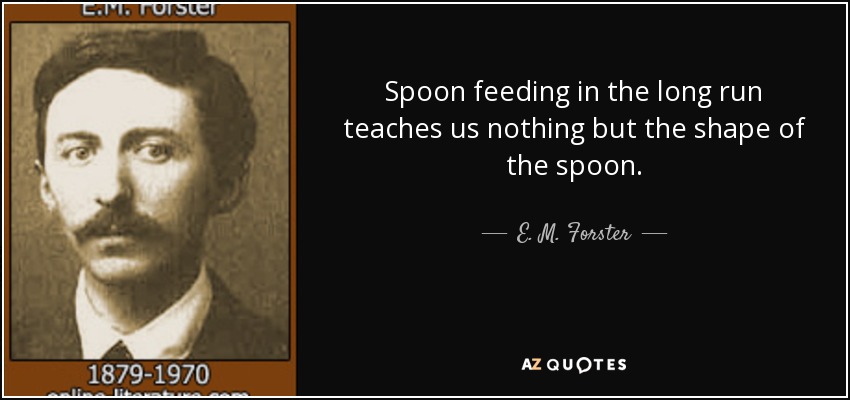
Spoon feeding in the long run teaches us nothing but the shape of the spoon.
The profound study of nature is the most fertile source of mathematical discovery.
But there is another reason for the high repute of mathematics: it is mathematics that offers the exact natural sciences a certain measure of security which, without mathematics, they could not attain.
Suppose that you want to teach the 'cat' concept to a very young child. Do you explain that a cat is a relatively small, primarily carnivorous mammal with retractible claws, a distinctive sonic output, etc.? I'll bet not. You probably show the kid a lot of different cats, saying 'kitty' each time, until it gets the idea. To put it more generally, generalizations are best made by abstraction from experience.
First, it is necessary to study the facts, to multiply the number of observations, and then later to search for formulas that connect them so as thus to discern the particular laws governing a certain class of phenomena. In general, it is not until after these particular laws have been established that one can expect to discover and articulate the more general laws that complete theories by bringing a multitude of apparently very diverse phenomena together under a single governing principle.
Mathematics is a logical method. . . . Mathematical propositions express no thoughts. In life it is never a mathematical proposition which we need, but we use mathematical propositions only in order to infer from propositions which do not belong to mathematics to others which equally do not belong to mathematics.
Nothing has afforded me so convincing a proof of the unity of the Deity as these purely mental conceptions of numerical and mathematical science which have been by slow degrees vouchsafed to man, and are still granted in these latter times by the Differential Calculus, now superseded by the Higher Algebra, all of which must have existed in that sublimely omniscient Mind from eternity.
Today's scientists have substituted mathematics for experiments, and they wander off through equation after equation, and eventually build a structure which has no relation to reality.
If I feel unhappy, I do mathematics to become happy. If I am happy, I do mathematics to keep happy.
Reductio ad absurdum, which Euclid loved so much, is one of a mathematician's finest weapons. It is a far finer gambit than any chess play: a chess player may offer the sacrifice of a pawn or even a piece, but a mathematician offers the game.
The Reader may here observe the Force of Numbers, which can be successfully applied, even to those things, which one would imagine are subject to no Rules. There are very few things which we know, which are not capable of being reduc'd to a Mathematical Reasoning, and when they cannot, it's a sign our Knowledge of them is very small and confus'd; and where a mathematical reasoning can be had, it's as great folly to make use of any other, as to grope for a thing in the dark when you have a Candle standing by you.
Where there is matter, there is geometry.
Music is the pleasure the human mind experiences from counting without being aware that it is counting.
The very term 'combinatorial methods' has an oxymoronic character.
Numbers are intellectual witnesses that belong only to mankind.
If you think it's simple, then you have misunderstood the problem.
I never use a computer.
Nature does not count nor do integers occur in nature. Man made them all, integers and all the rest, Kronecker to the contrary notwithstanding.
Mechanics is the paradise of the mathematical sciences because by means of it one comes to the fruits of mathematics.
With my full philosophical rucksack I can only climb slowly up the mountain of mathematics.
Everyone else would climb a peak by looking for a path somewhere in the mountain. Nash would climb another mountain altogether and from that distant peak would shine a searchlight back onto the first peak.
I don't agree with mathematics; the sum total of zeros is a frightening figure.
[A mathematician is a] scientist who can figure out anything except such simple things as squaring the circle and trisecting an angle.
When I entered graduate school I had carried out the instructions given to me by my father and had knocked on both Murray Gell-Mann's and Feynman's doors and asked them what they were currently doing. Murray wrote down the partition function for the three-dimensional Ising model and said it would be nice if I could solve it (at least that is how I remember the conversation). Feynman's answer was 'nothing'.
When I give this talk to a physics audience, I remove the quotes from my 'Theorem'.
Follow AzQuotes on Facebook, Twitter and Google+. Every day we present the best quotes! Improve yourself, find your inspiration, share with friends
or simply: