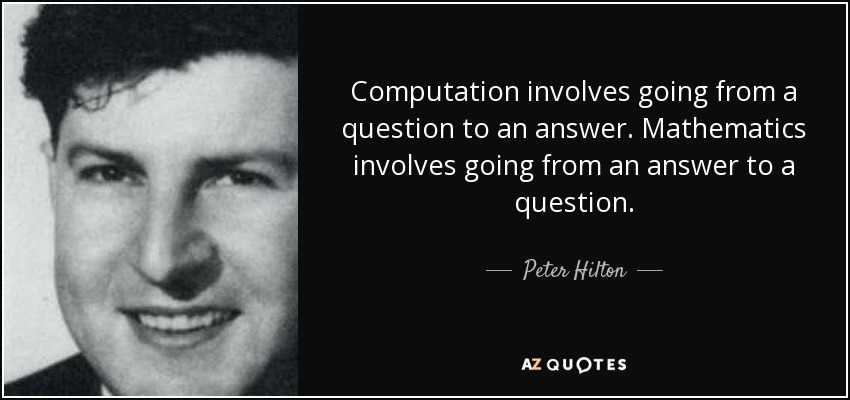
Computation involves going from a question to an answer. Mathematics involves going from an answer to a question.
The best therapy for emotional blocks to math is the realization that the human race took centuries or millennia to see through the mist of difficulties and paradoxes which instructors now invite us to solve in a few minutes.
University President: Why is it that you physicists always require so much expensive equipment? Now the Department of Mathematics requires nothing but money for paper, pencils, and erasers . . . and the Department of Philosophy is better still. It doesn't even ask for erasers.
Mathematics, the non-empirical science par excellence . . . the science of sciences, delivering the key to those laws of nature and the universe which are concealed by appearances.
Analytic It is clear that the definition of "logic" or "mathematics" must be sought by trying to give a new definition of the old notion of "analytic" propositions.
Formality Thus the absence of all mention of particular things or properties in logic or pure mathematics is a necessary result of the fact that this study is, as we say, "purely formal".
When a distinguished but elderly scientist states that something is possible, he is almost certainly right. When he states that something is impossible, he is very probably wrong. Perhaps the adjective 'elderly' requires definition. In physics, mathematics, and astronautics it means over thirty; in the other disciplines, senile decay is sometimes postponed to the forties. There are, of course, glorious exceptions; but as every researcher just out of college knows, scientists of over fifty are good for nothing but board meetings, and should at all costs be kept out of the laboratory!
On the ostensible exactitude of certain branches of human knowledge, including mathematics. The exactness is a fake.
The point of mathematics is that in it we have always got rid of the particular instance, and even of any particular sorts of entities. So that for example, no mathematical truths apply merely to fish, or merely to stones, or merely to colours. So long as you are dealing with pure mathematics, you are in the realm of complete and absolute abstraction. . . . Mathematics is thought moving in the sphere of complete abstraction from any particular instance of what it is talking about.
Can the difficulty of an exam be measured by how many bits of information a student would need to pass it? This may not be so absurd in the encyclopedic subjects but in mathematics it doesn't make any sense since things follow from each other and, in principle, whoever knows the bases knows everything. All of the results of a mathematical theorem are in the axioms of mathematics in embryonic form, aren't they?
There's a tendency for adults to label the math that they can do (such as identifying patterns, choosing between competing offers in a supermarket, and challenging statistics published by the government) as "common sense" and labeling everything they can't do as "math" - so that being bad at math becomes a self-fulfilling prophecy.
Like a stool which needs three legs to be stable, mathematics education needs three components: good problems, with many of them being multi-step ones, a lot of technical skill, and then a broader view which contains the abstract nature of mathematics and proofs. One does not get all of these at once, but a good mathematics program has them as goals and makes incremental steps toward them at all levels.
In other words these children, by avoiding the early drill on combinations, tables, and that sort of thing, had been able, in one year, to attain the level of accomplishment which the traditionally taught children had reached after three and one-half years of arithmetical drill.
I recognize the lion by his paw.
The solution "cost me study that robbed me of rest for an entire night."
I continued to do arithmetic with my father, passing proudly through fractions to decimals. I eventually arrived at the point where so many cows ate so much grass, and tanks filled with water in so many hours. I found it quite enthralling.
How then shall mathematical concepts be judged? They shall not be judged. Mathematics is the supreme arbiter. From its decisions there is no appeal. We cannot change the rules of the game, we cannot ascertain whether the game is fair. We can only study the player at his game; not, however, with the detached attitude of a bystander, for we are watching our own minds at play.
I suppose you are two fathoms deep in mathematics, and if you are, then God help you. For so am I, only with this difference: I stick fast in the mud at the bottom, and there I shall remain.
Mathematical thinking is not the same as doing mathematics - at least not as mathematics is typically presented in our school system. School math typically focuses on learning procedures to solve highly stereotyped problems. Professional mathematicians think a certain way to solve real problems, problems that can arise from the everyday world, or from science, or from within mathematics itself. The key to success in school math is to learn to think inside-the-box. In contrast, a key feature of mathematical thinking is thinking outside-the-box - a valuable ability in today's world.
What makes it possible to learn advanced math fairly quickly is that the human brain is capable of learning to follow a given set of rules without understanding them, and apply them in an intelligent and useful fashion. Given sufficient practice, the brain eventually discovers (or creates) meaning in what began as a meaningless game.
When I was a child, the Earth was said to be two billion years old. Now scientists say it's four and a half billion. So that makes me two and a half billion.
I soon found an opportunity to be introduced to a famous professor Johann Bernoulli. ... True, he was very busy and so refused flatly to give me private lessons; but he gave me much more valuable advice to start reading more difficult mathematical books on my own and to study them as diligently as I could; if I came across some obstacle or difficulty, I was given permission to visit him freely every Sunday afternoon and he kindly explained to me everything I could not understand.
Notable enough, however, are the controversies over the series 1 - 1 + 1 - 1 + 1 - ... whose sum was given by Leibniz as 1/2, although others disagree. ... Understanding of this question is to be sought in the word "sum"; this idea, if thus conceived - namely, the sum of a series is said to be that quantity to which it is brought closer as more terms of the series are taken - has relevance only for convergent series, and we should in general give up the idea of sum for divergent series.
The kind of knowledge which is supported only by observations and is not yet proved must be carefully distinguished from the truth; it is gained by induction, as we usually say. Yet we have seen cases in which mere induction led to error. Therefore, we should take great care not to accept as true such properties of the numbers which we have discovered by observation and which are supported by induction alone. Indeed, we should use such a discovery as an opportunity to investigate more exactly the properties discovered and to prove or disprove them; in both cases we may learn something useful.
A good problem should be more than a mere exercise; it should be challenging and not too easily solved by the student, and it should require some "dreaming" time.
Follow AzQuotes on Facebook, Twitter and Google+. Every day we present the best quotes! Improve yourself, find your inspiration, share with friends
or simply: