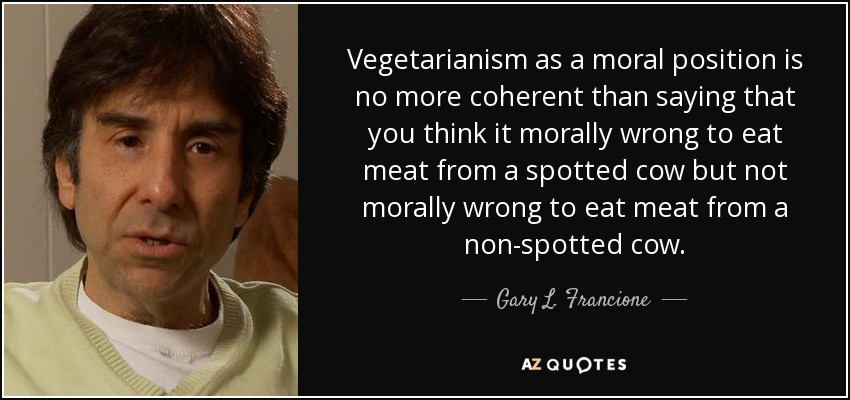
Vegetarianism as a moral position is no more coherent than saying that you think it morally wrong to eat meat from a spotted cow but not morally wrong to eat meat from a non-spotted cow.
Wait until the end, like the last two or three minutes of cooking, to add barbecue sauce, so it cooks into your meat. But if you add it too early, it will make your fire flame up. You don't have to slather on the sauce. Just lightly paste each side.
I like to have a spray bottle filled with apple juice to spray onto my meat. Whether it's pork, chicken, or beef, it adds flavor. Also, it helps keep your meat a real golden mahogany-looking color and prevents it from turning black.
A basic all-purpose rub: mix together one or two tablespoons equal parts black pepper, granulated garlic, grilled onion, and onion powder. That will give you real good base for any kind of meat. Just increase the amount if you're grilling large quantities.
Adding two or three chunks of wood to the coals adds a great smoke flavor to meat. I prefer pecan wood, which adds a mellow smoke flavor, but any good wood will work. And most barbecue sections in stores and supermarkets around the country, like Walmart, sell hickory wood, which adds a heavier smoke flavor. Oak is also a good option for a mellow smoke flavor.
A meat temperature gauge is a priceless tool. You can get a very inexpensive one at most hardware or sporting goods stores, which will easily help you determine the temperature of your meat so it is not over or undercooked. Pork is normally done at about 160, internal temperature. Steaks are cooked medium rare from 145 to 150. 165, medium. Well done is about 175, internal temperature.
Gas grills are a no-no. Gas is a petroleum product. Rather than a smokey flavor, it will add a a petroleum-based weird taste into your meat. However, if you already have a gas grill, you can bring in some smoke flavor by tightly rolling wood chips in tin foil really tight and placing them on the top of your burners.
If you're ordering me an edible arrangement to say thanks, I'd prefer a meat one.
Folklore and mythology, as well as man's catastrophic disregard for nature, are the meat of Joseph D'Lacey's horror. But the prime cuts are always compassion and surprise.
The hardest part of returning to a truly healthy environment may be changing the current totally unsustainable heavy-meat-eating culture of increasing numbers of people around the world. But we must try. We must make a start, one by one.
Negative, I am a meat popsicle.
I'm an old broken down piece of meat and I deserve to be all alone . . .
A cat who turns her nose up at bread does not deserve meat.
Jewish Christmas' - that's what my gentile friends called Chanukah when I was growing up in Michigan in the thirties and forties. Anachronistic, yes, but they had a point. Observing the dietary laws of separating milk and meat dishes was far easier for the handful of Jewish families in our little town than getting through December without mixing the two holidays.
I had just been doing graffiti around New York and this real estate investor guy had walked through meat packing in New York and saw some of my graffiti. He was impressed and asked if I sold canvases. I really had not made any canvases of my graffiti work yet, but told him I could make one for him. He then commissioned me to make ten paintings and put on my first art show. Between the sold out show and the cops chasing after me it created a lot of media and I've been doing really well since then.
Get in some pasta or brown rice with your vegetables like a sweet potato and some meat. You need a little bit of everything on your plate to make sure your energy levels are right for the match.
I've never been crazy when it comes to controlling my diet. I just avoid processed foods, don't mix carbs and make sure I get my protein. I'm a carnivore. I love my wild game and especially my buffalo meat.
Human overconsumption is a greater problem than human population growth, and meat eating is a big part of that problem.
In fact, we would know ourselves that we are not meant to be meat eaters, and we would not have allowed ourselves to become conditioned to meat eating in the first place, if the effects of meat eating were felt right away. But since heart disease, cancer, diabetes, osteoporosis, etc. usually take many years to develop, we are able to separate them from their cause (or contributing factors) and go on happily eating an animal-based diet.
Arctic-dwelling Eskimos have no choice but to eat large amounts of meat and animal fat. But let's get our facts straight: according to the American Journal of Clinical Nutrition, Eskimos also have the highest incidences of heart disease and osteoporosis in the world and, in general, short life spans. Perhaps that is something to consider when we are faced with the choice of what to eat for dinner and unlike Eskimos most of us do have choices.
Some meat eaters defend meat eating by pointing out that it is natural: in the wild, animals eat one another. The animals that end up on our breakfast, lunch, and dinner plates, however, aren't those who normally eat other animals. The animals we exploit for food are not the lions and tigers and bears of the world. For the most part, we eat the gentle vegan animals. However, on today's farms, we actually force them to become meat eaters by making them eat feed containing the rendered remains of other animals, which they would never eat in the wild.
Lions and other carnivorous animals do a lot of things besides eat meat. They live outdoors, not in houses; they don't wear clothes or drive around in cars; they usually sleep for many hours after eating a meal. Why cite just one of the many things that they do and argue that we should imitate them? This doesn't make much sense.
Lions and other carnivorous animals do eat meat, but that doesn't mean we should. They would die if they didn't eat meat. Human beings, in contrast, choose to eat meat; it isn't a physiological necessity.
It is true that every being is enjoying life or suffering as a direct result of his or her own past actions. The animals in the factory farms may have been meat-eating human beings in a previous birth; we don't know, and it is not our place to judge.
Raising crops to feed animals for human consumption requires a lot of land. It takes eight or nine cows a year to feed one average meat eater; each cow eats one acre of green plants, soybeans and corn per year; so it takes eight or nine acres of plants a year to feed one meat eater, compared with only half an acre to feed one vegetarian.
Follow AzQuotes on Facebook, Twitter and Google+. Every day we present the best quotes! Improve yourself, find your inspiration, share with friends
or simply: