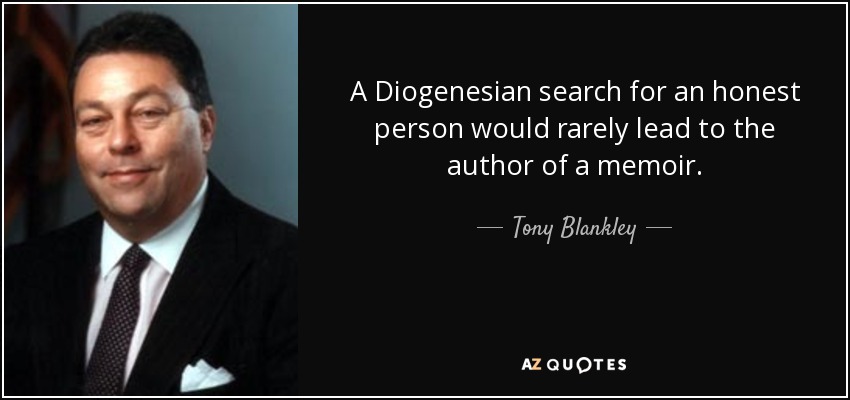
A Diogenesian search for an honest person would rarely lead to the author of a memoir.
It's easy to write one's memoirs when one has a terrible memory.
The current memoir craze has fostered the belief that confession is therapeutic, that therapy is redemptive and that redemption equals art, and it has encouraged the delusion that candor, daring and shamelessness are substitutes for craft, that the exposed life is the same thing as an examined one.
The Adderall Diaries is phenomenal. With jittery finesse and a reformed tweaker's eye for detail, Stephen Elliott captures the terrifying, hilarious, heart-strangling reality of a life whose scorched-earth physical and psycho-emotional dimensions no one could have invented - they absolutely had to be lived. By all rights, the author should either be dead or chewing his fingers in a bus station. Instead, he may well have written the memoir of an entire generation.
No one who reads this book will remain unchanged or unaffected-Julene Bair's story arcs from the cornfields of Kansas and Nebraska to the food on our tables and the gas in our cars. There is always a price to be paid, she reminds us, for the pleasures and comforts of this day. If you read only one memoir this year, this is the one to read and pass along.
I think most memoirs, though they purport to be about this particular time or this person you met, are really about the effect that person or time had on you.
I remember when I was writing my memoir and I was worried about what other people would think when they read it, and my mother, who can be this incredibly wise person, said that it really didn't matter because strangers who read it would never meet me anyway, and people I knew were aware of my secrets.
As a critic, I try to stay neutral about movies before I see them, but I really wanted "Whiskey Tango Foxtrot" to be great. It's based on a barbed memoir by Kim Barker called "The Taliban Shuffle: Strange Days In Afghanistan And Pakistan." And its stars Tina Fey, out of her comfort zone, just as Barker was a fish out of water when, in 2004, she began covering the Afghanistan occupation for the Chicago Tribune.
Well, I'd like to think I am, and I'd also like to think that we're all having a lot more fun getting older than we pretend. It was interesting to me when I first started working on this book that I'd mentioned that I was writing a memoir about aging and everybody would moan and groan and carry on.
I'm not into this memoir craze that's been going on for 20 years now and doesn't seem to ever let up. People just indiscriminately say "memoir" now when it's a person writing about their own life.
A memoir is a book about some particular thread or theme or moment in a person's life, whereas an autobiography is the entire life.
It's not as if I knew answers which I am going to set down in the form of a novel or a memoir or a sermon. It's, rather, I'm going to search myself for what I might have to say in this area.
I'd say, [writing memoir] not so much a model, but maybe to provide an insight, here or there, to help somebody come to terms with the dark corners of their own soul, to come to terms with the undecided, their own sense of self, and maybe help develop a capacity to love - to love wisdom, love justice.
I ignored my stand-up career for twenty-five years, but now, having finished this memoir, I view this time with surprising warmth. One can have, it turns out, an affection for the war years.
I dont know where the idea originated that memoir writing is cathartic. For me, its always felt like playing my own neurosurgeon, sans anesthesia. As a memoirist, you have to crack your head open and examine every uncomfortable thing in there.
Memoir is trustworthy and its truth assured when it seeks the relation of self to time, the piecing of the shards of personal experience into the starscape of history's night. The materials of memoir are humble, fugitive, a cottage knitting industry seeking narrative truth across the crevasse of time as autobiography folds itself into the vast, fluid essay that is history. A single voice singing its aria in a corner of the crowded world.
The journey toward authenticity, toward becoming whole is made palpable in Maureen Seaton's Sex Talks to Girls: A Memoir. It shines its considerable light on the passage from religion toward faith, from self-medication to sobriety, from daughterhood to motherhood, from being the disembodied 'good girl' to embracing her own bad lesbian self. In crisp chapters, Seaton leads us, step-by-step, over this harrowing and blissful road, so distinct from yet so much like our own.
Clyde Phillip Wachsberger's delightful memoir about tending beds of flowers as compensation for a lonely middle age only to find unexpected romance along the way is a sweet reminder that, as he puts it, 'anything can happen in a garden.' In prose that balances candor with perfect courtesy, he charms us with the message that keeping a garden with a beloved companion, this most ephemeral of all the arts, can bring us the most enduring joys and pleasures.
I've read my grandmother's memoirs and she served as a nurse during World War II. What they had to do was incredible.
The life we led was a proof of man's capacity for adaptation.I think that even the condemned souls in purgatory after time develop a sort of homely routine.That is ,by the way, why most prison memoirs are unreadable.The difficulty of conveying to the reader an idea of a nightmare world from which he has emerged makes the author depict the prisoner's state of mind as an uninterruped continuity of despair.He fears to appear frivolous or to spoil his effect by admitting that even in the depths of misery cheerfulness keeps breaking in.
Much more than memoir; it's history.
I don't like that word [memoir]. Whenever my publishers have wanted to use it, I've told them to take it away.
As a writer, I was deliberately creating an alternate world, and then populating it with experiences and people that I knew in this world, but I'd shake up the mix considerably. And about the same time that the memoir was becoming the dominant popular literary form in the mid to late 90s, I started reading writers who were deliberately playing with the notion of "truth" and "fiction" - that struck me as a much more interesting way to tell certain stories, particularly in the realm of comedy.
I’ve always liked to read about extremely wealthy people, especially when they are crazy (like Howard Hughes or Caligula.) While writing this book I did a lot of fun research on robber barons like Rockefeller and Morgan. But the most helpful stuff came from studying royal families and mad emperors. The best book I read was probably A King’s Own Story, which is the memoir of Edward VIII. Also, anything about Ivan the Terrible or Ted Turner.
One of my big inspirations was Céleste Mogador. She was a courtesan who wrote her memoirs in order to pay off her debts, which is a hilarious gesture.
Follow AzQuotes on Facebook, Twitter and Google+. Every day we present the best quotes! Improve yourself, find your inspiration, share with friends
or simply: