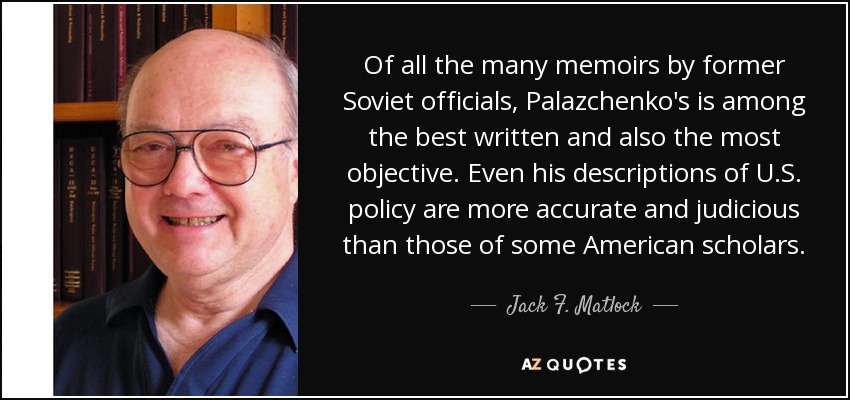
Of all the many memoirs by former Soviet officials, Palazchenko's is among the best written and also the most objective. Even his descriptions of U.S. policy are more accurate and judicious than those of some American scholars.
You have to take pains in a memoir not to hang on the reader's arm, like a drunk, and say, 'And then I did this and it was so interesting.
The wisdom of hindsight, so useful to historians and indeed to authors of memoirs, is sadly denied to practicing politicians.
I was always much impressed, in reading prison memoirs of revolutionists, such as Lenin and Trotsky ... by the amount of reading they did, the languages they studied, the range of their plans for a better social order. (Or rather, for a new social order.) In the Acts of the Apostles there are constant references to the Way and the New Man.
I have to say in premise 'Winter Journal' is really not a memoir. And I don't even think of it as an autobiography. I think of it as a literary composition - similar to music - composed of autobiographical fragments. I'm really not telling the story of my life in a coherent narrative form.
I don't know if memoirs can produce literary work of the first order. But I do know that novels are doing it only rarely.
Fiorito has all the right stuff. His splendid memoir about his relationship with his dying father belongs on that small shelf with Philip Roth's Patrimony and Frank McCourt's Angela's Ashes.
My children haven't read 'Winter Journal'. They have read some of my work, but I really don't foist it on them. I want them to be free to discover it in their own good time. I think reading an intimate memoir by your father - or an intimate autobiographical work, whatever we want to call this thing - you have to come at it at the right moment, so I'm certainly not foisting it upon them.
Frank Berliners spiritual memoir is beautifully crafted and written. It is a tale about love, and the great longing that springs from there—to learn, to grow, to be real, and to forge a genuine connection with oneself and others, with life, and with death. I highly recommend it.
autobiography at least saves a man or woman that the world is curious about from the publication of a string of mistakes called 'Memoirs.
The materials of true poetry are always humble, absolutely idiosyncratic, the autobiographical tatters that, in gifted hands, are made into the memoir that fits us all.
I can’t help thinking about memoir as a down-and-up process: Dive down for color; come up for context. Sink back down for action; climb back up for self-awareness and gratitude.
At forty my faculties may have closed up like flowers at evening, leaving me unable to write my memoirs with a fitting and discreet inaccuracy, or, having written them, unable to carry them to the publisher.
Published memoirs indicate the end of a man's activity, and that he acknowledges the end.
The desire for narration keeps on reasserting itself, so that since modernism and fiction brought narration to an end, it is sought in memoirs.
I think people dismiss celebrity memoirs as unreal, contrived and maybe partially made up. But that's definitely not true for anything that I write.
I believe the personal is the collective. One of the ironies of writing memoir is in using the "I" it becomes an alchemical "we." This is the sorcery of literature.
The memoirs I love are all very intense. If you're going to do a memoir and protect yourself, what the hell's the point? Just do fiction.
Nothing detains the reader's attention more powerfully than deep involutions of distress, or sudden vicissitudes of fortune; and these might be abundantly afforded by memoirs of the sons of literature. They are entangled by contracts which they know not how to fulfill, and obliged to write on subjects which they do not understand. Every publication is a new period of time, from which some increase or declension of fame is to be reckoned. The gradations of a hero's life are from battle to battle, and of an author's from book to book.
I actually find it pretty tedious when magazines ask me to write articles based on my real life, because I've already lived it and there's nothing new to discover. So, I'm unlikely to write a memoir.
Candid and searing, Deborah Jiang Stein’s memoir is a remarkable story about identity, lost and found, and about the author’s journey to reclaim—and celebrate—that most primal of relationships, the one between mother and child. I dare you to read this book without crying.
North Carolina Senator Jesse Helms has signed a deal with Random House to write his memoirs. Scholars will no doubt benefit from the reflections of a man who was wrong on every major issue for 40 years. Helms' aides say the proceeds from the book will be donated to the non-profit Jesse Helms Center where they apparently have more experience burning than publishing them.
I do not repeat conversations that I can't remember. And it's something that irritates me a great deal, because I think most memoirs are false novels.
I have begun writing what I have said I'd never write, a memoir ("I am not my own subject," I used to say with icy superiority).
Memoirs have dominated the literary scene now for ten or 20 or even 30 years: most of them seem to use the conventions of fiction and it's astonishing how in so many of these books people seem to be able to remember conversations that took place when they were five years old and give three pages of coherent dialogue, which is utterly impossible.
Follow AzQuotes on Facebook, Twitter and Google+. Every day we present the best quotes! Improve yourself, find your inspiration, share with friends
or simply: