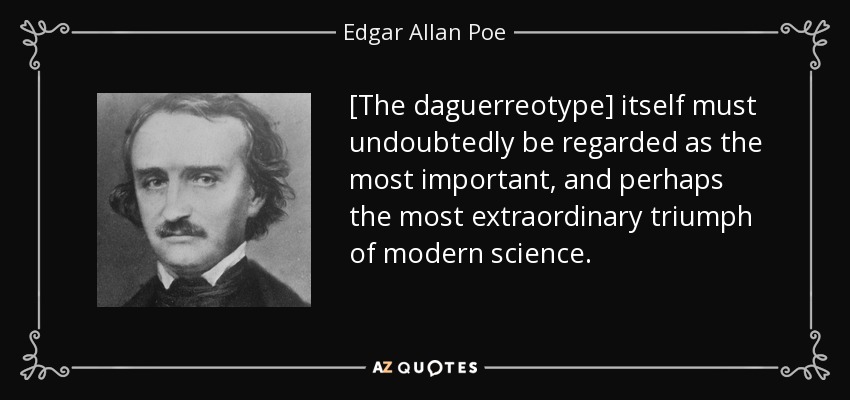
[The daguerreotype] itself must undoubtedly be regarded as the most important, and perhaps the most extraordinary triumph of modern science.
I had a growing feeling that most of the best art of the world in painting and sculpture had been done, and that this newest form [photography] was more related to the progress and tempo of modern science of the eye.
Between the poor and any appreciation for modern science stands a wall made of failed schools, defunded libraries, denied opportunities, and the systematic use of science and technology to benefit other people at their [the poor's] expense.
The age-long history of thinking on gravitation, too, was erased from the collective consciousness, and that force somehow became the serendipitous child of Newton's genius. The new attitude is well illustrated by the anecdote of the apple, a legend spread by Voltaire, one of the most active and vehement erasers of the past. ... The need to build the myth of an ex nihilo creation of modern science gave rise to much impassioned rhetoric.
If the oncoming mutation to interstellar immortality is screwed up by the politicians, it will be because those of us who see the opportunities in modern science are not adroit enough to outmaneuver the forces of inertia, stupidity and greed. Well, if we're not intelligent enough to overcome such obstacles, then we don't deserve to carry off the mutation at this stage of evolution.
Most of today's film actresses are typical of a mass-production age: living dolls who look as if they came off an assembly line and whose uniformity of appearance is frequently a triumph of modern science, thanks to which they can be equipped with identical noses, breasts, teeth, eyelashes, and hair.
The fact that so little of the findings of modern science is prefigured in Scripture to my mind casts further doubt on it divine inspiration.
A great unification is now taking place between science and spirituality. The most advanced discoveries of modern science are rising to reaffirm the timeless wisdom of the great religious and spiritual traditions of every culture.
I have never, so far, in all the studies I have done, met a contradiction between what the human, experimental and natural sciences are telling us and the Islamic rules. In fact, the opposite is true: anything that is coming from the modern sciences is helping me better understand the text. It's not a contradiction. It's a relation.
The first issue that compelled me was a very strange split between India being highly development scientifically (we were the third biggest scientific manpower in the world then) and yet at the same time struggling with amazing poverty. The linear equation that says that modern science equals progress and the reduction of poverty did not apply to India. It wasn't working.
Modern science has as its object as little pain as possible, as long a life as possible - hence a sort of eternal blessedness, but of a very limited kind in comparison with the promises of religion.
The fact is that philosophy has been a decisive source of inspiration in all the great crises that Europe has faced. It has been so in the time that preceded the fall of the Roman Empire, when Augustine of Hippo delineated the features of a new spiritual civilization; in the age of religious wars, when Descartes and Hobbes established the principles of modern science and politics; and at the turn of the French Revolution, interpreted by Kant and Hegel as an event destined to change the history of the world.
We are nothing but the product of billions of years of molecules coming together and ratcheting up through natural selection, we are composed only of highways of fluids and chemicals sliding along roadways within billions of dancing cells, trillions of synaptic conversations hum in parallel, this vast egglike fabric of micron-thin circuitry runs algorithms undreamt of in modern science, and these neural programs give rise to our decision making, loves, desires, fears, and aspirations. That understanding would be a numinous experience, better than anything ever proposed in anyone's holy text.
Industrial Society is not merely one containing 'industry,' large-scale productive units capable of supplying man's material needs in a way which can eliminate poverty: it is also a society in which knowledge plays a part wholly different from that which it played in earlier social forms, and which indeed possesses a quite different type of knowledge. Modern science is inconceivable outside an industrial society: but modern industrial society is equally inconceivable without modern science. Roughly, science is the mode of cognition of industrial society, and industry is the ecology of science.
Science is not sacrosanct. The mere fact that it exists, is admired, has results is not sufficient for making it a measure of excellence. Modern science arose from global objections against earlier views and rationalism itself, the idea that there are general rules and standards for conducting our affairs, affairs of knowledge included, arose from global objections to common sense.
Modern science cannot explain why the laws of physics are exactly balanced for animal life to exist.
It is true that neither the ancient wisdoms nor the modern sciences are complete in themselves. They do not stand alone. They call for one another. Wisdom without science is unable to penetrate the full sapiential meaning of the created and the material cosmos. Science without wisdom leaves man enslaved to a world of unrelated objects in which there is no way of discovering (or creating) order and deep significance in man's own pointless existence. (p. 4)
In the Middle Ages people believed that the earth was flat, for which they had at least the evidence of their senses: we believe it to be round, not because as many as 1 percent of us could give physical reasons for so quaint a belief, but because modern science has convinced us that nothing that is obvious is true, and that everything that is magical, improbable, extraordinary, gigantic, microscopic, heartless, or outrageous is scientific.
Modern science should indeed arouse in all of us a humility before the immensity of the unexplored and a tolerance for crazy hypotheses.
In China the struggle to consolidate the socialist system, the struggle to decide whether socialism or capitalism will prevail, will still take a long historical period. However, we should all realize that the new system of socialism will unquestionably be consolidated. We can assuredly build a socialist state with modern industry, modern agriculture, and modern science and culture.
Modern science has been a voyage into the unknown, with a lesson in humility waiting at every stop. Many passengers would rather have stayed home.
If I have put the case of science at all correctly, the reader will have recognised that modern science does much more than demand that it shall be left in undisturbed possession of what the theologian and metaphysician please to term its 'legitimate field'. It claims that the whole range of phenomena, mental as well as physical-the entire universe-is its field. It asserts that the scientific method is the sole gateway to the whole region of knowledge.
The real accomplishment of modern science and technology consists in taking ordinary men, informing them narrowly and deeply and then, through appropriate organization, arranging to have their knowledge combined with that of other specialized but equally ordinary men. This dispenses with the need for genius. The resulting performance, though less inspiring, is far more predictable.
Copernicanism and other essential ingredients of modern science survived only because reason was frequently overruled in their past.
It is the last lesson of modern science, that the highest simplicity of structure is produced, not by few elements, but by the highest complexity.
Follow AzQuotes on Facebook, Twitter and Google+. Every day we present the best quotes! Improve yourself, find your inspiration, share with friends
or simply: