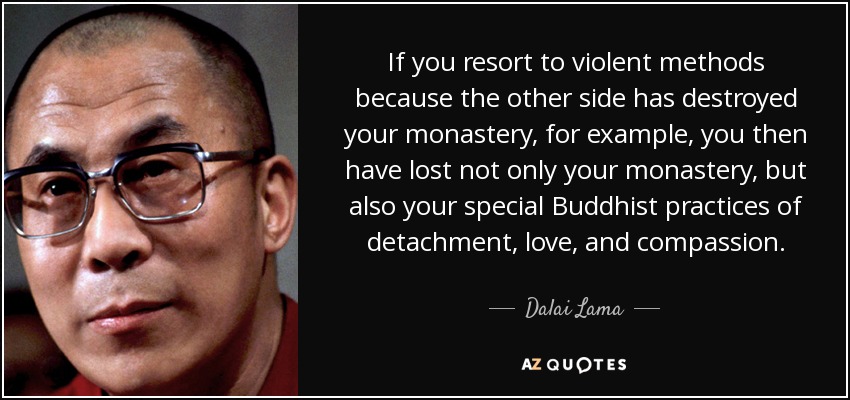
If you resort to violent methods because the other side has destroyed your monastery, for example, you then have lost not only your monastery, but also your special Buddhist practices of detachment, love, and compassion.
Most of the utopian community ideas actually are religious. They're based more on the idea of the monastery than the commune.
Admit that the press transferred the pontificate of Rome to Henry VIII-Admit that the press demolished in some sort the feudal system, and set the serfs and villains free; admit that the press demolished the monasteries, nunneries, and religious houses; into whose hands did all these alienated baronies, monasteries, and religious houses and lands fall? Into the hands of the democracy? Into the hands of serfs and villains? Serfs and villains were the only real democracy in those time. No. They fell into the hands of other aristocrats. . . .
Institutions develop because people put a lot of trust in them, they meet real needs, they represent important aspirations, whether it's monasteries, media, or banks, people begin by trusting these institutions, and gradually the suspicion develops that actually they're working for themselves, not for the community.
In our own case, we don't consider the loss of a monastery or a monument the end of our entire way of life. If one monastery is destroyed, sometimes it happens.
Man's history has been graven on the rock of Egypt, stamped on the brick of Assyria, enshrined in the marble of the Parthenon-it rises before us a majestic presence in the piled up arches of the Coliseum-it lurks an unsuspected treasure amid the oblivious dust of archives and monasteries-it is embodied in all the looms of religions, of races, of families.
From the beginning, I've stressed that home is something internal, invisible, portable, especially for those of us with roots in many physical places; we have to root ourselves in our passions, our values and our deepest friends. My home, I've always felt, lies in the songs and novels that I love, in the wife and mother that I'm never far away from, in the monastery to which I've been returning for 25 years.
It's a huge Carthusian monastery, stuck down between rocks and sea, where you may imagine me, without white gloves or hair curling, as pale as ever, in a cell with such doors as Paris never had for gates. The cell is the shape of a tall coffin, with an enormous dusty vaulting, a small window... Bach, my scrawls and waste paper - silence - you could scream - there would still be silence. Indeed, I write to you from a strange place.
During the last 2,500 years in Buddhist monasteries, a system of seven practices of reconciliation has evolved. Although these techniques were formulated to settle disputes within the circle of monks, i think they might also be of use in our households and in our society.The first practice is Face-to-Face-Sitting.
My most important projects have been the building and maintaining of schools and medical clinics for my dear friends in the Himalaya and helping restore their beautiful monasteries, too.
Follow AzQuotes on Facebook, Twitter and Google+. Every day we present the best quotes! Improve yourself, find your inspiration, share with friends
or simply: