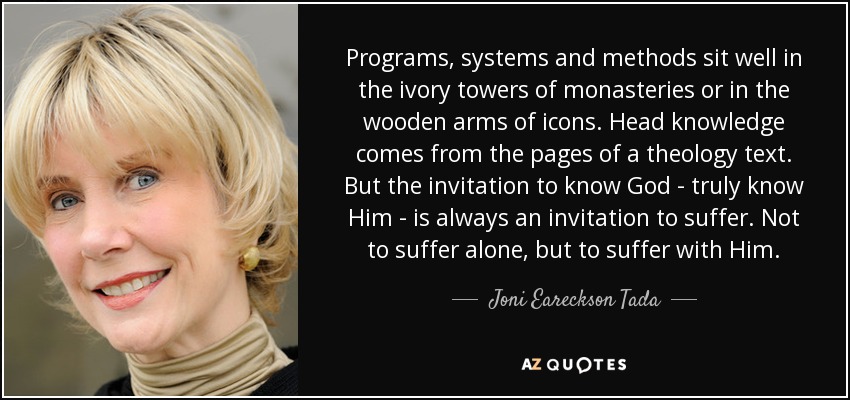
Programs, systems and methods sit well in the ivory towers of monasteries or in the wooden arms of icons. Head knowledge comes from the pages of a theology text. But the invitation to know God - truly know Him - is always an invitation to suffer. Not to suffer alone, but to suffer with Him.
I first had a version of this at a Japanese monastery during a silent retreat-don't ask, it's a long story.
In a quiet Franciscan monastery kind and silent monks looked after me. After many weeks I was discharged. Unfit for further service.
Society doesn't need that everybody is behaving in the full normal way... like people in a Buddhist monastery... But eccentricity may also connect with the irrational.
Henceforward the Christian Churches having a form of godliness, but denying the power thereof, came into the hands of the Encratites: and the Heathens, who in the fourth century came over in great numbers to the Christians, embraced more readily this sort of Christianity, as having a greater affinity with their old superstitions, than that of the sincere Christians; who by the lamps of the seven Churches of Asia, and not by the lamps of the Monasteries, had illuminated the Church Catholic during the three first centuries.
Personally I would like to have pupils, a studio, pass on my love to them, work with them, without teaching them anything.. ..A convent, a monastery, a phalanstery of painting where one could train together.. ..but no programme, no instruction in painting.. ..drawing is still alright, it doesn't count, but painting - the way to learn is to look at the masters, above all at nature, and to watch other people painting.
Quiet book-learning in monasteries and ethereal music, sonnets and courtly lovethat stuff is all fantasyand veneer? You couldn't afford to let the beauty of the thing seduce you too far or you forgot the truth and the truth was always hard as iron bloody bars.
Work sustains us as bodies and it consumes a great deal of energy. The conservation of energy is the component theme of Buddhist practice and yoga. That is why people live in monasteries.
You might say living in a monastery cuts down the commutation time. That alone gives you a couple extra hours a day to meditate. In a monastery you lead a relatively simply life. You don't need a lot of possessions.
The problem with monasteries, ashrams, convents is these institutions become extremely political. In other words, they're really small societies, and much of what you hope to avoid in societies you find there.
From the beginning, I've stressed that home is something internal, invisible, portable, especially for those of us with roots in many physical places; we have to root ourselves in our passions, our values and our deepest friends. My home, I've always felt, lies in the songs and novels that I love, in the wife and mother that I'm never far away from, in the monastery to which I've been returning for 25 years.
The person who's in the Zen monastery, who's doing a kind of poor job at meditating and a half-ass job cleaning the gardens is not doing very good yoga.
Combine meditation with career as a yoga. You will find that your practice will not be any less powerful than a person who lives in a monastery. You might even excel because practice in a monastery can get very one-sided.
One of the most persistent fallacies about the Christian Church is that it kept learning alive during the Dark and Middle Ages. What the Church did was to keep learning alive in the monasteries, while preventing the spread of knowledge outside them... Even as late as the beginning of the nineteenth century, however, nine-tenths of Christian Europe was illiterate.
Christianity ... has produced the iniquities of the Inquisition, the egotism and celibacy of the monasteries, the fury of religious wars, the ferocity of the Hussite, of the Catholic, of the Puritan, of the Spaniard, of the Irish Orangeman and of the Irish Papist; it has divided families, alienated friends, lighted the torch of civil war, and borne the virgin and the greybeard to the burning pile, broken delicate limbs upon the wheel and wrung the souls and bodies of innocent creatures on the rack; all this it has done, and done in the name of God.
Possession of books denounced as heretical was made a criminal offense. Copies of such books were burned and destroyed. But in Upper Egypt, someone, possibly a monk from a nearby monastery of St Pachomius, took the banned books and hid them from destruction - in the jar where they remained buried for almost 1,600 years.
The Jesuits are a MILITARY organization, not a religious order. Their chief is a general of an army, not the mere father abbot of a monastery. And the aim of this organization is power - power in its most despotic exercise - absolute power, universal power, power to control the world by the volition of a single man. Jesuitism is the most absolute of despotisms - and at the same time the greatest and most enormous of abuses.
The early masters also introduced walking meditation and hard work to the monastery, for too much sitting could reach the point of diminishing returns.
Just studying Buddhism, then meditating and going to Buddhist monasteries, talking to Buddhist monks, combined with the Thai people themselves, changed the way I look at the world.
It was a very aged, ghostly place; the church had been built many hundreds of years ago, and had once had a convent or monastery attached; for arches in ruins, remains of oriel windows, and fragments of blackened walls, were yet standing-, while other portions of the old building, which had crumbled away and fallen down, were mingled with the churchyard earth and overgrown with grass, as if they too claimed a burying-place and sought to mix their ashes with the dust of men.
Science is turning into a monastery for the Order of Capitulant Friars. Logical calculus is supposed to supersede man as moralist. We submit to the blackmail of the 'superior knowledge' that has the temerity to assert that nuclear war can be, by derivation, a good thing, because this follows from simple arithmetic.
Canoes, too, are unobtrusive; they don't storm the natural world or ride over it, but drift in upon it as a part of its own silence. As you either care about what the land is or not, so do you like or dislike quiet things--sailboats, or rainy green mornings in foreign places, or a grazing herd, or the ruins of old monasteries in the mountains. . . . Chances for being quiet nowadays are limited.
He'd once heard a story about a monastery on the top of some mountain in Japan or somewhere. After a long trek in the cold to get there, the monks would offer to sell you a cup of coffee. You had a choice: There was a two-dollar cup - or a two-hundred- dollar cup. When pressed to explain the difference, the monks were reported to say, 'A hundred and ninety-eight dollars.'
If you resort to violent methods because the other side has destroyed your monastery, for example, you then have lost not only your monastery, but also your special Buddhist practices of detachment, love, and compassion.
Most of the utopian community ideas actually are religious. They're based more on the idea of the monastery than the commune.
Follow AzQuotes on Facebook, Twitter and Google+. Every day we present the best quotes! Improve yourself, find your inspiration, share with friends
or simply: