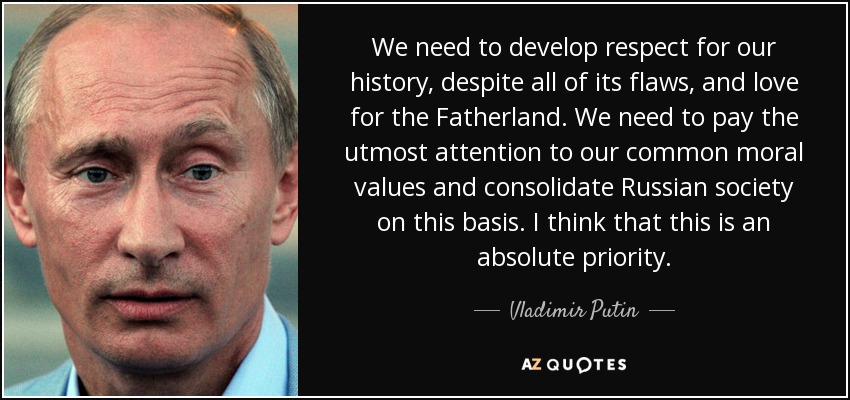
We need to develop respect for our history, despite all of its flaws, and love for the Fatherland. We need to pay the utmost attention to our common moral values and consolidate Russian society on this basis. I think that this is an absolute priority.
All human progress, even in morals, has been the work of men who have doubted the current moral values, not of men who have whooped them up and tried to enforce them.
I never view aesthetic ideas as having an existence purely of their own but as a function they have in connection with political or moral values.
As a result of changes which, over the last century, have modified our empirically based pictures of the world and hence the moral value of many of its elements, the "human religious ideal" inclines to stress certain tendencies and to express itself in terms which seem, at first sight, no longer to coincide with the "christian religious ideal".
Charity is from person to person; and it loses half, far more than half, its moral value when the giver is not brought into personal relation with those to whom he gives.
It would seem to me that If this physical life, of which we are now aware, does indeed comprise the entirety of human experience, then what we seem to intuitively know to be true is entirely backwards. For if this is the case, then it must be the despicable tyrant, free of any moral values, and not the selfless compassionate who sacrifices himself for the good of mankind that is truly the one most deserving of our reverence and emulation.
Many smart folks seem to think that if you just get your metaphors and messages right, you'll win. That if you start describing what you favor as a 'moral value' - 'affordable health care is a moral value' etc., - then you'll appeal to red-state voters.
It is paltry philosophy if in the old-fashioned way one lays down rules and principles in total disregard of moral values . As soon as these appear one regards them as exceptions, which gives them a certain scientific status, and thus makes them into rules. Or again one may appeal to genius , which is above all rules; which amounts to admitting that rules are not only made for idiots , but are idiotic in themselves.
Art is not and never has been subordinate to moral values. Moral values are social values; aesthetic values are human values. Morality seeks to restrain the feelings; art seeks to define them by externalizing them, by giving them significant form. Morality has only one aim - the ideal good; art has quite another aim - the objective truth... art never changes.
No one is born with good character; it's not a hereditary trait. And it isn't determined by a single noble act. Character is established by conscientious adherence to moral values, not by lofty rhetoric or good intentions.
My own ongoing research among secular Americans-as well as that of a handful of other social scientists who have only recently turned their gaze on secular culture-confirms that nonreligious family life is replete with its own sustaining moral values and enriching ethical precepts.
I think, like most people, my moral values tend to be pretty fuzzy.
State sanctioned marriage is a civil contract period. A contract is not a judgment of moral value. It is a legal agreement between two parties that testifies to a meeting of minds between those consenting entities. It is not a religious act or rite and so has nothing to do with Adam and Eve or Steve or even Harvey.
A scientist shouldn't be asked to judge the economic and moral value of his work. All we should ask the scientist to do is find the truth and then not keep it from anyone.
We must seek support in the moral values that have ensured the progress of our civilization. Honesty and hard work, responsibility and faith in our strength are bound to bring us success. There should be no place for despondency. The crisis can and must be fought by uniting our intellectual, spiritual and material resources.
Mankind has many things that it never knew before. What I can tell you is that human moral values are no longer good.
Rather than dividing the world between good and evil, the Left divided the world in terms of economics. Economic classes, not moral values, explained human behavior. Therefore, to cite a common example, poverty, not one's moral value system, or lack of it, caused crime.
But, in history, practical usefulness never determines the moral value of an achievement. Only the person who increases the knowledge humanity has about itself and enhances its creative consciousness permanently enriches humanity.
Women's rights, men's rights-human rights-all are threatened by the everpresent specter of war so destructive now of human material and moral values as to render victory indistinguishable from defeat.
Ethics, too, are nothing but reverence for life. This is what gives me the fundamental principle of morality, namely, that good consists in maintaining, promoting, and enhancing life, and that destroying, injuring, and limiting life are evil.
The discussion of the game of marbles seems to have led us into rather deep waters. But in the eyes of children the history of the game of marbles has quite as much importance as the history of religion or of forms of government. It Is a history, moreover, that is magnificently spontaneous; and it was therefore perhaps not entirely useless to seek to throw light on the child's judgment of moral value by a preliminary study of the social behaviour of children amongst themselves.
Dostoevsky wrote fiction about identity, moral value, death, will, sexual vs. spiritual love, greed, freedom, obsession, reason, faith, suicide. And he did it without ever reducing his characters to mouthpieces or his books to tracts. His concern was always what it is to be a human being—that is, how to be an actual *person*, someone whose life is informed by values and principles, instead of just an especially shrewd kind of self-preserving animal.
We are all born as empty vessels which can be shaped by moral values.
The morality of the 21st century will depend on how we respond to this simple but profound question: Does every human life have equal moral value simply and merely because it is human?
... the loss of belief in future states is politically, though certainly not spiritually, the most significant distinction betweenour present period and the centuries before. And this loss is definite. For no matter how religious our world may turn again, or how much authentic faith still exists in it, or how deeply our moral values may be rooted in our religious systems, the fear of hell is no longer among the motives which would prevent or stimulate the actions of a majority.
Follow AzQuotes on Facebook, Twitter and Google+. Every day we present the best quotes! Improve yourself, find your inspiration, share with friends
or simply: