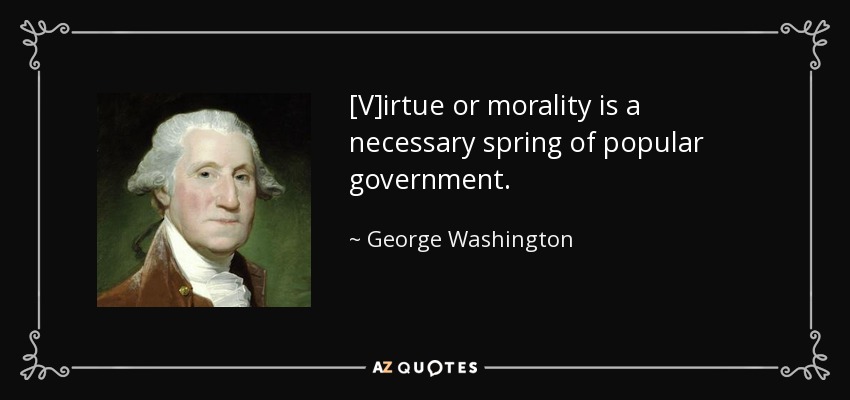
[V]irtue or morality is a necessary spring of popular government.
We have a very foolish notion in Western countries that progress delivers freedom. But progress doesn't necessarily bring moral virtue.
Some empirical feelings, such as sympathy, are indispensable parts of certain moral virtues.
Faith is an unclassified cognitive illness disguised as a moral virtue.
Our moral virtues benefit mainly other people; intellectual virtues, on the other hand, benefit primarily ourselves; therefore the former make us universally popular, the latter unpopular.
Moral virtue is ... a mean between two vices, that of excess and that of defect, and ... it is no small task to hit the mean in each case, as it is not, for example, any chance comer, but only the geometer, who can find the center of a given circle.
It is visible then that it was not any Heathen Religion or other Idolatrous Superstition, that first put Man upon crossing his Appetites and subduing his dearest Inclinations, but the skilful Management of wary Politicians; and the nearer we search into human Nature, the more we shall be convinced, that the Moral Virtues are the Political Offspring which Flattery begot upon Pride.
We assume therefore that moral virtue is the quality of acting in the best way in relation to pleasures and pains, and that vice is the opposite.
The aim of education is to guide young persons in the process through which they shape themselves as human persons-armed with knowledge, strength of judgment, and moral virtues-while at the same time conveying to them the spiritual heritage of the nation and the civilization in which they are involved.
Music like religion, unconditionally brings in its train all the moral virtues to the heart it enters, even though that heart is not in the least worthy.
The life of theoretical philosophy is the best and happiest a man can lead. Few men are capable of it and then only intermittently. For the rest there is a second-best way of life, that of moral virtue and practical wisdom.
That education should be regulated by law and should be an affair of state is not to be denied, but what should be the character of this public education, and how young persons should be educated, are questions which remain to be considered. As things are, there is disagreement about the subjects. For mankind are by no means agreed about the things to be taught, whether we look to virtue or the best life. Neither is it clear whether education is more concerned with intellectual or with moral virtue.
If then, as we say, good craftsmen look to the mean as they work, and if virtue, like nature, is more accurate and better than any form of art, it will follow that virtue has the quality of hitting the mean. I refer to moral virtue [not intellectual], for this is concerned with emotions and actions, in which one can have excess or deficiency or a due mean.
Moral virtue is a mean . . . between two vices, one of excess and the other of defect; . . . it is such a mean because it aims at hitting the middle point in feelings and in actions. This is why it is a hard task to be good, for it is hard to find the middle point in anything.
Prudence as well as Moral Virtue determines the complete performance of a man's proper function: Virtue ensures the rightness of the end we aim at, Prudence ensures the rightness of the means we adopt to gain that end.
Rightness in our choice of an end is secured by [Moral] Virtue.
[the virtues] cannot exist without Prudence. A proof of this is that everyone, even at the present day, in defining Virtue, after saying what disposition it is [i.e. moral virtue] and specifying the things with which it is concerned, adds that it is a disposition determined by the right principle; and the right principle is the principle determined by Prudence.
Reason is not the sole basis of moral virtue in man. His social impulses are more deeply rooted than his rational life.
The only moral virtue of war is that it compels the capitalist system to look itself in the face and admit it is a fraud. It compels the present society to admit that it has no morals it will not sacrifice for gain.
Complaisance, though in itself it be scarce reckoned in the number of moral virtues, is that which gives a lustre to every talent a man can be possessed of. It was Plato's advice to an unpolished writer that he should sacrifice to the graces. In the same manner I would advise every man of learning, who would not appear in the world a mere scholar or philosopher, to make himself master of the social virtue which I have here mentioned.
There can be no beauty if it is paid for by human injustice, nor truth that passes over injustice in silence, nor moral virtue that condones it.
Justice is a moral virtue, merely because it has that tendency to the good of mankind, and indeed is nothing but an artificial invention to that purpose. The same may be said of allegiance, of the laws of nations, of modesty, and of good manners. All these are mere human contrivances for the interest of society.
Here then is the origin and rise of government; namely, a mode rendered necessary by the inability of moral virtue to govern the world; here too is the design and end of government, viz. Freedom and security.
The amount of electricity that has been saved in spite of Vice President Cheney saying that efficiency is only a moral virtue ... and that you need increased supply like ANWR-is two ANWRs worth of energy.
[Prudence] is the virtue of that part of the intellect [the calculative] to which it belongs; and . . . our choice of actions will not be right without Prudence any more than without Moral Virtue, since, while Moral Virtue enables us to achieve the end, Prudence makes us adopt the right means to the end.
Follow AzQuotes on Facebook, Twitter and Google+. Every day we present the best quotes! Improve yourself, find your inspiration, share with friends
or simply: