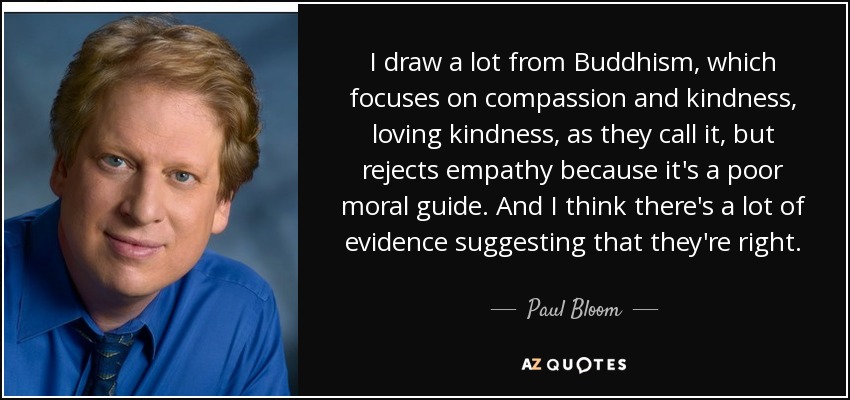
I draw a lot from Buddhism, which focuses on compassion and kindness, loving kindness, as they call it, but rejects empathy because it's a poor moral guide. And I think there's a lot of evidence suggesting that they're right.
I think we should really discourage this sort of empathic engagement when it comes to making moral decisions. I think we should focus on something like compassion, on getting people to care more for others without putting ourselves in their shoes.
If we don't hold fast to our moral principles, nobody's going to. We don't have to have a majority, but once ten, fifteen, twenty million people start voting left, we'll scare the piss out of the Democrats, and they'll have to respond. But they're not going to respond to us until that happens.
Again, although I'm not a particularly religious person, I go back to the religious left that I come out of: There are moral imperatives to fight back. As Daniel Berrigan says, "We're called to do the good." And then we have to let it go. It's not our job to know where the good goes.
If you can have a show that has quite strong morals and cover important themes but be able to put them out to a broad audience, that's an interesting thing.
I don't believe our country will last the way we know it much longer unless there's a change. And we just continue this moral decline going down, and the only hope, I believe, is God. We just hope and pray that maybe he'll hear our prayers and give us some godly leadership.
I was raised Catholic and didn't like the dogma and exclusivity of that teaching but I was moved by the moral teachings and by the power of the Jesus fellow.
Robert Nozick [a Havard philosopher, famous for his book "Anarchy, State and Utopia"] defined revenge as delivering the message that you know what someone has done, and it doesn't involve hurting them or doing anything to them beyond that. It's just delivering the message that their crime has been noted not just by its victims, because the victim might be dead, but by another who has a different moral view and will challenge the perpetrator's view.
There is no comfortable middle path where we get to provide a rational justification for our basic moral, religious and common sense beliefs.
There is a sinister anachronistic interpretation of the aesthetic state as some kind of totalitarian regime that puts aesthetic over moral standards; one associates it with national-socialism. But this has nothing to do with the romantics, whose ideal of the aesthetic state has much more to do with the republican tradition.
The relevant features of scientific practice often have mundane explanations which don't point to any deep metaphysical moral. (Thus it would simply be messy and pointless for the chemists to essay physical reductions, or for the biologists to offer number-free explanations. It's a weird kind of science-worship that views these practical considerations as clues to the nature of reality.)
I am certainly open to the idea that this might be used to explain other philosophical categories besides knowledge. I have some real sympathy with the work of those moral realists who have tried to give naturalistic accounts of human flourishing, and who offer accounts of right action in such terms. (I suppose this is more evidence that I really do have deep affinities with Aristotle!)
For me, most comedy scripts fail in the mechanical playing-out of the setup. They'll pay lip service to a moral lesson or a psychological progression.
The number of nuclear bombs on the planet today - the sheer quantity of weapons of mass destruction in the possession of people and governments throughout the world - along with the fact that the use of brute force and militarism is an almost knee-jerk way of problem-solving on the planet today, makes the eradication of war the great moral issue of this generation.
Vaclav Havel was the most amazing man in terms of being the combination of somebody with massive moral authority, great courage for having espoused the concepts of democracy, freedom throughout a very difficult communist period, a very modest man, and somebody with a fabulous sense of humor and the idea of being able to see the absurd in situations.
Vaclav Havel had moral stature. The president in first Czechoslovakia and the Czech Republic in many ways is a ceremonial role. And so, speaking out and having that strong moral fiber, people just knew that he told the truth to people who had only heard lies. And so I think his - that's his legacy.
One of the ways in which parenting is a learning experience and an opportunity for moral growth is that we learn as parents that we don't choose the kind of child that we have.
I am trying to get at the moral arguments and the ethical status of various attempts at enhancement, or genetic engineering, or the bid for designer children. But there are implications for society at large.
My argument is not that we must never intervene in nature. My argument is that there is a moral difference between intervention for the sake of health, to cure or prevent disease, and intervention for the sake of achieving a competitive edge for our kids in a consumer society.
I'm a supporter of embryonic stem cell research. I do think there are very important moral and also religious questions at stake in the debate over embryonic stem cell research.
I don't need to think that I'm being loomed over my shoulder in order to behave in a way that's moral.
Parents sometimes object to the amount of humor introduced into stories that are designed to teach moral or spiritual lessons. They seem to think that simple grim lecturing of children is the best way to achieve such goals.
The job of the critic, as it might have been conceived in the 1950's or 1960's, was some kind of role of moral arbiter for people, not a huge number of people, but people who were, you know, fairly educated, well-placed people.
I don't think that taste should be the decider of moral issues.
I'm very, very, very, very spiritual. I grew up in an organized religion, I went to Sunday school as a kid. I'm very grateful that there was religion. I think it instills a good moral compass.
Follow AzQuotes on Facebook, Twitter and Google+. Every day we present the best quotes! Improve yourself, find your inspiration, share with friends
or simply: