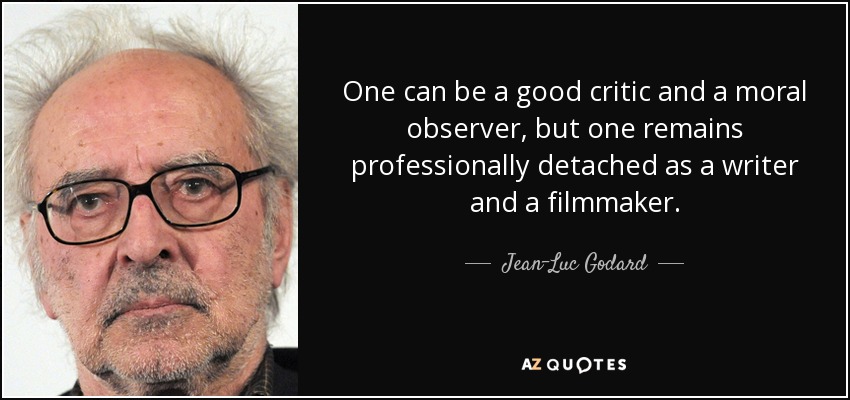
One can be a good critic and a moral observer, but one remains professionally detached as a writer and a filmmaker.
[Being unique] gives so much privilege to people who can make it, rather than having some moral and aesthetic discussions.
After Hitler was destroyed, there was the threat of Stalin, but it was always the world pressure that was upon America that enabled black people to go forward. It was not the initiative internally that the Negro put forth in America, nor was it a change of moral heart on the part of Uncle Sam it was world pressure.
A comprehensive doctrine, either religious or secular, aspires to cover all of life. I mean, if it's a religious doctrine, it talks about our relation to God and the universe; it has an ordering of all the virtues, not only political virtues but moral virtues as well, including the virtues of private life, and the rest. Now we may feel philosophically that it doesn't really cover everything, but it aims to cover everything, and a secular doctrine does also.
We don't have much wisdom about the second half when things really open up and end up looking a lot more progressive. In my own Catholic church, for example, we're sort of circling the wagons today by thinking that more moral strictures, more exclusionary rules on this or that, that that's going to do for the first half of life. I don't think it really does.
Humans have more moral responsibility perhaps, because they are capable of reasoning.
There is a whole field of inquiry that has come up in the last 30 or 40 years - some call it sociobiology or evolutionary psychology - relating to where we get our moral sense and why we value the idea of altruism, and locating both answers in behavioral adaptations for the preservation of our genes.
The moral law is a reason to think of God as plausible - not just a God who sets the universe in motion but a God who cares about human beings, because we seem uniquely amongst creatures on the planet to have this far-developed sense of morality.
Do humans have a different moral significance than cows in general?
I was really interested in a pretty simple thing: what happens when someone tries to introduce moral considerations into Wall Street, what happens when someone wants to actually demand of himself and those who work with him that what they do is not just profitable but good and useful.
I guess to me religion is a kind of moral code.
I never had a moral problem with being gay.
A group of four cardinals wrote to [Pope] Francis accusing him of sowing confusion on important moral issues, and they asked for clarifications. He did not reply. And one of the signatories, the American Cardinal Raymond Burke, said if the pope does not clarify, he will proceed with what he called a formal correction of the pope after Christmas.
I try to see their moral relevance [in the Bible] and, of course, to admire the literary beauty of the text. Prophetic poetry: No one has written the way Isaiah does.
I may be a descendant of Seth. I say to myself, What does [the story of Cain and Abel] teach me? So I go back to all the interpretations in the Talmud, which to me are a source of pleasure and joy. Then I say, maybe this story is not for then; maybe it's for now! It's possible for brothers to kill one another in civil wars. But most important, whoever kills, kills his brother. That's a moral conclusion that may not be there; but that must be my conclusion. Otherwise, why read it? Whoever kills, kills his brother.
I never wake up wondering whether the day is going to be a meaningful one or whether my labors are gonna be worthwhile. They may be futile, but it doesn't mean they're not important, in a moral sense and in an historical sense.
As a general remark, I would say we must move from the moral to the mystical life.
We have a moral concern to feed all of the hungry, wipe out malnutrition, so that every American be housed and every child have access to education.
If Christ would have left Christian ethics codified on the table, then he wouldn't produce moral beings choosing between good and evil, but conformists fulfilling orders. I think the same can be said about the Bible.
I worry about younger generations who were born to view their country trampling on humanity of everyone that comes in its way, as the 'normal state of affairs" - because they knew no other. We know how easy it is to shed, under such circumstances, the thin and frail veneer of civilization, not to mention the moral standards of which the Jews were presumed to be the world's teachers.
Of course, [Adolf] Hitler was a dilettante, but he was a completely amoral person. Yes, he had no morals at all.
It also seems beyond controversy that moral responsibilities are greater to the extent that people "have the resources, the training, the facilities and opportunities to speak and act effectively."
[Moral responsibilities] has nothing particular to do with academia, except insofar as those within it tend to be unusually privileged in the respects just mentioned.
The beam in our own eye is harder to detect, although - or more accurately because - to detect it, and remove it, is vastly more important on elementary moral grounds, and commonly more important in terms of direct human consequences as well. Intellectuals have historically played a critical function in performing these tasks, and [Ivan] Illich is right to observe that claims to scientific expertise and special knowledge are often used as a device.
When you are talking about moral issues you are talking about same-sex marriage, which has been relegated over to the states. It's no longer a federal issue and yet, we are dealing with it like it's a federal issue but for a large degree it has become a state issue.
Follow AzQuotes on Facebook, Twitter and Google+. Every day we present the best quotes! Improve yourself, find your inspiration, share with friends
or simply: