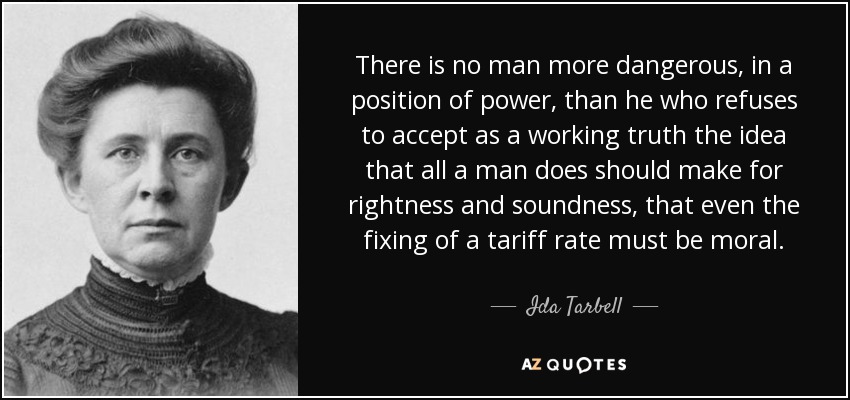
There is no man more dangerous, in a position of power, than he who refuses to accept as a working truth the idea that all a man does should make for rightness and soundness, that even the fixing of a tariff rate must be moral.
I consider poetry very subordinate to moral and political science.
Moral #1: "If you work hard, stay focused, and never give up, you will eventually get what you want in life." Moral #2: Sometimes the things we want most in life are the things that will kill us.
My language limitations here are real. My vocabulary is adequate for writing notes and keeping journals but absolutely useless for an active moral life. If I really knew this language, there would surely be in my head, as there is in Webster's or the Dictionary of American Slang, that unreducible verb designed to tell a person like me what to do next.
Widespread intellectual and moral docility may be convenient for leaders in the short term, but it is suicidal for nations in the long term. One of the criteria for national leadership should therefore be a talent for understanding, encouraging, and making constructive use of vigorous criticism.
Most gods have the manners and morals of a spoiled child.
But I think that because they trusted themselves and respected themselves as individuals, because they knew beyond doubt that they were valuable and potentially moral units -- because of this they could give God their own courage and dignity and then receive it back. Such things have disappeared perhaps because men do not trust themselves anymore, and when that happens there is nothing left except perhaps to find some strong sure man, even though he may be wrong, and to dangle from his coattails.
On the dogmas of religion, as distinguished from moral principles, all mankind, from the beginning of the world to this day, have been quarrelling, fighting, burning and torturing one another, for abstractions unintelligible to themselves and to all others, and absolutely beyond the comprehension of the human mind.
Volumes can be and have been written about the issue of freedom versus dictatorship, but, in essence, it comes down to a single question: do you consider it moral to treat men as sacrificial animals and to rule them by physical force?
The human moral sense can excuse any atrocity in the minds of those who commit it, and it furnishes them with motives for acts of violence that bring them no tangible benefit.
The objections to religion are of two sorts - intellectual and moral. The intellectual objection is that there is no reason to suppose any religion true; the moral objection is that religious precepts date from a time when men were more cruel than they are and therefore tend to perpetuate inhumanities which the moral conscience of the age would otherwise outgrow.
Oh, Jeeves,' I said; 'about that check suit.' Yes, sir?' Is it really a frost?' A trifle too bizarre, sir, in my opinion.' But lots of fellows have asked me who my tailor is.' Doubtless in order to avoid him, sir.' He's supposed to be one of the best men in London.' I am saying nothing against his moral character, sir.
The moral duty of the free writer is to begin his work at home: to be a critic of his own community, his own country, his own government, his own culture. The more freedom the writer possesses, the greater the moral obligation to play the role of critic.
Under the discipline of unity, knowledge and morality come together. No longer can we have that paltry 'objective' knowledge so prized by the academic specialists. To know anything at all becomes a moral predicament. Aware that there is no such thing as a specialized effect, one becomes responsible for judgments as well as facts. Aware that as an agricultural scientist he had 'one great subject,' Sir Albert Howard could no longer ask, What can I do with what I know? without at the same time asking, How can I be responsible for what I know?
According to the most common interpretation of biblical prophecy, Jesus will return only after things have gone horribly awry. Imagine the consequences if any significant component of the U.S. government believed that the world was about to end and that its ending would be glorious. The fact that nearly half of the American population apparently believes this should be considered a moral and intellectual emergency.
Have the courage to use your own reason- That is the motto of enlightenment. "Foundations of the Metaphysics of Morals" (1785)
The rat had no morals, no conscience, no scruples, no consideration, no decency, no milk of rodent kindness, no compunctions, no higher feeling, no friendliness, no anything
We respect the dignity and the rights of every man and every nation. The path to a brighter future of the world leads through honest reconciliation of the conflicting interests and not through hatred and bloodshed. To follow that path means to enhance the moral power of the all-embracing idea of human solidarity.
If we examine every stage of our lives, we find that from our first breath to our last we are under the constraint of circumstances. And yet we still possess the greatest of all freedoms, the power of developing our innermost selves in harmony with the moral order of the universe, and so winning peace of heart whatever obstacles we meet.
Nonviolence is the answer to the crucial political and moral questions of our time: the need for man to overcome oppression and violence without resorting to oppression and violence. Man must evolve for all human conflict a method which rejects revenge, aggression and retaliation. The foundation of such a method is love.
Sir," returned Mrs. Sparsit, " I cannot say that i have heard him precisely snore, and therefore must not make that statement. But on winter evenings, when he has fallen asleep at his table, I have heard him, what I should prefer to describe as partially choke. I have heard him on such occasions produce sounds of a nature similar to what may be heard in dutch clocks. Not," said Mrs. Sparsit, with a lofty sense of giving strict evidence, " That I would convey any imputation on his moral character. Far from it.
Together they had overcome the daily incomprehension, the instantaneous hatred, the reciprocal nastiness, and fabulous flashes of glory in the conjugal conspiracy. It was time when they both loved each other best, without hurry or excess, when both were most conscious of and grateful for their incredible victories over adversity. Life would still present them with other moral trials, of course, but that no longer mattered: they were on the other shore.
Darkness invades the dreams of the glassblower. Of all the unpleasantries his dreams grab in out of the night air, an extinguished light is the worst. Light in his dreams, was always hope: the basic, moral hope. As the contacts break helically away, hope turns to darkness, and the glassblower wakes sharply tonight crying, "Who? Who?"
You don't care what people think. You don't see your beloved's faults, the slight stinginess, the bit of carelessness, the occasional streak of meanness. You don't mind that he is beneath you socially, educationally, financially, and morally--that's the worst, I think, deficient morals. (Saving Fish From Drowning)
The moral of Snow White is never eat apples.
Follow AzQuotes on Facebook, Twitter and Google+. Every day we present the best quotes! Improve yourself, find your inspiration, share with friends
or simply: