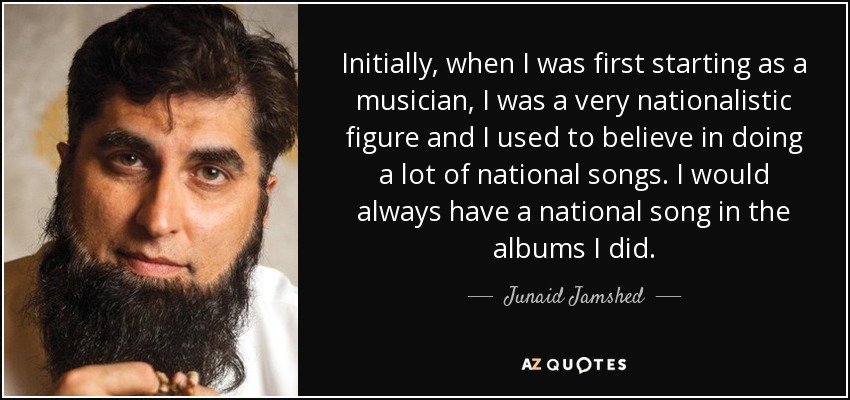
Initially, when I was first starting as a musician, I was a very nationalistic figure and I used to believe in doing a lot of national songs. I would always have a national song in the albums I did.
If you can create a reality that is entirely fictitious, it doesn't owe anything to this stuff out here, but you interact with it on your own terms. I mean, if you took it to the point where finally you get, say, tactile feedback, so you were wired in in terms of the whole nervous system. The sensorium. You would have the ultimate art form. I mean, any painter would want it, any filmmaker would want access to it you know, any musician would want access to it. It would eliminate the need for the divisions between what we describe as the arts, converting the whole thing to experience.
Jazz musicians are so comfortable. The reason they can't do what we do is because they're so comfortable doin' what they do.
You have to be ready, and also you have to discard notions that are fondly held by a lot of musicians, about sequences and notes and about scales and musical systems as a whole. If you think of music as a language, the space part is where you throw out all the syntax.
You might have asked [about skill] of an artist or a musician or whatever... but with me it just happens.
Obviously, [Wham!] made me a lot more comfortable as a musician. I was very confident that I would become a successful musician, but I had no idea I would be a celebrity.
At a certain age I just stopped arguing. I realized that there was no way [my father] could see, because for him to approve of what I was doing, he would have to have some belief in me as a musician.
I got really excited about it. But then we went into the studio and tried to record some with different musicians, and it didn't sound good. It didn't work. So we put together the album [Unchained] with just a guitar and myself.
I don't know anyone on my mom's or dad's side that was a musician.
I was co-editor of the magazine called The Jazz Review, which was a pioneering magazine because it was the only magazine, then or now, in which all the articles were written by musicians, by jazz men. They had been laboring for years under the stereotype that they weren't very articulate except when they picked up their horn.
Miranda [Hentoff] is a complete musician. She's a composer, a singer. She writes scripts along - with her projects. And she's a superb teacher. Her teaching pupils have ranged from Itzhak Perlman to Sting.
[Miranda Hentoff] was teaching once at Lincoln Center, and the hall was full of other professionals - musicians, professors, teachers. And she was explaining how [Béla] Bartok composed his second piano concerto. And she explained how the music was interwoven with the rhythms and what he had in his mind. And I was just stunned. This is a kid who used to work - on a piano with a cracked keyboard.
Up-and-coming musicians can easily reach out and find a loving teacher, and that's definitely what happened to me.
Daniel Handler's a writer, musician and the author of, among other things, the "Series Of Unfortunate Events" books. He also wrote the TV version of the books that is available now on Netflix. As said, I recommend both media for this story.
For better or for worse, I think my approach to jazz is very traditional, in one sense, but is [also] very out of fashion today. It's about the musicians, and it's about that magic that happens in the moment.
For me, the difference between a musician reading an arrangement on a piece of paper, and them closing their eyes and listening to what's happening around them and responding to it, is huge.
There used to be a club in new york called Bradley's - I've never been there, it closed in the 80's - but I used to study with Junior Mance, and he would tell me about Bradley's. It was a very important place for a generation of jazz musicians in New York. It was really all about pianists there.
Nowadays it's hard to get somebody to invest the time - everybody wants to be famous rather than be a good musician.
People who are qualified are symphonic orchestra players and jazz musicians; they're qualified to do what they do. Rock stars are lucky. It's a combination of right time, right place and having certain genes or a gimmick or whatever, but it's really not anything more than sugar. It tastes good and goes away fast.
To actually get together and make a band record feels like a bit of a big deal, and that can be quite daunting when you're musicians.
I wish I could say differently, but I really don't think so. There are too many musicians already for probably anyone to be noticed without some sort of commercial support. Even the most talented ones drown in a sea of mediocrity, and only the politically correct ones will ever be promoted (willingly...) by the press anyhow.
The thing is, autism is a big spectrum. Going from folks who remain nonverbal, all the way up to, ya know, famous scientists and musicians. And we've got to work on strengths. We also have to work on teaching basic manners and skills.
A good song is a good song, and good musicians can play all different styles.
By the time I was 19, my parents weren't very authoritative over my life.I didn't have any doubt about that - at that time about what I was going to do or where I was going. I was a musician. I was going to play. I had a band. We were going to make enough money to survive on.
Patti [ Scialfa] was an artist and a musician and she was a songwriter. And she was a lot like me in that she was transient also. She worked busking on the streets in New York. She waitressed. She had - she just lived a life - she lived a musician's life. She lived an artist's life. So we were both people who were very uncomfortable in a domestic setting, getting together and trying to build one and seeing if our particularly strange jigsaw puzzle pieces were going to fit together in a way that was going to create something different for the two of us. And it did.
Follow AzQuotes on Facebook, Twitter and Google+. Every day we present the best quotes! Improve yourself, find your inspiration, share with friends
or simply: