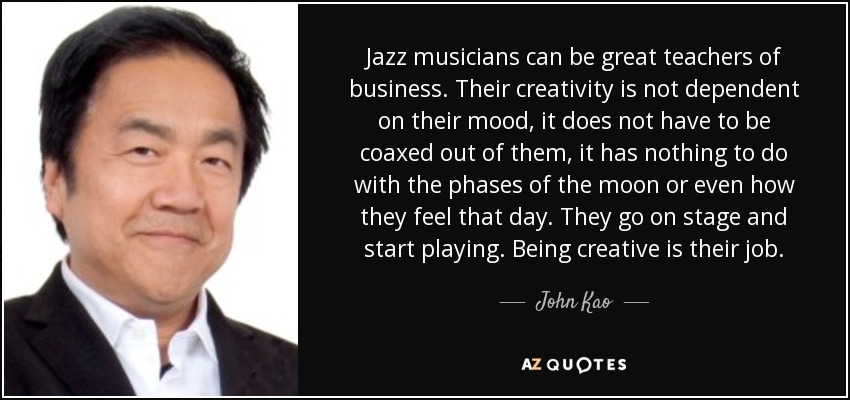
Jazz musicians can be great teachers of business. Their creativity is not dependent on their mood, it does not have to be coaxed out of them, it has nothing to do with the phases of the moon or even how they feel that day. They go on stage and start playing. Being creative is their job.
In the end it is the musician who actually plays the notes. The impresario - or the project leader - is only there to make sure that happens. That is a very different type of management mind-set.
We talked a lot with the musician. And for now there are few options, and I give him few weeks to come and surprise me with something. I don't want to start and say, okay here is what I want. Because maybe he has an idea that is better than mine.
There's something really natural to me about being what they call in the business a "hyphenate." Being a musician-actor or writer-musician-actor.
I'm going to be a better actor, or I'm going to try to be a better actor. I'm going to try to be a better musician. I'm going to be an artist instead of just this one thing.
I have got to look at the flip side of things, because, in a way, music is always a conversation, you know? It's a conversation between the musician and their tools and their technologies.
The cliché of that sort of wasted, renegade, drugged-out musician of the '70s is kind of dead and gone now. And I suppose that a lot of people still keep relying on that, or some kind of image to perpetuate something that they think they're supposed to sound like. But that kind of takes you away from real inspiration and, you know, real artistic discovery of the individual.
Nowadays, [young musicians] are so quick to be like, "OK, fine, I'll take the cheque, or I'll get the stamp from XYZ, and I'm expanding my brand," rather than thinking, "I'm part of this space over here, and in order for it to grow, you can't have it assimilated by this bigger bubble or corporate brand."
I had abandoned my plans for priesthood and replaced them with dreams of being a musician.
I just consider myself lucky that I've been a musician this long and not had to find another job.
I promised to finish school, so I'll figure it out I guess. Besides, I'm on a special school for musicians and artists, so I'm not the only one with this life style.
Music reflects the time that it's being made in, and so certainly, the music that's being made in 1986 by a 14-year-old kid will reflect some magic of 1986 for him if he's an inspired and creative musician.
Of course the headspace for the young musician is whatever the guy who is paying you says, is right, but that's all.
If we want to be musicians, dancers or sportspeople, we can download a certain amount and watch DVDs and read books, but in the end we need someone to assess us and give us personal instruction. The two go together.
You don't find geniuses in street musicians, but that doesn't mean to say you can't be really good.
I often call Daptone the Motown and Stax of today. But in some ways it's different. At Motown, a lot of the musicians didn't get recognized, music got stolen, and people didn't get paid. Or the label would just throw them a pinch of money for their songs. That is one thing we're not doing. Anything anyone writes here, we get a percentage.
I think it's time to travel, start gathering some real right-in-there experiences with street musicians around the world.
So far I've been very, very fortunate because it appears that people like to hear the music I like to play. What more fortunate position can a musician be in?
A lot of things inspire me. Music, for one; in addition to acting, I'm also a musician.
I had success early on where I'm able to try to keep it fun, and I don't have to do things just for the sake of making a living, which a lot of my musician friends don't have that luxury of course.
I was born in Philadelphia, Pennsylvania, and am a product of a family that were jazz aficionados and also very interested in progressive politics. And so I had a lot of artists and musicians in my home. Lots of Latin music, folk, and jazz and blues, bluegrass-type of stuff. Painters and stuff like that.
It is not enough to do a desktop exercise of a Beethoven symphony. You need to practice with an orchestra. The musicians need to read the notes. Otherwise it will be a disaster.
I recognize that as a musician there is a certain chauvinism attached to it, which is the thing of, "I spent my time learning how to play. You didn't spend time learning how to play, therefore, you are not a musician."
Patti [ Scialfa] was an artist and a musician and she was a songwriter. And she was a lot like me in that she was transient also. She worked busking on the streets in New York. She waitressed. She had - she just lived a life - she lived a musician's life. She lived an artist's life. So we were both people who were very uncomfortable in a domestic setting, getting together and trying to build one and seeing if our particularly strange jigsaw puzzle pieces were going to fit together in a way that was going to create something different for the two of us. And it did.
Most musicians, regardless of what culture they come from, can get together and agree on some stuff about music. As there is going to be a common ground.
Follow AzQuotes on Facebook, Twitter and Google+. Every day we present the best quotes! Improve yourself, find your inspiration, share with friends
or simply: