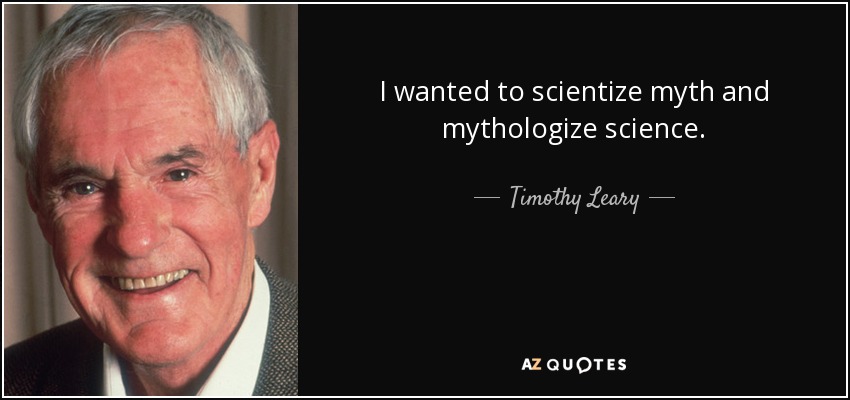
I wanted to scientize myth and mythologize science.
Willpower is a myth. The problem with trying to use willpower to achieve and sustain a behavioral change is that it is fueled by emotion. And as we all know, our emotions are, at best, fickle. They come and go. When your emotions start running down -- and they will -- even your best-laid plans will fall flat.
Today, we know that time travel need not be confined to myths, science fiction, Hollywood movies, or even speculation by theoretical physicists. Time travel is possible. For example, an object traveling at high speeds ages more slowly than a stationary object. This means that if you were to travel into outer space and return, moving close to light speed, you could travel thousands of years into the Earth's future.
Music is our myth of the inner life.
It is significant that people who refuse to tell their children fairytales do not fear that the children will believe in princes and princesses, but that they will believe in witches and bogeys.
Freudian psychoanalytical theory is a mythology that answers pretty well to Levi-Strauss's descriptions. It brings some kind of order into incoherence; it, too, hangs together, makes sense, leaves no loose ends, and is never (but never) at a loss for explanation. In a state of bewilderment it may therefore bring comfort and relief.... give its subject a new and deeper understanding of his own condition and of the nature of his relationship to his fellow men. A mythical structure will be built up around him which makes sense and is believable-in, regardless of whether or not it is true.
Now the myths represent the Gods themselves and the goodness of the Gods subject always to the distinction of the speakable and the unspeakable, the revealed and the unrevealed, that which is clear and that which is hidden: since, just as the Gods have made the goods of sense common to all, but those of intellect only to the wise, so the myths state the existence of Gods to all, but who and what they are only to those who can understand.
One may call the world a myth , in which bodies and things are visible, but souls and minds hidden. Besides, to wish to teach the whole truth about the Gods to all produces contempt in the foolish, because they cannot understand, and lack of zeal in the good, whereas to conceal the truth by myths prevents the contempt of the foolish, and compels the good to practice philosophy.
The myth of independence from the mother is abandoned in mid- life as women learn new routes around the mother--both the mother without and the mother within. A mid-life daughter may reengage with a mother or put new controls on care and set limits to love. But whatever she does, her child's history is never finished.
There is a place where the human enters dream and myth, and becomes a part of it, or maybe it is the other way around when the story grows from the body and spirit of humankind. In any case, we are a story, each of us, a bundle of stories, some as false as phantom islands but believed in nevertheless. Some might be true.
The idea that beauty is unimportant is the real beauty myth.
rummaging in the storehouses of religious or literary history for myth-matter for ideational uses is of the nature of spiritual vulgarity.
Myth is a tale once believed as truth; believed, it is not myth, but religion. A tale once religiously believed that has come to be called a myth is something of religion corrupted with disbelief. What are beliefs for some societies but myths for others cannot fill spiritual vacancies in the life of those others.
Unconscious of your story, you are in its grasp; but with consciousness, an alchemical process begins: The solidity of the complex dissolves and you can open up to the arrival of a new archetype, the birth of a new cycle of life. In the shadow, then, lies our myth and our fate.
Every new social structure strives to come up with some kind of mythology of divine origin for its values and aims.
Mythology is the mother of religions, and grandmother of history.
Schools, the institutions traditionally called upon to correct social inequality, are unsuited to the task; without economic opportunity to follow educational opportunity, the myth of equality can never become real. Far more than a hollow promise of future opportunity for their children, parents need jobs, income, and services. And children whose backgrounds have stunted their sense of the future need to be taught by example that they are good for more than they dared dream.
The myth of self-sufficiency blinds us to the workings of other forces in family life. For families are not now, nor were they ever, the self-sufficient building blocks of society, exclusively responsible, praiseworthy, and blamable for their own destiny. They are deeply influenced by broad social and economic forces over which they have little control.
Recognizing that family self-sufficiency is a false myth, we also need to acknowledge that all today's families need help in raising children. The problem is not so much to reeducate parents but to make available the help they need and to give them enough power so that they can be effective advocates with and coordinators of the other forces that are bringing up their children.
The myth of the self-sufficient individual and of the self-sufficient, protected, and protective familytells us that those who need help are ultimately inadequate. And it tells us that for a family to need help--or at least to admit it publicly--is to confess failure. Similarly, to give help, however generously, is to acknowledge the inadequacy of the recipients and indirectly to condemn them, to stigmatize them, and even to weaken what impulse they have toward self-sufficiency.
The psyche is the inward experience of the human body, which is essentially the same in all human beings, with the same organs, the same instincts, the same impulses, the same conflicts, the same fears. Out of this common ground have come what Jung has called the archetypes, which are the common ideas of myths.
The happy ending of the fairy tale, the myth, and the divine comedy of the soul, is to be read, not as a contradiction, but as a transcendence of the universal tragedy of man. The objective world remains what it was, but, because of a shift of emphasis within the subject, is beheld as though transformed. Where formerly life and death contended, now enduring being is made manifest-as indifferent to the accidents of time as water boiling in a pot is to the destiny of a bubble, or as the cosmos to the appearance and disappearance of a galaxy of stars.
Knowledge is not a series of self-consistent theories that converges toward an ideal view; it is rather an ever increasing ocean of mutually incompatible (and perhaps even incommensurable) alternatives, each single theory, each fairy tale, each myth that is part of the collection forcing the others into greater articulation and all of them contributing, via this process of competition, to the development of our consciousness.
It's a myth that if you're liked by only four people it must be good. It might also be very bad: they might be your mother, your brother, your uncle and your aunt.
I have suggested that behind almost all myth lies the mono-plot of the game of hide-and-seek.
Follow AzQuotes on Facebook, Twitter and Google+. Every day we present the best quotes! Improve yourself, find your inspiration, share with friends
or simply: