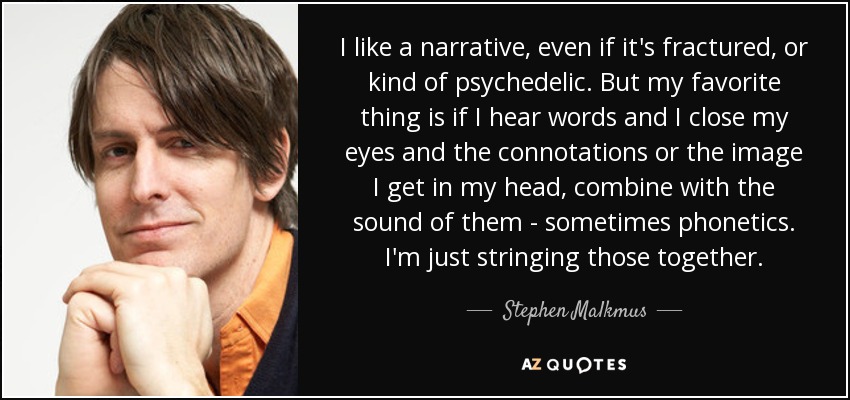
I like a narrative, even if it's fractured, or kind of psychedelic. But my favorite thing is if I hear words and I close my eyes and the connotations or the image I get in my head, combine with the sound of them - sometimes phonetics. I'm just stringing those together.
With some songs, I have written narratives or I've tried to carry it through, but generally the things that were more genius, as far as I was concerned, were not that.
The narrative songs were well-written, like an article in The New Yorker. They're nice and pat. They're more like I'm just showing I can do that when I write a song like that. It's not my true calling.
Because for me to go fully experimental, it would turn into an artist book actually. And I'm not opposed to that. But I wanted to toy with the conventions of traditional narrative and sometimes to do that all the way, you have to actually utilize traditional narrative, I think - or it's one way to do it.
I used to teach writing in a federal prison, and for my students' benefit, I would liken the narrative use of this highly personal point of view to a boxer's getting in close to his opponent.
A first-person voice helps to ensure the uniformity and cohesiveness of the narrative; it gathers unto itself incidents and characters in its unstoppable progress toward the story's end.
I really like narrative songs, but I wonder if that's a thing for some people. Once they've heard the story, do they really need to hear the story again?
've always defined a truly alluring story as a journey we're not equipped to take ourselves with a person we're tempted but afraid to emulate. Impostor narratives are exactly that. When they end in disaster, as Clark's did, or as Gatsby's did, we can congratulate ourselves for our own wisdom. We can also experience, safely, at no cost, the terrible thrill of radical self-invention, of trading who we are for who we might be.
With my students, I don't offer any simple tips like that, maybe because my own process is pretty messy, but when we workshop we talk a lot about the deeper subject, which is what the story or novel is about. I think defining a narrative's themes can lay bare a narrative's tensions.
It's something that's difficult to explain but I think all writers work this way to some extent, whether we're aware of it or not. For me, writing has little to do with thinking. I don't want to control the narrative. I listen to the rhythm of the words and dialogue and try to give the characters the space in which to say and do what they want without intervening too much.
I've learned a lot about language from reading slush. You can immediately tell if a writer is in control of the narrative. This writer will avoid using too many words like "possibly," "probably," "maybe," "perhaps," etc. He/she will avoid using clichés, as well as a lot of metaphors, and won't take four sentences to say what they could in one (or write a great sentence and follow it up with a bunch of stuff that just weakens it).
Fiction is risky for writers also in that the process of making certain books, of shaping certain narratives, leaves scars and marks on your inner life.
If there was no risk, it wouldn't be art. It wouldn't be worth making. There is risk even in a fairy tale. Fiction is closest to pure narrative, and pure narrative is simply the logic we try to impose on an ever-changing reality.
Narrative is a very feeble weapon in the face of human darkness and yet it's all we have. That we have to hang the transformation and survival of our species on the journey and transformation of one singular person so far outside of what we expect they can do.
Unlike other books or TV shows or sometimes life, my narrative worlds are stripped of implicit moral centers. There is only what you bring. That makes the characters risky in every way and the narrative, a journey of change for the reader. But I make the journey as fun as I can.
The truth is that History, with its imposing capital H, is simply the amalgamation of many quotidian lives lived in very ordinary ways. History is always personal. If you read Holocaust survivor or American slavery survivor narratives, you realize all too well that these great Historical moments were personal to someone at some time.
I think that everything in this life is a story you know; our own narrative, our own history, it's all a story.
A good mixtape didn't just gather together a bunch of love songs, but instead created an emotional narrative specific to your affection. The stories in most of my favorite collections are collected more like songs on a mixtape than, say, collected like spare change. By which I mean they are in conversation with each other and work to become larger than their parts.
I tend to employ braided narrative threads in the lyric, so often echoes (of phrases or images) will occur and will hit my ear so I can shape different resonances and shifts in tone.
Because I love narrative but am more lyrically inclined, I've learned that if I freight titles with narrative information (the who, what, when, where, why of the poem), I can get to my main interest, which is the language, and where it wants to take me. If I can establish the poem's occasion in the title, then so much the better for my freedom to associate.
I think I've learned to be mindful. I may not have taken the time to try to understand narrative techniques, let's say, with any rigor, if I did not also have to try to explain those techniques to someone else.
You could be attached to merely a description of a plant or a flower. Or a narrative of an event. Or rage at injustice. Isaiah and the other Hebrew prophets, in their rage, were being altogether attached - not at all detached, although as I think of the word "detachment," I also think of a sheet of paper, loose from its notebook, fluttering around somewhere in the wind trying to find its home again.
For whatever reason, thus far it's been important to me not to write that kind of collection. Which means that I've spent months playing tic-tac-notecard, trying to get the stories in an order whereby stories that are similar in any given way (diction, narrative stance, setting, plot) are separated by others that aren't.
I think in many ways what my films are about is that search for my grandpa's dentures: for that humanizing narrative that bridges the gap between "us" and "them" to arrive at a "we."
In documentary you sometimes see the tyranny of the linear, but what I've noticed in the last ten years in narrative film is the tyranny of the non-linear.
Follow AzQuotes on Facebook, Twitter and Google+. Every day we present the best quotes! Improve yourself, find your inspiration, share with friends
or simply: