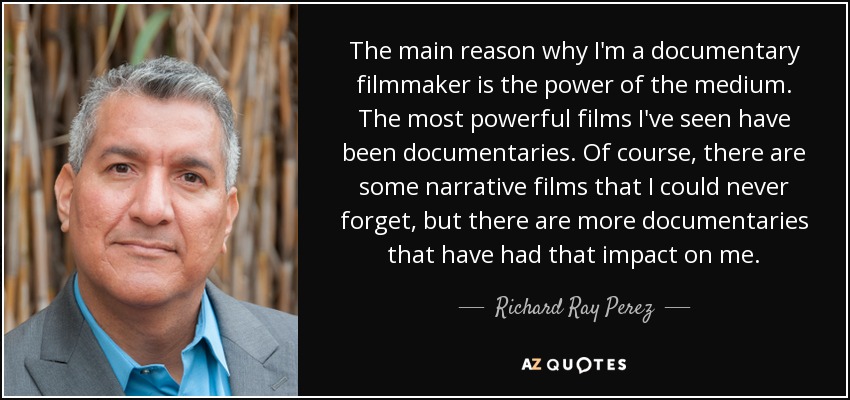
The main reason why I'm a documentary filmmaker is the power of the medium. The most powerful films I've seen have been documentaries. Of course, there are some narrative films that I could never forget, but there are more documentaries that have had that impact on me.
The power of the documentary film, when done well, I think is usually more impacting than a narrative, at least for me. Documentaries are also cheaper, they are more accessible to make.
I am fairly optimistic about the disillusionment that produces homogeneity in general. The films that succeed in [theaters] are fairly homogeneous in terms of narrative and vision of the world.
Escaping into the fantasy of intellectual investigation or narrative story telling makes me feel hopeful. That too is a fiction, but one that makes me feel good sometimes.
[I have a] way of making narrative sculpture, where first you make a text and out of that text you make objects. [...] I start with a story and then I make sculpture from that story, it's just that the stories become more and more elaborate.
If you're not [Federico] Fellini you might make something very vulgar. Animation made it possible to maintain unity with all these different narratives.
For me becoming a filmmaker was about taking back my voice - crafting stories that would move away from the problematic narratives that the studio system would put out about Latinos. I think this is why people like my films. They're refreshing. They feel more real.
We don't really know how technology will affect narrative. That's the question. See, people used to say that the novel is going to die, but they would never say that movies will die with it, when in fact all forms depend on the narrative. I think if one of them fails, the others are going to fail as well. Maybe this will happen to both forms, and maybe movies will take a totally different direction with fiction.
Terror is now the world narrative, unquestionably. When those two buildings were struck, and when they collapsed, it was, in effect, an extraordinary blow to consciousness, and it changed everything.
We are opinionated society. We're very happy to spout forth our own views; we're not good about listening. We have to listen to other's stories. Learn to listen to the stories of the terrorists just as we hope that they will listen to ours because very often these narratives express frustrations, fears, and anxieties that most societies can safely ignore.
I feel like in a conversation if things get said and then repeated, it sort of becomes inherently part of the narrative whether you want it to be or not.
I think that's true of all cinema, that's why cinema is the great humanistic art form. Whatever the film is, it doesn't matter what the film is about, or even whether it's a narrative or figurative film at all, it's an invitation to step into somebody else's shoes. Even if it's the filmmaker's shoes filming a landscape, you go into somebody else's shoes and you look out of their lens, you look out of their eyes and their imagination. That's what going to the pictures is all about.
I think that you can treat a classic like a museum piece -stuffed and mounted- or you can make it a living, breathing narrative that is unfolding right then and there.
I have been suspected of being what is called a Fundamentalist. That is because I never regard any narrative as unhistorical simply on the ground that it includes the miraculous.
Culture and technology exist in a dynamic reciprocal relationship. Culture comprehends technology through the means of narratives or myths, and those narratives influence the future shape and purposes of technology. The culture-technology circuit is at the heart of cultural evolution.
I guess the biggest difference from the things I've done in the past is that my work will be more narrative-driven adult films or vignettes, not just "gonzo" scenes, which are straight sex, no storyline.
It's hard, because when you talk about process or your characters ruling your narrative, it sounds like you have no control, but obviously you're ultimately the author, so you do have control.
I'm not denying Christ by not being Christian. I'm a theist, which involves expanding on the Christ narrative.
In Western culture, there's a dichotomy between the easy narratives of God and the Devil. I now believe in this greater overarching spiritual thing. We are the light and the dark, and have to own the darkness. It's part of us. It's not evil. It's needed. You need to own both of them to be whole. Absorb it, and live it as part of your life.
What's interesting is that when you get into the post-war period, many of the narratives in books and movies conclude that if you killed Hitler, you're actually going to make history worse.
We also knew we definitely wanted to infuse into the narrative the relation of women at different ages with motherhood, their relationship with their babies versus their partners', their overall "need" to have children, their fears and projections on their children, etc. All of this we put into a pot, if you will, and simmered for a while until we had what made sense to us.
Setting aside the issue of gender while highlighting the symmetry of bodies seemed indispensable in order to focus on the narrative of human beings in the making.
When you're on stage, you build strong relationships with the actors, but it's a story you tell with the audience - you have to include them, you have to respond to them, they have to understand the narrative.
Women don't question themselves when they enter into a story that has male characters, but men do question the validity of a female narrative.
There is enormous need for professionals who know how to tell stories with narrative punch and nuance, who can work proactively and not just reactively, and whose approach is multi-faceted. We need more "useful photographers."
Follow AzQuotes on Facebook, Twitter and Google+. Every day we present the best quotes! Improve yourself, find your inspiration, share with friends
or simply: