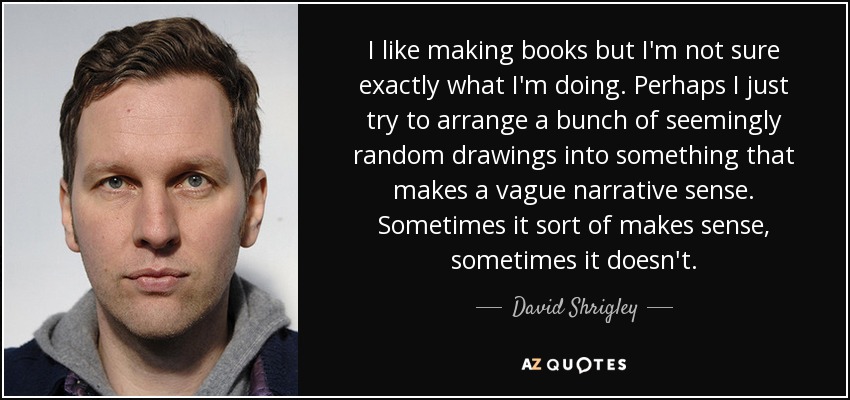
I like making books but I'm not sure exactly what I'm doing. Perhaps I just try to arrange a bunch of seemingly random drawings into something that makes a vague narrative sense. Sometimes it sort of makes sense, sometimes it doesn't.
My concern is how we live fictions, how fictions have real effects, become facts in that sense, and how our experience of the world changes depending on its arrangement into one narrative or another.
I guess when I'm frightened or in pain or maybe very bored I've tried to hold myself together by imposing a narrative order on the experience as it happens.
I'm aware of narrating certain experiences as they happen or obliterating those experiences with narrative and then those stories - not the experiences themselves - might become material for art. This kind of transformation shows up a lot in 10:04 because the book tracks the transposition of fact into fiction in the New Yorker stor
Each character requires different language, and these issues become inseparable. You have all these balls in the air: language, character, narrative. For me, the primary focus must be words, sentences, paragraphs.
I wouldn't want to be defined so much by comics or cartoons. My work is more narrative than that. If you take your basic cartoon, there's always a punchline or a joke at the end. My drawings don't depend on that so much.
I don't really think in terms of the future of literature. I think literature will be around "forever" - but in a relatively niche way, like jazz and poetry, although probably more widely consumed than jazz and poetry since it's fundamentally a narrative form. And I think that's important and places like Word Riot and 'The New York Tyrant' and 'n+1' will be responsible for keeping it alive.
"Hello" is always presented as a linear narrative, a singular chain, sometimes in a loop. But the reality of making it is that connections are naturally sprawling all over the place, so I am free to edit any way I want.
Modernism had two great wishes. It wanted its audience to be led toward a recognition of the social reality of the sign (away from the comforts of narrative and illusionism, was the claim); but equally it dreamed of turning the sign back to a bedrock of World/Nature/Sensation/Subjectivity which the to and fro of capitalism had all but destroyed.
The biggest challenge in the research process is to let go, to stop, to say enough, and then to reduce all of that beloved labor down to a few succinct paragraphs that shape the background to your narrative. I love research - that's all the fun, especially in the field. To write, however, is to suffer, and my pieces usually come in thousands of words over the assigned length. That's a serious flaw in my writing process - shaping and disciplining the footlockers of material one has so happily gathered.
Writing is a process of discovering. I could never outline a narrative; that just sounds boring. There's no joy of discovery in what you're doing if that's your strategy.
Girlchild . . . unfolds a compelling, layered narrative told by a protagonist with a voice so fresh, original, and funny you'll be in awe. This novel rocks . . . In Girlchild Tupelo Hassman has created a character you'll never forget. Rory Dawn Hendrix of the Calle has as precocious and endearing a voice as Holden Caulfield of Central Park. When you finish this novel, your sorrow at turning the last page will be eased by your excitement at what this sassy, talented author will do next.
I've never been interested in the convention of dialogue that facilitates narrative-it's always sort of bored me. I find myself zoning out just listening to cadences of voices and tonality and this sort of thing.
The true history of Vietnamese civilian suffering does not fit comfortably into America's preferred postwar narrative - the tale of a conflict nobly fought by responsible commanders and good American boys, who should not be tainted by the occasional mistakes of a few 'bad apples' in their midst.
Or is anyone's identity a matter of fragments held together by convenient or useful narrative, that in ordinary circumstances never reveals itself as a fiction? Or is it really a fiction?
The biggest misconception is that I'm only a documentary filmmaker, but in fact I have made many narrative shorts. My biggest inspirations are narrative films, and that's ultimately where I see myself going next.
The museum in D.C. is really a narrative museum - the nature of a people and how you represent that story. Whereas the Studio Museum is really a contemporary art museum that happens to be about the diaspora and a particular body of contemporary artists ignored by the mainstream. The Studio Museum has championed that and brought into the mainstream. So the museums are like brothers, but different.
I do feel that scripts get developed now to a point where they're sort of actor-proof. If the actor is not very good, the narrative still survives because it's all in the dialogue. Not to say there aren't great performances in English-language films, because there are every year, but the 1970s were awash with great performances, and I was wondering whether it had to do with the amount of space and the amount of responsibility given to the actors.
One of the things that's important about family is the narrative history they create for themselves.
Those subject to capital punishment are real human beings, with their own backgrounds and narratives. By contrast, those whose lives are or might be saved by virtue of capital punishment are mere 'statistical people.' They are both nameless and faceless, and their deaths are far less likely to be considered in moral deliberations.
Having made films, I know very well that the scope of the average 90- to 120-minute movie is about the same narrative heft as a long short story or a novella.
Why would so many risk their reputations, families, careers—even presidential legacies—for something that runs against human nature? Were monogamy an ancient, evolved trait characteristic of our species, as the standard narrative insists, these ubiquitous transgressions would be infrequent and such horrible enforcement unnecessary. No creature needs to be threatened with death to act in accord with its own nature.
The urge to create a fictional narrative is a mysterious one, and when an idea comes, the writer's sense of what a story wants to be is only vaguely visible through the penumbra of inspiration.
Once we truly grasp the message of the New Testament, it is impossible to read the Old Testament again without seeing Christ on every page, in every story, foreshadowed or anticipated in every event and narrative. The Bible must be read as a whole, beginning with Genesis and ending with Revelation, letting promise and fulfillment guide or expectations for what we will find there.
The decision to write in prose instead of poetry is made more by the readers than by writers. Almost no one is interested in reading narrative in verse.
Follow AzQuotes on Facebook, Twitter and Google+. Every day we present the best quotes! Improve yourself, find your inspiration, share with friends
or simply: