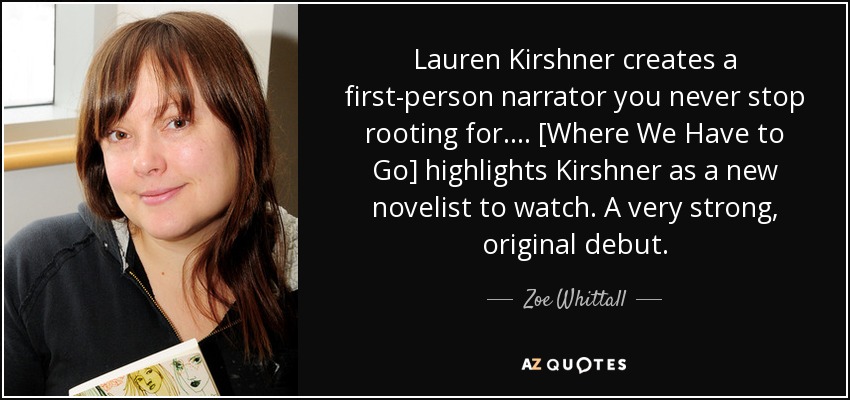
Lauren Kirshner creates a first-person narrator you never stop rooting for. . . . [Where We Have to Go] highlights Kirshner as a new novelist to watch. A very strong, original debut.
I am somebody who creates images, with my perspectives, fascinations and my instincts as a narrator. You have to activate the audience's imagination. If you are just giving them scientific results, they would forget the film in five minutes flat.
If you just go get one of these little fine arts degrees or writing program degrees, it never forces you to confront your responsibility as narrator, whereas any of the social sciences make you at look the interaction between the storyteller and story.
Usually when I finish the draft of a book, I'm sure I'll never write another one. I'm just that tired and sick of myself. But then another idea starts percolating. It usually begins with the narrator's name, then some idea that intrigues me about her life or situation. I try to ignore it as long as I can, because I know when I start writing, I'll be right back into it, every single day. But eventually, I just have to. It's a compulsion!
I learned capacity for self-reflection very early, finding it through interior monologues that books are so good at and that visual media is so bad at because it's so boring - nothing's happening. In a book, you can be inside the narrator's head for 50 pages, and nothing needs to happen. Then you learn to be inside your own head without something needing to happen. It's a very good antidote to a crazy, restless, "what's next?" culture - that you can just be in your own head and nothing is happening except that this is a rich place. I love that.
When someone walks in and you say "a six-foot-tall man," you miss the opportunity to describe what a six-foot-tall man would look like to your narrator, because how the narrator describes a six-foot-tall man says more about the narrator than about the man.
I'm really shocked when critics get morally outraged at my fiction because they think I'm condoning what's going on. I never come in as the author and say, "Hey, okay. I'm interrupting the narrator here. I'm Bret Easton Ellis, and I'm the author."
I personally just want to do as many different things as I can do, whether it's comedy, drama, science fiction, horror, narrator... You've got a documentary, I've got a voice. Animated films. Big films, small films.
You can do everything differently in a novel. Hero narrates the novel; we're in his head. You're hearing all his thought processes and you're hearing him call himself out on his bad behavior. You don't have the benefit of that narrator in a movie. What you see a character do, very often, becomes that much more important because you don't have him editorializing it for you.
I have no policy, for or against: only a personal style. Which is to say, I use them when I think it's appropriate to; for example, an internal monologue by a locquacious and verbose narrator is more likely to be larded with adverbs than an exchange of instant messages between cops at a crime scene.
Early on, I settled on the first-person strategy as a way to deal with exposition and world-description issues. As long as the book is, it could have been far longer had I gone with an omniscient third-person narrator, or multiple point-of-view characters, since either of those would have enabled me to impart much more detailed information about the history and geography of the world.
We see everything from the narrator's point of view, so exposition about the world is limited to what impinges directly on him and the story he's telling. Considering how old the world is, we learn very little about its history, which I think is a good thing.
I think first-person narrators should be complex, because otherwise the first-person is too shallow and predictable. I like a first-person narrator who can't totally be trusted.
I make very involved drawings, even little structures, and try using design to figure out the rhythm of a plot. If there are several narrators then a clue has to pop up in the first line. There have to be certain grammatical clues, or distinctive names.
Kerouac's books portray a hero and narrator free and easy, confident, sure of his rebellion against the American system. In reality, Jack was torn between Catholicism, Buddhism, and his own demon-driven pursuit of kicks, between spirit and flesh, between mom's house and the Beat coffeehouse, patriotism and subversion, men and women, society and solitude, carousing and meditation, sacred and profane, secular and divine. It's a miracle he survived as long as he did.
I don't know if you've ever seen this film called Elite Squad, which, actually Wagner [Moura] is the one narrating that. José Padilha, one of creators of our show, that's where the style comes from. It has a heavy narrator. But I thought about it a lot. You [the viewers] have to work for the show, unless you're bilingual. It's a really aggressive type of filming, it's engaging, you've got to read.
One naturally identifies to some extent with an "I" female narrator going through something that you recognize whether you've gone through it or not.
Sometimes I can better describe a person by another person's reaction. In a story in my first book, I couldn't think of a way to sufficiently describe the charisma of a certain boy, so the narrator says, "I knew girls who saved his gum."
Everyone is interesting except the narrator in a first-person story.
My biggest lesson ... was to try and create narrators that were believable. ...so the listener becomes really invested in the story or the song.
A miracle signifies nothing more than an event... the cause of which cannot be explained by another familiar instance, or.... which the narrator is unable to explain.
The truth of the matter is that for all the drive-in movie references, what Weston Ochse has really created in Multiplex Fandango is a travelogue. Acting as narrator and guide, Weston takes you on a trip to places familiar and obscure-New Orleans, the Sonoran desert, Mexico's Pacific coast, and the dark, impenetrable reaches of the soul. He shows off sights that chill the blood, and as with any good trip, the things seen and experienced along the way will stay with you for a lifetime.
Nostalgia for people, cultures, everything. There's an ability to use these marks to note things that are erased, deleted. Traces are a species of history, of evidence. It's a way for the way the narrator to construct a semblance of self, even though all of this creates a deception, a way to think of one's traces as a real way to define oneself. The trace is fallible, impermanent. It's one of the motives I had in mind throughout the text.
It is hard to create a first-person narrator that can be a child and yet is able to take in enough information for the narrative to be legible to the reader.
I wanted to do a collection where the narrator is constant throughout, so that there's a little unity.
Follow AzQuotes on Facebook, Twitter and Google+. Every day we present the best quotes! Improve yourself, find your inspiration, share with friends
or simply: