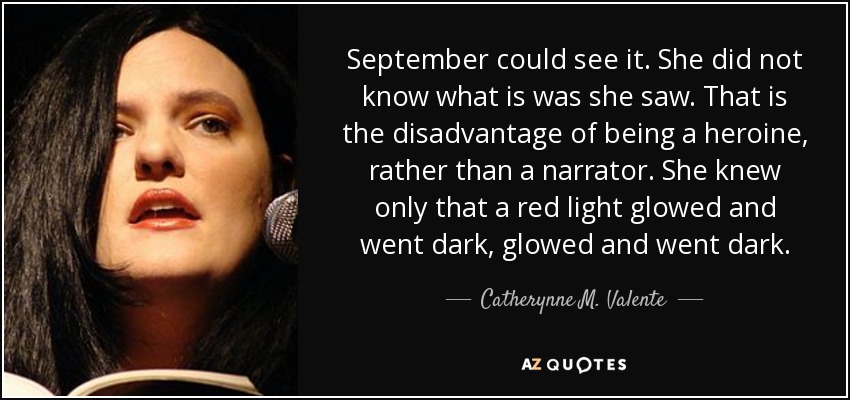
September could see it. She did not know what is was she saw. That is the disadvantage of being a heroine, rather than a narrator. She knew only that a red light glowed and went dark, glowed and went dark.
WARNING: The following is a transcript of a digital recording. In certain places, the audio quality was poor, so some words and phrases represent the author's best guesses. Where possible, illustrations of important symbols mentioned in the recording have been added. Background noises such as scuffling, hitting, and cursing by the two speakers have not been transcribed The author makes no claims for the authenticity of the recording. It seems impossible that the two young narrators are telling the truth, but you, the reader, must decide for yourself.
Time passes, as the novelist says. The single most useful trick of fiction for our repair and refreshment: the defeat of time. A century of family saga and a ride up an escalator can take the same number of pages. Fiction sets any conversion rate, then changes it in a syllable. The narrator’s mother carries her child up the stairs and the reader follows, for days. But World War I passes in a paragraph. I needed 125 pages to get from Labor Day to Christmas vacation. In six more words, here’s spring.
She was like a heroine in a novel that she herself was writing the character kept protesting that she was too strong for love and yet the narrator went on describing her desire.
Once I got interested in organized crime, and, specifically, Jewish organized crime, I got very interested in it. I have learned that, like my narrator Hannah, I'm a crime writer in my own peculiar way. Crime with a capital "C" is the subject that I'm stuck with - even Sway is about "crime" in a certain way. The nice thing about crime is that it enables you to deal with some big questioO
***A Last note from your narrator*** I am haunted by humans.
It is rare and almost impossible for a novel to have only one narrator.
I have never done anything except write, but I don't possess the vocation or talents of a narrator, have no knowledge at all of the laws of dramatic composition, and if I have embarked upon this enterprise it is because I trust in the light shed by how much I have read in my life.
Nothing ever begins. There is no first moment; no single word or place from which this or any story springs. The threads can always be traced back to some earlier tale, and the tales that preceded that; though as the narrator's voice recedes the connections will seem to grow more tenuous, for each age will want the tale told as if it were of its own making.
Francis Ford Coppola did this early on. You tape a movie, like a radio show, and you have the narrator read all the stage directions. And then you go back like a few days later and then you listen to the movie. And it sort of plays in your mind like a film, like a first rough cut of a movie.
The narrator blames the birds. And you want to blame the birds as well. I blamed the birds for a long time. But in this story everyone is hungry, even the birds. And at this point in the story so many things have gone wrong, so many bad decisions made, that it’s a wonder anyone would want to continue reading.
It is such a secret place, the land of tears. That is what the narrator ofThe Little Prince says after the little prince argues with him the first time about matters of consequence. And he was right. My land of tears had been a secret for a very long time.
The Polar Express was the easiest of my picture book manuscripts to write... Once I realized the train was going to the North Pole, finding the story seemed less like a creative effort than an act of recollection. I felt, like the storys narrator, that I was remembering something, not making it up.
But we may want to keep in mind that deeds and words are not as distinguishable as often we presume. History does not belong only to its narrators, professional or amateur. While some of us debate what history is or was, others take it into their own hands.
I am voice actor Roger Craig Smith. You may know me as Batman, Captain America, Sonic the Hedgehog, Ezio from Assassin's Creed, Transformers: RID, or narrator of “Say Yes To the Dress” (among many other things). AMA!
I think every first-person narrator in a novel should be compromised. I prefer that word to unreliable.
This is what you learned in college," the narrator tells you early on. "A man desires the satisfaction of his desire; a woman desires the condition of desiring.
Narrator: You had to give it to him: he had a plan. And it started to make sense, in a Tyler sort of way. No fear. No distractions. The ability to let that which does not matter truly slide.
If you just go get one of these little fine arts degrees or writing program degrees, it never forces you to confront your responsibility as narrator, whereas any of the social sciences make you at look the interaction between the storyteller and story.
I am somebody who creates images, with my perspectives, fascinations and my instincts as a narrator. You have to activate the audience's imagination. If you are just giving them scientific results, they would forget the film in five minutes flat.
You can do everything differently in a novel. Hero narrates the novel; we're in his head. You're hearing all his thought processes and you're hearing him call himself out on his bad behavior. You don't have the benefit of that narrator in a movie. What you see a character do, very often, becomes that much more important because you don't have him editorializing it for you.
I personally just want to do as many different things as I can do, whether it's comedy, drama, science fiction, horror, narrator... You've got a documentary, I've got a voice. Animated films. Big films, small films.
We see everything from the narrator's point of view, so exposition about the world is limited to what impinges directly on him and the story he's telling. Considering how old the world is, we learn very little about its history, which I think is a good thing.
Early on, I settled on the first-person strategy as a way to deal with exposition and world-description issues. As long as the book is, it could have been far longer had I gone with an omniscient third-person narrator, or multiple point-of-view characters, since either of those would have enabled me to impart much more detailed information about the history and geography of the world.
I have no policy, for or against: only a personal style. Which is to say, I use them when I think it's appropriate to; for example, an internal monologue by a locquacious and verbose narrator is more likely to be larded with adverbs than an exchange of instant messages between cops at a crime scene.
Follow AzQuotes on Facebook, Twitter and Google+. Every day we present the best quotes! Improve yourself, find your inspiration, share with friends
or simply: