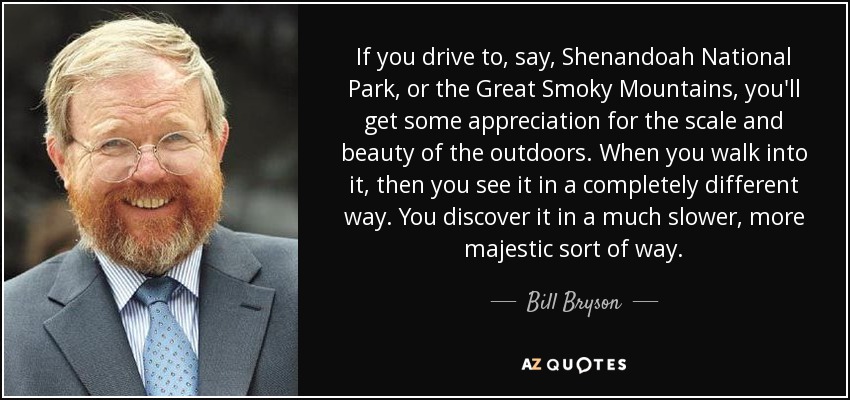
If you drive to, say, Shenandoah National Park, or the Great Smoky Mountains, you'll get some appreciation for the scale and beauty of the outdoors. When you walk into it, then you see it in a completely different way. You discover it in a much slower, more majestic sort of way.
The central part of the state is more remote and less scenic, and there's a huge agricultural belt that stretches from the south of Lake Okeechobee to the border of Everglades National Park, where the restoration effort is being concentrated, .. Obviously the movement to save the Everglades runs up against agricultural concerns.
I got involved in Gateway National Park and just became fascinated with gardens.
On the lip of the Grand Canyon. I've always wanted to do that. My very first TV special out of the Olympics was on a glacier in Alaska. Right after that one, I went and pitched this idea to skate in three National Parks. Like Voyageurs National Park, because it freezes over and you have these little islands that you can skate around. [The networks] were like, 'Way too expensive.'
Biodiversity can't be maintained by protecting a few species in a zoo, or by preserving greenbelts or national parks. To function properly, nature needs more room than that. It can maintain itself, however, without human expense, without zookeepers, park rangers, foresters or gene banks. All it needs is to be left alone.
Although biodiversity loss continues globally, many countries are significantly slowing the rate of loss by shoring up protected natural areas and the services they provide, and in expanding national park systems with tighter management and more secure funding.
The influence of (the national parks) is far beyond what is usually esteemed or usually considered. It has a relation to efficiency -- the working efficiency of the people, to their health, and particularly to their patriotism -- which would make the parks worth while, if there were not a cent of revenue in it, and if every visitor to the parks meant that the Government would have to pay a tax of $1 simply to get him there.
He was skinning a bear. I was terrified at first, because the corpse resembled a naked man quartered between two trees. He'd created a deadfall trap over some big talus blocks and the bear had fallen in. He used the skin for something and jerked the meat. If it wasn't astonishing enough behavior in a national park, the next day he made donuts, using bear fat for grease ! Surely, by now, he's created an empire somewhere in the world.
we'll have to reclaim the ward 'taxes.' Why has it become a synonym for 'evil'? I understand that no one likes to pay good money for nothing. But fire and police protection aren't nothing. ... Roads, bridges, airports, and mass transit systems aren't nothing. National parks, clean air, and clear water aren't nothing. A safe food supply, functioning schools with well-trained teachers, and well-equipped hospitals aren't vaporous apparitions either.
It's good to see so many friends here in the Rose Garden. This is our first event in this beautiful spot, and it's appropriate we talk about policy that will affect people's lives in a positive way in such a beautiful, beautiful part of our national - really, our national park system, my guess is you would want to call it.
At the foot of the mountain, the park ended and suddenly all was squalor again. I was once more struck by this strange compartmentalization that goes on in America -- a belief that no commercial activities must be allowed inside the park, but permitting unrestrained development outside, even though the landscape there may be just as outstanding. America has never quite grasped that you can live in a place without making it ugly, that beauty doesn't have to be confined behind fences, as if a national park were a sort of zoo for nature.
If you're Maasai Mara National Park in Kenya, if you're in Serengeti National Park in Tanzania, you don't get out of your vehicle and go walking around amid the lions and the leopards. You stay in your Land Rover. You stay in your safari van, and you look out the windows or you look out the pop top at these animals. I know by experience how badly that can work out if you violate those guidelines.
It's the one species I wouldn't mind seeing vanish from the face of the earth. I wish they were like the White Rhinosix of them left in the Serengeti National Park, and all males.
I haven't been to Tasmania. I haven't been to the South Pole, and I haven't been to the North Pole. I want to see the polar bear migration before there are no polar bears. I want to see Glacier National Park before the glacier melts.
I've been through legislation creating a dozen national parks, and there's always the same pattern. When you first propose a park, and you visit the area and present the case to the local people, they threaten to hang you. You go back in five years and they think it's the greatest thing that ever happened.
Let the people walk. Or ride horses, bicycles, mules, wild pigs-anything-but keep the automobiles and the motorcycles and all their motorized relatives out. We have agreed not to drive our automobiles into cathedrals, concert halls, art museums, legislative assemblies, private bedrooms and other sanctums of our culture; we should treat our national parks with the same deference, for they, too, are holy places.
In Yellowstone National Park there are more ‘do not feed the animals’ signs than there are animals you might wish to feed.
Nature is located mainly in national parks, which are vast tracts of wilderness that have been set aside by the United States government so citizens will always have someplace to go where they can be attacked by bears. And we're not talking about ordinary civilian bears, either: We're talking about federal bears, which can behave however they want to because they are protected by the same union as postal clerks.
National parks, zoos, protected areas, polluted seas - using the whole world as a readymade, I thought about it as a stage set. To activate a stage set you need a drama, an actor to offset it.
I have family in Tanzania. I can't even explain the joy of riding through the Tanzania national park and seeing giraffes run across the road and elephants over in a pond and baboons running.
I got to Africa. I got the opportunity to go and learn, not about any animal, but chimpanzees. I was living in my dream world, the forest in Gombe National Park in Tanzania. It was Tanganyika when I began.
However useful may be the National Parks and Forests of the West for those affording the Pullman fare to reach them, what is needed by the bulk of the American population is something nearer home.
Everybody needs beauty as well as bread.
It is important that the remaining scenic areas of the country be at once made into State or National Parks. Fortunately there still are a number of these wild places, but it will require effort to save them. Each Park proposed will have powerful and insidious opposition. The insidious opposition to National Parks will say, ‘There is a feeling in Congress that we should not have any more National Parks at this time’; or, ‘We should wait until present ones are improved.’
The decay of the late, great country of South Africa is beginning to become apparent. The name of the Transvaal has been officially changed to 'Gauteng.' (One of our friends has suggested that in view of this its inhabitants in the future should be referred to as Oranggautengs.) ... And now there is a move afoot to wreck the Kruger National Park, one of the wonders of the world, on the notion that a good bit of its land was 'taken from the blacks.' This idea is somewhat akin to giving Yellowstone Park back to the Blackfeet.
Follow AzQuotes on Facebook, Twitter and Google+. Every day we present the best quotes! Improve yourself, find your inspiration, share with friends
or simply: