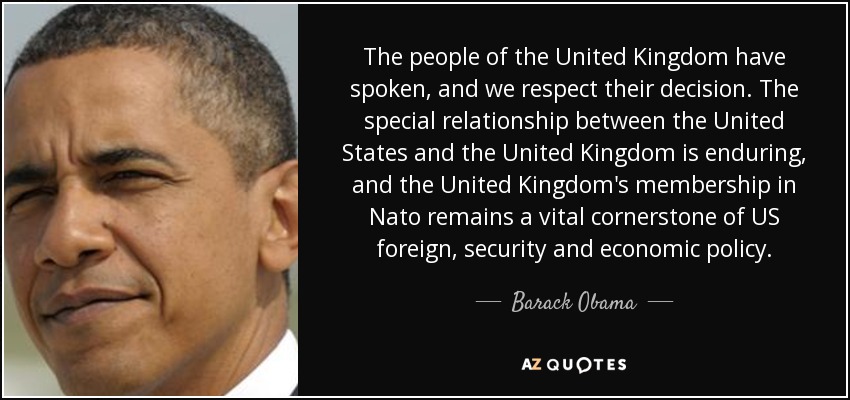
The people of the United Kingdom have spoken, and we respect their decision. The special relationship between the United States and the United Kingdom is enduring, and the United Kingdom's membership in Nato remains a vital cornerstone of US foreign, security and economic policy.
We know that Donald Trump has shown a very troubling willingness to back up [Vladimir] Putin, to support Putin, whether it's saying that NATO wouldn't come to the rescue of allies if they were invaded, talking about removing sanctions from Russian officials after they were imposed by the United States and Europe together, because of Russia's aggressiveness in Crimea and Ukraine, his praise for Putin which is I think quite remarkable.
Whole part of the world is a mess under [Barack] Obama, with all the strength that you're talking about and all of the power of NATO.
I think we have started accelerating over the past years. It's a modernization of NATO. It's at air, it's at sea, it's undersea, it's in cyber. Estonia in 2007, hit by Russian cyber-attacks. So what you see there with those exercises are critical.
We need additional funding for more U.S. combat brigades in Europe. NATO needs to continue to modernize. It is starting to show with the Russians but these exercises are central to show that the alliance is firm, especially as the E.U. starts to have some weakness on the economic front.
The US tactical nuclear weapons are in Europe, let us not forget this. Does it mean that the US has occupied Germany or that the US never stopped the occupation after World War II and only transformed the occupation troops into the NATO forces?
There used to be the Soviet Union and the Warsaw Pact. There used to be Soviet troops in the GDR. And we must honestly admit that they were occupation troops, which remained in Germany after WWII under the guise of allied troops. Now these occupation troops are gone, the Soviet Union has collapsed, and the Warsaw Pact is no more. There is no Soviet threat, but NATO and U.S. troops are still in Europe. What for?
Back in 2007, many people criticized me for my talk at the Munich Security Conference. But what did I say there? I merely pointed out that the former NATO Secretary General Manfred Wörner had guaranteed that NATO would not expand eastwards after the fall of the Wall.
[Egon] Bahr even said: If Russia agreed to the NATO expansion, he would never come to Moscow again.
I have heard this a thousand times. Of course every state has the right to organize its security the way it deems appropriate. But the states that were already in NATO, the member states, could also have followed their own interests - and abstained from an expansion to the east.
Now they [NATO and the USA ] are sitting there, and we are talking about all these crises we would otherwise not have. You can also see this striving for an absolute triumph in the American missile defense plans.
The fact is that there was a long war in which Serbia and its capital Belgrade were bombarded and attacked with missiles. It was a military intervention of the West and NATO against the then rump Yugoslavia.
Early in my term I will also be requesting that all NATO nations promptly pay their bills, which many are not now doing.
Only five NATO countries, including the United States, are currently meeting their minimum requirement to spend 2% of GDP on defense.
[NATO countries] have no respect for our country. They will do it. They'll be happy to do it.
I'm a businessperson. I did really well. But I have common sense. And I said, well, I'll tell you. I haven't given lots of thought to NATO. But two things.Number one, the 28 countries of NATO, many of them aren't paying their fair share. Number two - and that bothers me, because we should be asking - we're defending them, and they should at least be paying us what they're supposed to be paying by treaty and contract.
NATO as a political alliance does need to be relooked at in terms of everything - resourcing, capabilities.
NATO was formed post-World War II. We're a little bit more than a half-century old. Do we want NATO to go on for another half-century? I think that the answer is, sitting here today: I don't know. If I had to bet on it, I would say, yeah, we have to have these alliances going forward and see who's going to pay for them.
I think that there is a bipartisan consensus that's incorrect that we should have the whole world be in NATO. For example, if we had Ukraine and Georgia in NATO - and this is something McCain and the other neocons have advocated for - we would be at war now because Russia has invaded both of them.
The rubber hits the road if Trump somehow turns his sights on Canada, as he has with Mexico, Australia and Germany, and takes some gratuitous comments on Canada's laxity on security or that Canada is not pulling its weight and has to do more in NATO, and so on. At that point, the pressure is on Trudeau politically, both from the media in Canada, from the opposition, maybe from his own party members, to shoot back.
It's been a long time since NATO was created, and I also think Donald Trump has spoken very wisely about the need to rethink the mission of NATO.
The most important thing is to build local capacity, meaning train local forces, build the local defense institutions, defense ministries, command and control, because, in the long run, it is expected that local forces are stabilizing their own country, fighting terrorism themselves, instead of NATO deploying a large number of combat troops in combat operations.
As Iraqi forces continue the liberation of Mosul, I'm pleased that NATO will be meeting the commitment we made in Warsaw to begin training additional forces in Iraq.
NATO's got a vital role to play. It's very important that we protect NATO.
Why do three-quarters of NATO [countries] get away with not paying anything? They have to pay their bills.
Follow AzQuotes on Facebook, Twitter and Google+. Every day we present the best quotes! Improve yourself, find your inspiration, share with friends
or simply: