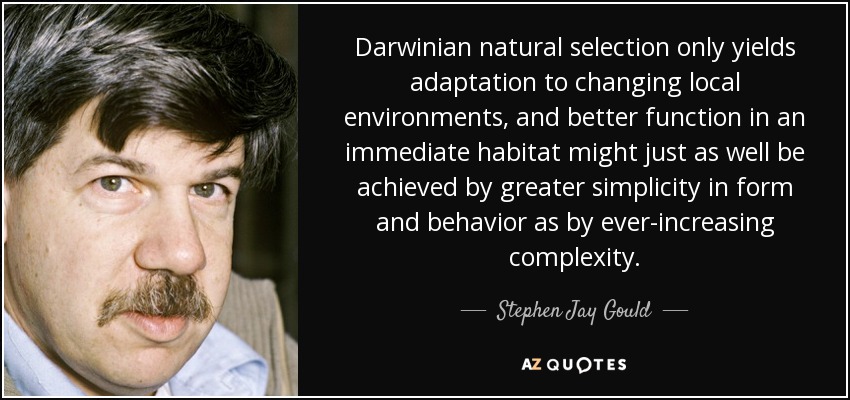
Darwinian natural selection only yields adaptation to changing local environments, and better function in an immediate habitat might just as well be achieved by greater simplicity in form and behavior as by ever-increasing complexity.
Natural selection is all about the differential success of rival DNA in getting itself transmitted vertically in the species archives.
As natural selection works solely by and for the good of each being, all corporeal and mental endowments will tend to progress toward perfection.
The underlying reason for convergence seems to be that all organisms are under constant scrutiny of natural selection and are also subject to the constraints of the physical and chemical factors that severely limit the action of all inhabitants of the biosphere. Put simply, convergence shows that in a real world not all things are possible.
Darwin's theory of evolution by natural selection is the only workable explanation that has ever been proposed for the remarkable fact of our own existence, indeed the existence of all life wherever it may turn up in the universe.
In one of my latest conversations with Darwin he expressed himself very gloomily on the future of humanity, on the ground that in our modern civilization natural selection had no play, and the fittest did not survive. Those who succeed in the race for wealth are by no means the best or the most intelligent, and it is notorious that our population is more largely renewed in each generation from the lower than from the middle and upper classes.
What had been released into the desert vacuum and starry oases of the galaxy was the inexorable logic of reproduction and natural selection. What followed was parasitism, predation, symbiosis, interdependency chaos, complexity, life.
The basic formulation, or bare-bones mechanics, of natural selection is a disarmingly simple argument, based on three undeniable facts (overproduction of offspring, variation, and heritability) and one syllogistic inference (natural selection, or the claim that organisms enjoying differential reproductive success will, on average, be those variants that are fortuitously better adapted to changing local environments, and that these variants will then pass their favored traits to offspring by inheritance).
As Stephen Jay Gould pointed out in Time, in no other Western country is the teaching of Evolution regarded as controversial. Throughout the world, one way or another, most Christian denominations have managed to reconcile belief in God with belief in the mechanisms of natural selection. A French or German or Scandinavian politician who called for students to entertain as a reasonable deduction from existing evidence the proposition that Earth is at most 10,000 years old would be bundled off to a mental hospital.
If I were to give a prize for the single best idea anybody ever had, I'd give it to Darwin for the idea of natural selection - ahead of Newton, ahead of Einstein - because his idea unites the two most disparate features of our universe: the world of purposeless, meaningless matter and motion, particles jostling on the one side, and the world of meaning and purpose, design on the other.
The traditional view of purpose says it comes from on high, from God, from the Creator. Darwin's idea of natural selection makes people uncomfortable because it reverses the direction of tradition. Whereas people used to think of meaning coming from on high and being ordained from the top down, now we have Darwin saying, "No, all of this design can happen, all of this purpose can emerge from the bottom up without any direction at all."
After Darwin, God's role changes from being the designer of all creatures great and small to being the designer of the laws of nature, from which natural selection can unfold, to being perhaps just the chooser of the laws. By the time God's role has been so diminished, he becomes a bit like a constitutional monarch, presiding ceremonially but not having any more work to do. That's a place for God if it makes people comfortable to keep God as the presider over the universe. I suppose that is satisfying for many.
You put three facts together - that all organisms produce more offspring that can survive, that there's variation among organisms, and that at least some of that variation is inherited - and the syllogistic inference is natural selection.
Natural selection is just three factors - over-production, variation, and inheritance combined to produce adaptation to changing local environments. It's not a principle or progress; it's just a principle of local adaptation. You don't make better creatures in any cosmic sense; you make creatures that are better suited to the changing climates of their local habitats.
Natural selection saw to it that professional heroes who at a crucial moment tended to ask themselves questions like 'What is my purpose in life?' very quickly lacked both.
Natural selection based on the differential multiplication of variant types cannot exist before there is material capable of replicating itself and its own variations, that is, before the origination of specifically genetic material or gene-material.
The growth of our knowledge is the result of a process closely resembling what Darwin called 'natural selection'; that is, the natural selection of hypotheses: our knowledge consists, at every moment, of those hypotheses which have shown their (comparative) fitness by surviving so far in their struggle for existence, a competitive struggle which eliminates those hypotheses which are unfit.
We should learn to understand natural selection, so that we can oppose any tendency to apply it to human politics.
That there is much suffering in the world no one disputes. Which is more likely, that pain and evil are the result of an all-powerful and good God, or the product of uncaring natural forces? The presence of much suffering agrees well with the view that all organic beings have been developed through variation and natural selection.
In fact, nothing in science as a whole has been more firmly established by interwoven factual information, or more illuminating than the universal occurrence of biological evolution. Further, few natural processes have been more convincingly explained than evolution by the theory of natural selection, or as it has been popularly called, Darwinism.
The new advocates of ID [Intelligent Design] ask that their ideas be judged by scientific, not religious, criteria. OK, let's see how well ID stacks up as a scientific alternative to Darwinism. To gauge how well ID is doing as a platform for scientific research, I logged into the best database of the biological literature. A search for keyword ''evolution'' yielded 24,000 hits in the last decade. A search for ''intelligent design'' yielded not a single piece of research. Evolution by natural selection remains the basis of every successful biological research program.
You can be a thorough-going Neo-Darwinian without imagination, metaphysics, poetry, conscience, or decency. For 'Natural Selection' has no moral significance: it deals with that part of evolution which has no purpose, no intelligence, and might more appropriately be called accidental selection, or better still, Unnatural Selection, since nothing is more unnatural than an accident. If it could be proved that the whole universe had been produced by such Selection, only fools and rascals could bear to live.
Natural selection is a theory of local adaptation to changing environments. It proposes no perfecting principles, no guarantee of general improvement
Natural selection, the blind, unconscious, automatic process which Darwin discovered, and which we now know is the explanation forthe existence and apparently purposeful form of all life, has no purpose in mind. It has no mind and no mind's eye. It does not plan for the future. It has no vision, no foresight, no sight at all. If it can be said to play the role of the watchmaker in nature, it is the blind watchmaker.
Alfred Russel Wallace, the codiscoverer of the theory of natural selection. Following their twin announcements of the theory in 1858, both Darwin and Wallace struggled like Laocoöns with the serpentine problem of human evolution and its encoiling difficulty of consciousness. But where Darwin clouded the problem with his own naivete, seeing only continuity in evolution, Wallace could not do so.
Follow AzQuotes on Facebook, Twitter and Google+. Every day we present the best quotes! Improve yourself, find your inspiration, share with friends
or simply: