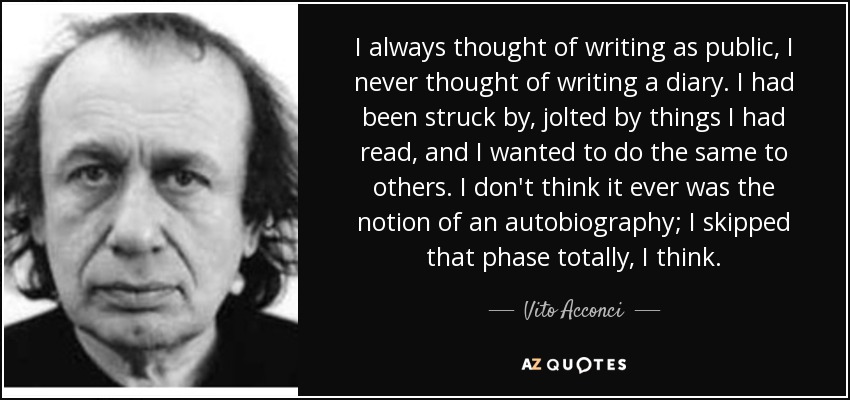
I always thought of writing as public, I never thought of writing a diary. I had been struck by, jolted by things I had read, and I wanted to do the same to others. I don't think it ever was the notion of an autobiography; I skipped that phase totally, I think.
If something's public then it seems like the important thing is the person in that public. And the notion of rhetoric. I went to Jesuit schools that focused on first there's grammar, then there's rhetoric, and rhetoric's usually seen as a kind of degraded method, because you're trying to persuade.
The scarcity trap captures this notion we see again and again in many domains. When people have very little, they undertake behaviors that maintain or reinforce their future disadvantage. If you have very little, you often behave in such a way so that youll have little in the future.
Quintilian [educational writer in Rome around A.D. 100] thought that the earliest years of the child's life were crucial. Education should start earlier than age seven, within the family. It should not be so hard as to give the child an aversion to learning. Rather, these early lessons would take the form of play--that embryonic notion of kindergarten.
I don't feel any great need to subscribe to a certain notion of Buddhism that says "You have to do this" or "You have to do that." Buddhism does not prescribe rituals or prohibitions in the way many religions do.
People have notions of what a wife's role should be in this process, and it's been a traditional one of blind adoration. My model is a little different - I think most real marriages are.
What I resist is techniques. I find techniques very problematic. So when critics talk about my work in those terms, I find that they miss the condition. I am comfortable with the notion of pattern and ornament as a system of organization, [but] for me it acts as a textile. So it's not about pattern, but the notion of architecture through the lens of textile, rather than architecture through the lens of brick and mortar.
My patriotism is of the kind which is outraged by the notion that the United States never was a great nation until in a petty three months' campaign it knocked to pieces a poor, decrepit, bankrupt old state like Spain. To hold such an opinion as that is to abandon all American standards, to put shame and scorn on all that our ancestors tried to build up here, and to go over to the standards of which Spain is a representative.
Americans have a strange notion that the ordinary laws of economics do not apply to them. So doubtless they will think they are prosperous if the boom starts, and that deficits and indebtedness are merely signs of how prosperous they are.
Philosophically, the notion of a beginning of the present order of Nature is repugnant to me ... I should like to find a genuine loophole.
The things a man believes most profoundly are rarely on the surface of his mind or tongue. Newly acquired notions, decisions based on expediency, the fashionable ideas of the moment are right on top of the pile, ready to be displayed in bright after dinner conversation. But the ideas that make up a man's philosophy of life are somewhere way down below.
What an absurd notion that women have not intellectual and moral faculties sufficent for anything else but domestic concerns!
It is a distortion of the notion of romantic love to want to see obedience as the quintessential expression of respect.
The notion that economic life is a distinct realm, governed by immutable laws of narrow self-interest, is giving way to a much older notion: economic life is only one strand in the rich web of human relationships.
When the modern movement began, starting perhaps with the paintings of Manet and the poetry of Baudelaire and Rimbaud, what distinguished the modern movement was the enormous honesty that writers, painters and playwrights displayed about themselves. The bourgeois novel flinches from such notions.
Art for the most part, is about concentration, solitude and determination. It's really not about other people's needs and assumptions. I'm not interested in the notion that art serves something. Art is useless, not useful.
I'm always uncomfortable with that notion of setting people up in order to kind of promote, you know, some sort of a face-off.
I actually don't subscribe to the notion that comedy is easier than drama. When you're trying to be funny and you're not funny, that's really terrible. It's a horrible feeling.
We shall have to share out the fruits of technology among the whole of mankind. The notion that the direct and immediate producers of the fruits of technology have a proprietary right to these fruits will have to be forgotten. After all, who is the producer? Man is a social animal, and the immediate producer has been helped to produce by the whole structure of society, beginning with his own education.
The whole notion that you can equalize opportunity in things that matter is utopian.
There is this persistent theme in all of these notions that death is made more easy, whatever that means, if you've learned the territory before you get there. And you know, in the Mahayana Buddhist situation it even becomes as extreme as saying; 'life is essentially a preparation for death, a studying of the maps of a learning of the skills a packing of your picnic basket so that when you get out there and demons are sniffing you up one side and down the other you don't bungle your mantras'.
And what we're looking toward is a moment when the artificial language structures which bind us within the notion of ourselves are dissolved in the presence of the realization that we are a part of nature. And when that happens, the childhood of our species will pass away, and we will stand tremulously on the brink of really the first moment of coherent human civilization.
On these matters of specific fact, like is the mushroom an extraterrestrial and that sort of thing, I haven't the faintest idea. The mushroom itself is such a mercurial, elusive, Zen sort of personality that I never believe a word it says. I simply entertain its notions and try and sort through them, and I found that to be the most enriching approach to it.
Think about this for a moment, we grow so inured to these religious forms, think about the notion of instituting at the center of your religion a rite where you eat your god is probably a memory of a relationship to some kind of a psychedelic experience of some sort.
I don't think you can help but personalize a role. You almost play to none of the preconceived notions of it. It's more or less a personal experience and journey.
Follow AzQuotes on Facebook, Twitter and Google+. Every day we present the best quotes! Improve yourself, find your inspiration, share with friends
or simply: