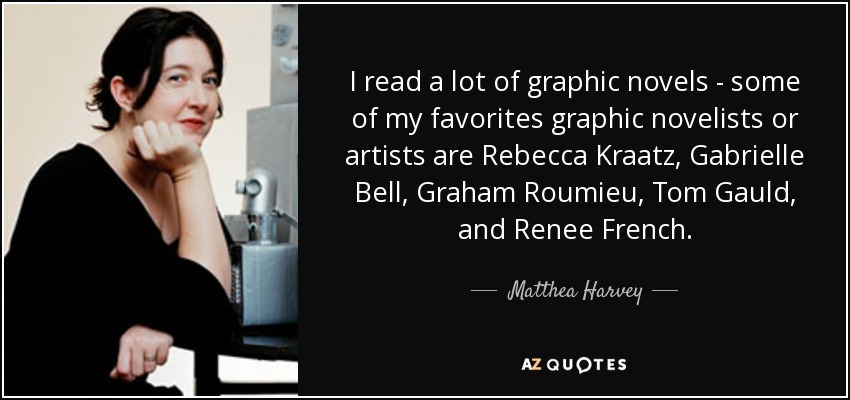
I read a lot of graphic novels - some of my favorites graphic novelists or artists are Rebecca Kraatz, Gabrielle Bell, Graham Roumieu, Tom Gauld, and Renee French.
I don't want to name names because they'd be mad at me if I did, but people who are significant novelists can't get published by real publishers at this point, or have to go through two years of trying after writing a novel that's taken them five or six years and simply can't get the thing in print. Or it gets in print and it doesn't get reviewed in the New York Times Book Review and disappears without a trace. I mean, it's terrifying. I don't know how anybody can stand it. It's such an enormous amount of work and the economics of it are really quite brutal.
Maybe someone's who's a different kind of writer [would think otherwise] - someone who'd be just as comfortable writing essays on what their novels are about. Sometimes you feel like certain novelists are like that.
The syndicates take the strip and sell it to newspapers and split the income with the cartoonists. Syndicates are essentially agents. Now, can you imagine a novelist giving his literary agent the ownership of his characters and all reprint, television, and movie rights before the agent takes the manuscript to a publisher? Obviously, an author would have to be a raving lunatic to agree to such a deal, but virtually every cartoonist does exactly that when a syndicate demands ownership before agreeing to sell the strip to newspapers.
Most established novelists are writing books informed by experiences gained in their youth. Middle age is not the best time to be changing smartphones every six months or adopting new technology platforms - because we tend to get slower and less accommodating to change as we age.
We're currently living with a generation of established novelists who are embarrassingly out of date with respect to social networking, internet skills, and so on.
Naturally a direct comparison of terrorist and novelist is complete nonsense. But there was once a time when the novelist also had some influence on how his contemporaries thought, the way they saw the world, the way they lived.
I think it's especially important for an editor to say what he's enjoying. For a novelist to be told, midstream, what he's doing right can actually influence the unwritten parts of a novel in a positive way - praise helps a writer know what's good about what he's written, what's interesting and exciting, and what to work for in writing the conclusion.
We are befouling and destroying our own home, we are committing a slow but accelerating race suicide and life murder - planetary biocide. Now there is a mighty theme for a mighty book but a challenge to which no modern novelist or poet has yet responded. Where is our Melville, our Milton, our Thomas Mann when we need him most?
Canada has one great novelist (Robertson Davies), which means it has one for every twenty-five million citizens - the world's highest ratio.
Snowden is almost preternaturally prepossessing and self-possessed. I think of a novelist whose dream character just walks into his or her head. It must have been like that with you and Snowden. But what if he'd been a graying guy with the same documents and far less intelligent things to say about them? In other words, how exactly did who he was make your movie and remake our world?
Every novelist should possess a hermaphroditic imagination.
I'm completely surrounded, not only my father, but also my three brothers, and Sergio, my husband, all four of them work in film. Some are writers, or directors, or cinematographers, all of them. I'm surrounded by men that make films, so much that at some point I felt there was no more room in the family for another filmmaker.For many years I was only working as novelist or writing screenplays for others to direct.
I always think the novelist should go to the culture's dark places and poke around. Pose a lot of hard questions.
I sometimes feel that my goal as a novelist would be to write a novel in which the language was so transparent that the reader would forget that language was the medium of understanding. Of course that's not possible, but it's some sort of idealized goal.
The professions of novelist and journalist are very separate. As a novelist, you are ultimately working for yourself. Yes, you need the approval of a publisher and an audience, but what is valued in fiction writing - style, individual voice, insight - is scorned by the editor who is combing through your newspaper article.
Novelists may be able to seek advice from readers and editors, but in the end, it is up to them to get the book right.
Radio is the medium that most closely approximates the experience of reading. As a novelist, I find it very exciting to be able to reach people who might not ever pick up one of my books, either because they can't afford it (as is often the case in Latin America), or because they just don't have the habit of reading novels.
Radio, or at least the kind of radio we're proposing to do, can cut through that. It can reach people who would otherwise never hear your work, and of course I find that very notion inspiring. Radio stories are powerful because the human voice is powerful. It has been and will continue to be the most basic element of storytelling. As a novelist (and I should note that working my novel is the first thing I do in the morning and the very last thing I do before I sleep), shifting into this new medium is entirely logical. It's still narrative, only with different tools.
I always have done work on mythic relations since I started writing. I really want to be a novelist, or at least a writer of imaginative work... I do try to make my critical studies imaginative and try to write them in ways that are more like literature than philosophy, but I have disappointed myself because I am still so wedded to criticism.
Teaching high school was my real training as a novelist: it got me out of my head, and (at least a little) out of books, and invested me in the lives of others and the world around me.
If you write a screenplay that gets circulated, you have a bigger readership than any literary novelist. And it's an educated audience as well.
The novelist loses, every time. Politics is insidious, the modern conduct of war (from shoulder-launched rockets to drone strikes) is insidious. Someone presses a button in California and twenty people are incinerated at a wedding in Pakistan. The killer is spared the sight of the corpses.
There are so many other people involved in the making of a play or a television series or whatever... even if you're a novelist there's so much in just the marketing of a book, or even the time... the zeitgeist, the moment at which it comes out. There's a lot you can't control.
I think it's the source material. 27 Dresses was a famous book, and Devil Wears Prada was also a wonderful book, so it's coming out of the novelists who are really creating these wonderful female characters that we want to see on the big screen.
Follow AzQuotes on Facebook, Twitter and Google+. Every day we present the best quotes! Improve yourself, find your inspiration, share with friends
or simply: