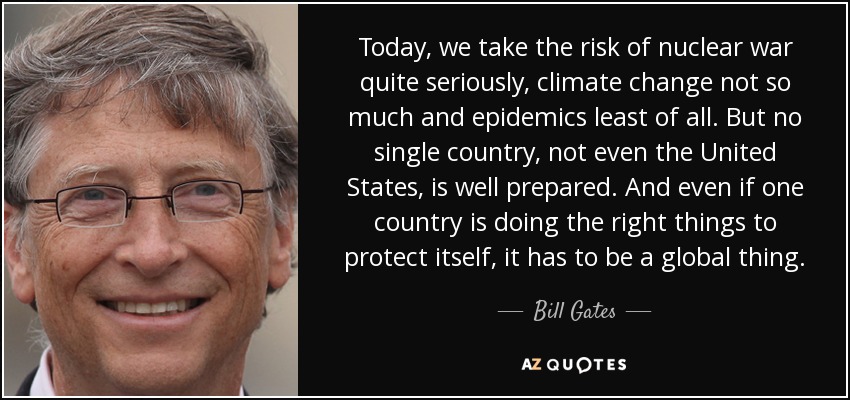
Today, we take the risk of nuclear war quite seriously, climate change not so much and epidemics least of all. But no single country, not even the United States, is well prepared. And even if one country is doing the right things to protect itself, it has to be a global thing.
We need to cooperate globally on epidemic preparedness and prevention in the same way we are cooperating globally to stop people from getting nuclear weapons.
The distance between a gene and a behavior is of greatest interest to me. The relative contributions of nature and nurture, of nucleotide and nuclear family, are perpetually fascinating to me.
Everybody says, "Well, if it's a democracy, let them have nuclear weapons." America is the only country that has ever used nuclear weapons. We're the only ones, this democracy, our great democracy.
I happen to love America. I love this freedom and democracy. The fact is we are the ones who killed innocent people, men, women and children, in Hiroshima and Nagasaki with nuclear weapons, weapons that should have never been used, should have never been developed in the first place, you know?
Nuclear weapons are inherently threatening to all of civilization. If that had been a nuclear weapon at the World Trade Center, even the most primitive kind of the Hiroshima, Nagasaki, you wouldn't have a Manhattan. There wouldn't be a democracy of any kind in America.
Remember that in any major nuclear war, the first strike destroys the country that attacks; it's been known for years. The first strike of a major power is very likely to cause what's called nuclear winter, leads to global famine for years and everything's basically gone. Some survivors straggling around. Could [Donald Trump] do it? Who knows.
Some of [Donald Trump] comments can be interpreted as potentially reducing the threat of nuclear war. The major threat right now is right on the Russian border. Notice, not the Mexican border, the Russian border. And it's serious. He has made various statements moving towards reducing the tensions, accommodating Russian concerns and so on.
On the other hand, you have to balance that against expanding our nuclear forces, add to our so-called depleted military, which is already more powerful than the rest of the world combined; attack in Syria, send forces to Syria, start bombing. Who knows what could be next?
Any incident could instantly blow up. Both sides [USA and Russia] are modernizing and increasing their military systems, including nuclear systems.
The [Ronald] Reagan administration picked up the rhetoric of the anti-nuclear movement; they said "Yyeah, you're right." We have to eliminate nuclear weapons.
That's a point that Dan Ellsberg has made for years. He said it's kind of like if you and I go into a grocery store to rob it, and I have a gun. The guy may give you the money in the cash register. I'm using the gun even if I don't shoot. Well that's nuclear weapons - essential to post-war deterrence - they cast a shadow over everything.
It's easy to put [serious threats] aside, and the media don't talk about them. Other things are more important. How am I going to put food on the table tomorrow? That's what I've got to worry about, and so on. It's very serious, but it's hard to bring out the enormity of these issues, when they do not have the dramatic character of something you can show in the movies, with a nuclear weapons falling and everything disappears.
The animosity between India and Pakistan is deeply unfortunate and dangerous, and it's something I've long campaigned to reduce. But right now, when there's artillery being exchanged in Kashmir - which is not for from here, either - and there are 100-ish nuclear weapons on each side of the border, there's never really been a case like this where two nuclear armed countries are happily shelling each other.
The Soviet Union was, by the 1970s and 1980s, relatively stable and predictable. Putin's Russia is much more volatile. Nuclear policy is really in the hands of one person, or a small group of people, instead of a huge party-state apparatus. The possibility of a mistake is greater now.
Donald Trump has the ability to renegotiate the Iran nuclear deal as he says, but if he were to do so, this would be regarded in Tehran as an abrogation of the deal. This would allow the Iranian side of the deal to in effect withdraw because they could say that the United States has not held up its end of the bargain, and therefore we're going to restart our nuclear program.
In 2009, pre-Hillary, ISIS was not even on the map, Libya was stable, Egypt was peaceful, Iraq was seeing really a big, big reduction in violence, Iran was being choked by sanctions, Syria was somewhat under control. After four years of Hillary Clinton, what do we have? ISIS has spread across the region and the entire world. Libya is in ruins and our ambassador and his staff were left helpless to die at the hands of savage killers. Egypt was turned over to the radical Muslim Brotherhood, forcing the military to retake control. Iraq is in chaos. Iran is on the path to nuclear weapons.
I happen to be a scientist. My background is in nuclear physics. I was a nuclear engineer. But I don't see any incompatibility at all with my religious faith and God the creator of everything and the incompatibility between when the earth was created as specified in the Bible. I don't see any incompatibility there because those that were interpreting God's overall message didn't know anything about modern-day science.
I know that a world in which countries are stockpiling nuclear weapons and using them in the ways that India and Pakistan and America do to oppress others and to deceive their own people is a dangerous world.
With one hand, you're selling the country out to Western multinationals. And with the other, you want to defend your borders with nuclear bombs. It's such an irony! You're saying that the world is a global village, but then you want to spend crores of rupees on building nuclear weapons.
What's a country? It's just an administrative unit, a glorified municipality. Why do we imbue it with esoteric meaning and protect it with nuclear bombs? I can't bow down to a municipality... it's just not intelligent. The bastards will do what they have to do, and we'll do what we have to do. Even if they annihilate us, we'll go down on the other side.
In our age of nuclear and biological weapons and the ever more efficient exploitation of nature, the mix of high technology and an ethos of domination could take us to an evolutionary dead end.
If you want to find weapons of destruction, you can find them all over the place. Take, say, Israel. There is a very great concern right now about proliferation of nuclear weapons, as there should be. Israel has a couple of hundred nuclear weapons and also chemical and biological weapons. This stockpile is not only a threat in itself but encourages others to proliferate in reaction and in self-defense. Is anybody saying anything about this?
Pakistan will never be able to match the Indian militarily and the effort to do so is taking an immense toll on the society. It's also extremely dangerous with all the weapons development. The two countries have already come close to nuclear confrontation twice and this could get worse. So dealing with the relationship with India is extremely important.
The Iranian issue I don't think has much to do with nuclear weapons frankly. Nobody is saying Iran should have nuclear weapons nor should anybody else. But the point in the Middle East, as distinct from North Korea, is that this is center of the world's energy resources. Originally the British and secondarily the French had dominated it, but after the Second World War, it's been a U.S. preserve. That's been an axiom of U.S. foreign policy, that it must control Middle East energy resources.
Follow AzQuotes on Facebook, Twitter and Google+. Every day we present the best quotes! Improve yourself, find your inspiration, share with friends
or simply: