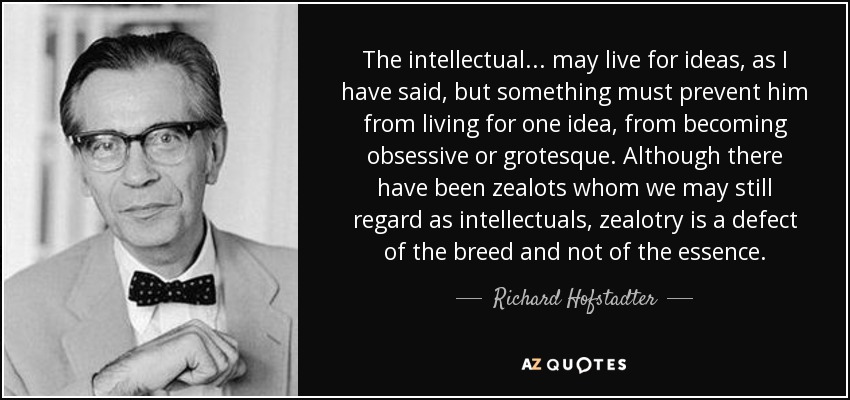
The intellectual ... may live for ideas, as I have said, but something must prevent him from living for one idea, from becoming obsessive or grotesque. Although there have been zealots whom we may still regard as intellectuals, zealotry is a defect of the breed and not of the essence.
I'm an anorak. I've always been an obsessive collector of things. Richard Briers collects stamps. I collect cars and guns, which are much more expensive, and much more difficult to store.
My mind has an obsessive, neurotic quality, but I also have a very hard work ethic. I know that a lot of people think, oh, you have a wild imagination. I don't, really. If ten people are sitting around and someone says, "Hey complete this sentence in a funny way," I'm never ahead of the pack.
I don't even know if Stephenie Meyer could tell you why she was so fixated on this very, very contained story [The Twilight] with obsessive characters. It's just an anomaly. That's a terrible answer. I don't know.
The ways in which acquired savants show up are usually the same ways that congenital, or non-acquired, savant syndrome shows up. They tend to show up in the same areas: music, art, math, visual, spatial skills, and calendar calculating, although calendar calculating probably isn't quite as prominent in that group. They tend to show up quite quickly, or sort of explode on the scene and they then tend to have an obsessive sort of forceful quality about them in the same way as savant skills. So they tend to show up in the same ways.
We often think that tragedies happen because of great earthquakes in people's lives. I think they sometimes occur because of small things that become obsessive to a particular person.
The obsessive documentation is itself adjacent to hyper-consumption in our society. The desire to just have everything all the time and adjacent to that is - it might be a little hokey but - a certain loss of identity that then only gets sort of found or ascribed to these moments that are documented. If so much of your experience is devoted to the thought of documentation, you're already sort of spinning out this narrative from this moment that you are attempting to control instead of just experiencing it.
Our mother always taught us to be in control of our voice and our bodies and our work, and she showed us that through her example. If she conjured up an idea, there was not one element of that idea that she was not going to have her hand in. She was not going to hand that over to someone. And I think it's been an interesting thing to navigate, especially watching you do the same in all aspects of your work: Society labels that a control freak, an obsessive woman, or someone who has an inability to trust her team or to empower other people to do the work, which is completely untrue.
Boulez's only concern is with power. He lost the leadership of the avant-guard more than ten years ago to Stockhausen. Now others have moved in. With the need for power, where was he to go? So he chose to be a conductor. He is a wonderful musician, a wonderful intelligence. It's a pity there is no humanity there. Does he have sex? I think not. When men have no sex, they go after power in this big, obsessive way.
I knew I was breaking about a dozen laws but I guess I had different attitudes to stuff like that since the war. Laws were for the stupid the immature the irresponsible. The inflexible and the narrow-minded. The prejudiced. The obsessive. The lazy and careless and selfish and spoilt. The violent.
Now people are celebrated for being obsessive.
I could not do what I do if I were not obsessive compulsive to a certain extent. I don't act clinically OCD. I'm not going to check things so many times I have to take drugs for it. But the kind of complicated and painstaking work I have to do to make my drawings, it just kind of harnesses that compulsive energy in a constructive way.
Once I get on something, once I have something that I'm working on, then I become very obsessive. In a good way. I mean,... is there a positive way to say obsessive? It's a good thing and if you're out there and you're working on something right now and you're crazed and you're up in the middle of the night, or you can't stop thinking about it, or you have to keep reading other things about the subject that you're working on or whatever. That's good and I think that's necessary creatively.
People always ask us women about how we balance our lives. Rarely do they ever ask men this but we are asked this and it makes a lot of sense - balance, right? It sounds right. And of course you do have to balance because otherwise you'd go crazy. And you do have to find ways of doing things in a sensible manner, raising children and all those choices. But then there's a part of creativity which is irrational and which is obsessive and then that's also part of what we do. So, I don't think that's a bad thing. I think that's part of what makes someone good.
I was pretty self-conscious about my body because everybody kept going on like, "Oh, she's so curvy!" and "She's a plus-size model!" and this and that. It's all people would talk about - how I'm not very skinny. For a while, it made me pretty upset and I got a bit obsessive about it. I did a bunch of dieting and exercising and everything. I was losing weight, but I was still much bigger than everybody else. I didn't really see the point of making myself crazy anymore, so I kind of toned it down a little bit.
When you're obsessive, like me, searching for something unattainable can become unhealthy ... it's like falling through the air and grabbing at the clouds.
I'm obsessive about the kind of melodrama of getting through the days and trying to make them good and funny and a happy experience. But my feeling towards the fans is that they delivered me from darkness.
When people are temperate in their behavior, in their lives, someone who is addictive or extreme or obsessive can't understand how people can just go through their lives in the middle, and people who are rational and balanced can't understand the opposite. I'm one who's in the extreme camp in almost every area of my life and I always have been. I've observed that I'm in a minority, but I never understand people who are measured.
I had a Tourette's period. And obsessive compulsive disorder. Things would get in my brain that I couldn't get out of my brain.
I suppose I could read more fiction, but I haven't moved in that direction. I'd like more time even though I spend six hours a day reading. People say their eyes get tired, but I've never experienced that. In college I used to read 10 hours a day. My wife says I'm obsessive compulsive. She might have a point because when I was an undergrad student we had the required reading list and the suggested reading list. I always read all the suggested reading too.
Collectors become obsessive and then addicted. You become addicted to art and you can't live without it.
I consume an enormous number of books, but they're always on a particular subject because I'm obsessive.
I had enormous self-image, problems and very low self-esteem, which I hid behind obsessive writing and performing. It's exactly what I do now except I enjoy it now. I'm not driven like I was in my twenties. I was driven to get through life very quickly.
I'm as obsessive with health as I was with destruction.
Dedication, absolute dedication, is what keeps one ahead. A sort of indomitable obsessive dedication and the realization that there is no end or limit to this because life is simply an ever-growing process, an ever-renewing process.
Follow AzQuotes on Facebook, Twitter and Google+. Every day we present the best quotes! Improve yourself, find your inspiration, share with friends
or simply: