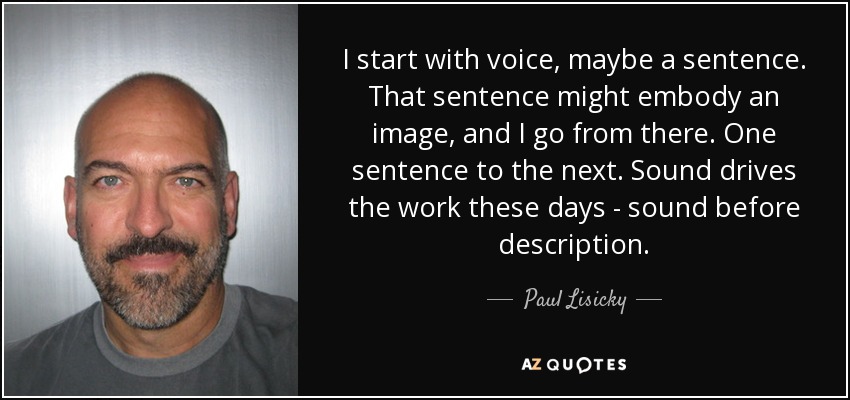
I start with voice, maybe a sentence. That sentence might embody an image, and I go from there. One sentence to the next. Sound drives the work these days - sound before description.
So, some of the most difficult formal poems that I've written, say one sentence sonnets, I've been able to do those fairly quickly whereas some of the clearest, simplest lyrics that I've written have taken me the longest to get to the clarity of feeling that you're looking for.
A lot of the letters that are coming in - a lot of them are queries or comments - are one sentence long... These are from Twitter. And if you look at the nature of those one sentence letters, most of the time it's something that came to somebody's mind - somebody walking down the street had a thought and sent it out. If they thought about it for two minutes they would not have sent it.
Actually learning ancient Greek was a brilliant practice of mine because you'd sit there and you'd read a sentence and sometimes it would take you a day, an entire day to figure out one sentence. But it really trains you to be analytical, to think in a certain way to try and interpret what something means. So I've been thinking like that my whole life and then I love Machiavelli and I love thinking about politics that way. So it's sort of all that put together and then the good luck to meet a man who is sort of interested in the same thing.
The words, "I have a dog named Winn-Dixie," popped into my head in the voice of a small girl with a southern accent. I'd been writing long enough at that point to know not to ignore that kind of red flag. The next day, I put aside what I'd been working on, started with that one sentence, and followed it all the way to the end.
I think you can tilt too far to the side of the story where the message is just simply entertainment. So I think your goal has to be to craft in one sentence what the truth is you are trying to convey. And then you find or create a story that you wrap around that truth.
When reviewers take the trouble to compliment a writer on her style, it is usually because she has made it easy for them to slide from one sentence to another like an otter down a slope.
When you have a full page of well-written dialogue that has a thought process to it, it is pretty easy to memorize. It's a lot easier to memorize than if you're in a scene and other people are talking, and you have maybe one word or one sentence that you have to interject at the right time and in a natural way.
I always do casting for every role, even if it's just one sentence. I like to work with theater actors because they're used to a process. I think filmmaking sometimes can become so stiff. Sometimes I have the feeling that people come together praying in the morning that, "Let's just shoot something, no matter what! Let's just finish this day, no matter what we will tape!"
I just wanted to speak to you about something from the Internal Revenue Code. It is the last sentence of section 509A of the code and it reads: 'For purposes of paragraph 3, an organization described in paragraph 2 shall be deemed to include an organization described in section 501C-4, 5, or 6, which would be described in paragraph 2 if it were an organization described in section 501C-3.' And that's just one sentence out of those fifty-seven feet of books.
Boiled down to one sentence, my message is the unboundedness of life and the unboundedness of human destiny.
All of us encounter, at least once in our life, some individual who utters words that make us think forever. There are men whose phrases are oracles; who condense in one sentence the secrets of life; who blurt out an aphorism that forms a character or illustrates an existence.
Education today, in this particular social period, is assuming truly unlimited importance. And the increased emphasis on its practical value can be summed up in one sentence: education is the best weapon for peace.
I feel it’s important to talk about the complex issues affecting us. And these are complex issues. I think it’s insulting to an audience to make them sit and watch a film and then give them a message in one sentence.
There may be thousands of principles of Marxism, but in the final analysis they can be summed up in one sentence: Rebellion is justified.
We put together a one-sentence petition asking Congress to censure President Clinton and move on to other pressing issues. We sent it to under 100 friends and family, and within a week we had 100,000 people sign the petition.
I started writing the one-sentence stories when I was translating 'Swann's Way.' There were two reasons. I had almost no time to do my own writing, but didn't want to stop. And it was a reaction to Proust's very long sentences.
If I were forced to sum up in one sentence what the Copenhagen interpretation says to me, it would be 'Shut up and calculate!'
Even one word, or certainly one sentence, should be able to describe the basic characteristic that the scene has, or the character has, or the story has. And then you begin to detail that one spine, and you have offshoots from that spine, and it becomes more and more complex, but all of it stems from that one-word, one-line theme, which can give the character, the scene, or the play its uniqueness.
Community is another such phenomenon. Like electricity, it is profoundly lawful. Yet there remains something about it that is inherently mysterious, miraculous, unfathomable. Thus there is no adequate one-sentence definition of genuine community. Community is something more than the sum of its parts, its individual members. What is this "something more?" Even to begin to answer that, we enter a realm that is not so much abstract as almost mystical. It is a realm where words are never fully suitable and language itself falls short.
Like all great theologies, Bill [O'Reilly]'s can be boiled down to one sentence: There must be a god, because I don't know how things work.
Religion can no longer rest its claims on a dogmatic supernaturalism, because any dogma that is irreconcilable with tested knowledge must be rejected... One sentence ... sums up the dark and deadly pages of Chistian history: "If we believe absurdities, we shall commit atrocities."
The word 'career' and 'actor' really don't fit in the same paragraph, let alone sentence. There is no career structure for actors.
What a labour writing is ... making one sentence do the work of a page; that's what I call hard work.
The most disheartening tendency common among readers is to tear out one sentence from a work, as a criterion of the writer's ideas or personality.
Follow AzQuotes on Facebook, Twitter and Google+. Every day we present the best quotes! Improve yourself, find your inspiration, share with friends
or simply: