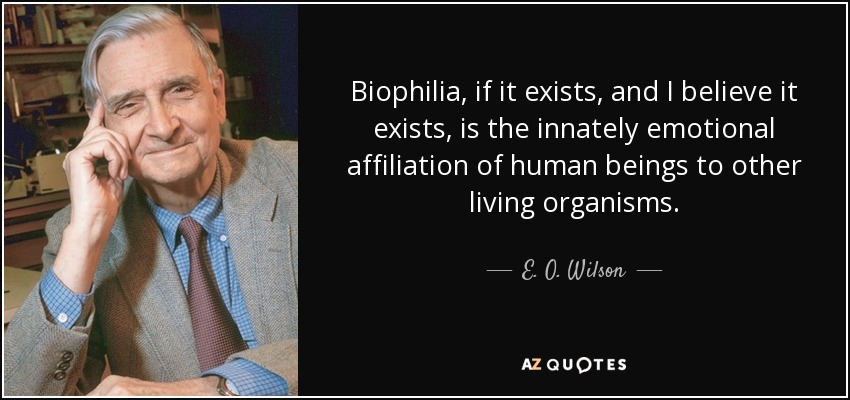
Biophilia, if it exists, and I believe it exists, is the innately emotional affiliation of human beings to other living organisms.
A disease is never a mere loss or excess. There is always a reaction on the part of the organism or individual to restore, replace or compensate for and to preserve its identity, however strange the means may be.
Four elements, Hydrogen, carbon, oxygen and nitrogen, also provide an example of the astonishing togetherness of our universe. They make up the "organic" molecules that constitute living organisms on a planet, and the nuclei of these same elements interact to generate the light of its star. Then the organisms on the planet come to depend wholly on that starlight, as they must if life is to persist. So it is that all life on the Earth runs on sunlight. [Referring to photosynthesis]
This root [the potato], no matter how much you prepare it, is tasteless and floury. It cannot pass for an agreeable food, but it supplies a food sufficiently abundant and sufficiently healthy for men who ask only to sustain themselves. The potato is criticized with reason for being windy, but what matters windiness for the vigorous organisms of peasants and laborers?
If an addict who has been completely cured starts smoking again he no longer experiences the discomfort of his first addiction. There exists, therefore, outside alkaloids and habit, a sense for opium, an intangible habit which lives on, despite the recasting of the organism. The dead drug leaves a ghost behind. At certain hours it haunts the house.
The morphological characteristics of plant and animal species form the chief subject of the descriptive natural sciences and are the criteria for their classification. But not until recently has it been recognized that in living organisms, as in the realm of crystals, chemical differences parallel the variation in structure.
Now, a living organism is nothing but a wonderful machine endowed with the most marvellous properties and set going by means of the most complex and delicate mechanism.
[A living organism] ... feeds upon negative entropy ... Thus the device by which an organism maintains itself stationary at a fairly high level of orderliness (= fairly low level of entropy) really consists in continually sucking orderliness from its environment.
Biologists have long attempted by chemical means to induce in higher organisms predictable and specific changes which thereafter could be transmitted in series as hereditary characters. Among microorganisms the most striking example of inheritable and specific alterations in cell structure and function that can be experimentally induced and are reproducible under well defined and adequately controlled conditions is the transformation of specific types of Pneumococcus.
We may consequently state the fundamental theorem of Natural Selection in the form: The rate of increase in fitness of any organism at any time is equal to its genetic variance in fitness at that time.
A sound Physics of the Earth should include all the primary considerations of the earth's atmosphere, of the characteristics and continual changes of the earth's external crust, and finally of the origin and development of living organisms. These considerations naturally divide the physics of the earth into three essential parts, the first being a theory of the atmosphere, or Meteorology, the second, a theory of the earth's external crust, or Hydrogeology, and the third, a theory of living organisms, or Biology.
To demonstrate experimentally that a microscopic organism actually is the cause of a disease and the agent of contagion, I know no other way, in the present state of Science, than to subject the microbe (the new and happy term introduced by M. Sédillot) to the method of cultivation out of the body.
If it is a terrifying thought that life is at the mercy of the multiplication of these minute bodies [microbes], it is a consoling hope that Science will not always remain powerless before such enemies.
All living organisms are but leaves on the same tree of life. The various functions of plants and animals and their specialized organs are manifestations of the same living matter. This adapts itself to different jobs and circumstances, but operates on the same basic principles. Muscle contraction is only one of these adaptations. In principle it would not matter whether we studied nerve, kidney or muscle to understand the basic principles of life. In practice, however, it matters a great deal.
Every creature alive on the earth today represents an unbroken line of life that stretches back to the first primitive organism to appear on this planet; and that is about three billion years.
From all we have learnt about the structure of living matter, we must be prepared to find it working in a manner that cannot be reduced to the ordinary laws of physics. And that not on the ground that there is any 'new force' or what not, directing the behaviour of the single atoms within a living organism, but because the construction is different from anything we have yet tested in the physical laboratory.
The nucleic acids, as constituents of living organisms, are comparable In importance to proteins. There is evidence that they are Involved In the processes of cell division and growth, that they participate In the transmission of hereditary characters, and that they are important constituents of viruses. An understanding of the molecular structure of the nucleic acids should be of value In the effort to understand the fundamental phenomena of life.
Physical science enjoys the distinction of being the most fundamental of the experimental sciences, and its laws are obeyed universally, so far as is known, not merely by inanimate things, but also by living organisms, in their minutest parts, as single individuals, and also as whole communities. It results from this that, however complicated a series of phenomena may be and however many other sciences may enter into its complete presentation, the purely physical aspect, or the application of the known laws of matter and energy, can always be legitimately separated from the other aspects.
Darwin was one of our finest specimens. He did superbly what human beings are designed to do: manipulate social information to personal advantage. The information in question was the prevailing account of how human beings, and all organisms, came to exist; Darwin reshaped it in a way that radically raised his social status. When he died in 1882, his greatness was acclaimed in newspapers around the world, and he was buried in Westminster Abbey, not far from the body of Isaac Newton. Alpha-male territory.
Seen in retrospect, evolution as a whole doubtless had a general direction, from simple to complex, from dependence on to relative independence of the environment, to greater and greater autonomy of individuals, greater and greater development of sense organs and nervous systems conveying and processing information about the state of the organism's surroundings, and finally greater and greater consciousness. You can call this direction progress or by some other name.
Think of it : zillions and zillions of organisms running around, each under the hypnotic spell of a single truth, all these truths identical, and all logically incompatible with one another : 'My hereditary material is the most important material on earth; its survival justifies your frustration, pain, even death'. And you are one of those organisms, living your life in the thrall of a logical absurdity.
Neo-Darwinian language and conceptual structure itself ensures scientific failure: Major questions posed by zoologists cannot be answered from inside the neo-Darwinian straitjacket. Such questions include, for example, 'How do new structures arise in evolution?' 'Why, given so much environmental change, is stasis so prevalent in evolution as seen in the fossil record?' 'How did one group of organisms or set of macromolecules evolve from another?' The importance of these questions is not at issue; it is just that neo-Darwinians, restricted by their resuppositions, cannot answer them.
One has only to contemplate the magnitude of this task to concede that the spontaneous generation of a living organism is impossible. Yet here we are-as a result, I believe, of spontaneous generation.
Perhaps bacteria may tentatively be regarded as biochemical experiments; owing to their relatively small size and rapid growth, variations must arise much more frequently than in more differentiated forms of life, and they can in addition afford to occupy more precarious positions in natural economy than larger organisms with more exacting requirements.
A cell of a higher organism contains a thousand different substances, arranged in a complex system. This great organized system was not discovered by chemical or physical methods; they are inadequate to its refinement and delicacy and complexity.
Follow AzQuotes on Facebook, Twitter and Google+. Every day we present the best quotes! Improve yourself, find your inspiration, share with friends
or simply: