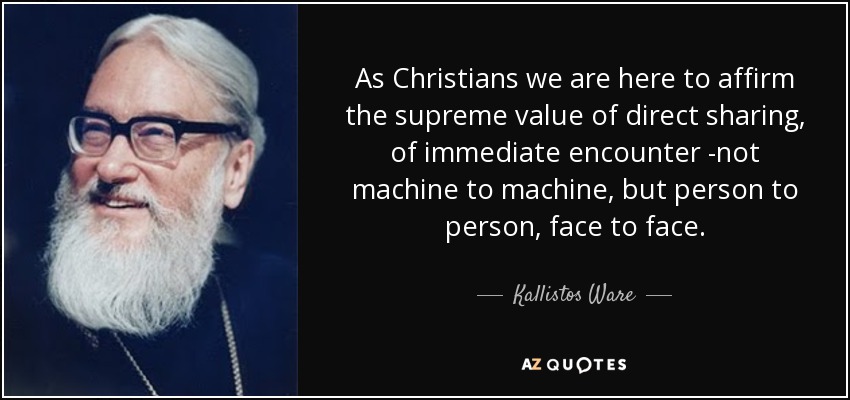
As Christians we are here to affirm the supreme value of direct sharing, of immediate encounter -not machine to machine, but person to person, face to face.
The Gates of Hell shall not prevail against it.
Every man possesses that which is according to the image of God, for the gifts of God are irrevocable (Rom. 11:29). But only a few ? those who are virtuous and holy, and have imitated the goodness of God to the limit of human powers ? possess that which is according to the likeness of God.
The Lord said: 'Without Me you can do nothing' (Jn. 15:5). So for the duration of our life, every day and at every moment, we must keep unchanged in our heart the feeling, conviction and disposition, that on no occasion can we allow ourselves to think of relying on ourselves and trusting ourselves.
...God will be 'all in all' (I Cor. 15:28) when we are no longer what we are now, a multiplicity of impulses and emotions, with little or nothing of God in us, but are fully like God , with room for God and God alone. This is the 'maturity' (cf. Col. 1:28) towards which we speed.
Keep the Feast of the Resurrection. Be a Peter or a John; hasten to the Sepulchre, running together, running against one another, vying in the noble race (cf. Jn. 20:3-4). And even if you be beaten in speed, win the victory of zeal; not looking into the tomb, but going in.
They have not understood that the Lord's Cross discloses the entire dispensation of His coming in the flesh, and contains within it the whole mystery of this dispensation. Extending in all directions, it embraces everything above, below, around and between.
Being bodiless, God is nowhere, but as God He is everywhere. If there were a mountain, a place or any part of Creation where God was not, then He would be found to be in some way circumscribed. So He is everywhere and in everything. In what way is this so? Is He contained not by each part but by the whole? No, because then that would be a body. He embraces and encompasses everything, and is Himself everywhere and also above everything, worshipped by true worshippers in His Spirit and Truth.
To Whom does our God say, 'in our image' (Gen. 1:26), to whom if it is not to Him who is 'the brightness of His glory and the express image of His Person' (Heb. 1:3), 'the image of the invisible God' (Col. 1:15)? It is then to His living image, to Him Who has said 'I and My Father are one' (Jn. 10:30), 'He who has seen Me has seen the Father' (Jn. 14:9), that God says, 'Let us make man in our image'.
He who is accustomed to give account of his life at confession here will not fear to give an answer at the terrible judgment-seat of Christ. It is for this purpose that the mild tribunal of penitence was here initiated, in order that we, being cleansed and amended through penitence here below, may give an answer without shame at the terrible judgment-seat of Christ.
No one seeing a beautifully elaborated lyre with its harmonious, orderly arrangement, and hearing the lyre's music will fail to form a notion of its craftsman-player, to recur to him in thought though ignorant of him by sight. In this way the creative power, which moves and safeguards its objects, is clear to us, though it be not grasped by the understanding. Anyone who refuses to progress this far in following instinctive proofs must be wanting in judgment. But still, whatever we imagined or figured to ourselves or reason delineated is not the reality of God.
All who have lived according to God still live unto God, though they have departed this life. For this reason, God is called the God of Abraham, Isaac and Jacob, since He is the God, not of the dead, but of the living
...the souls of the dead [are] not deprived of their intellectual faculties but... they also are not lacking in feelings such as hope and sadness, joy and fear. They already have a foretaste of what is in store for them after the general judgment. Nor does it happen, as some unbelievers would hold, that upon leaving this world they are turned to nothing. Actually they live more intensely and they concentrate more on the praises of God.
...night possessed us and the shadow of death encompassed us, for we had fallen into sin and lost the power of sight which was ours by God's grace and by which we were able to perceive the light that bestows true life. Night and death had been poured out on our human nature, not because of any change in the true light, but because we had turned aside and no longer had any inclination towards the life-bearing light. In the last times, however, the Giver of eternal light and Source of true life has had mercy upon us.
If the kingdom of God is within us and that is a kingdom of justice, of peace, and of joy then whoever remains with these virtues is certainly in the kingdom of God. By contrast, all who deal in unrighteousness, in discord, and in death-bearing gloom have taken their stand in the kingdom of the devil, in hell and in lifelessness. It is by these tokens that the kingdom of God or of the devil is recognized.
A Christian man is on his guard with respect to those who philosophize according to the elements of this world, not according to God, by Whom the world itself was made; for he is warned by the precept of the apostle and faithfully hears what has been said, 'Beware that no one deceive you through philosophy and vain deceit, according to the elements of the world'
Do you conceive of your Lord as less because? He shows that humiliation is the best road to exaltation (cf. Mt. 23:12); because He humbles Himself for the sake of the soul that is bent down to the ground, that He may even exalt within Himself that which is bent double under a weight of sin?... If so, you must blame the physician for stooping over suffering and putting up with evil smells in order to give health to the sick?
It is written, 'Be wise as serpents and innocent as doves' (Mt. 10:16). Being like serpents means not ignoring the attacks and wiles of the devil. Like is quickly shown to like. The simplicity of the dove denotes purity of action.
...the greatest thing each person can do is to give himself to God utterly and unconditionally - weaknesses, fears, and all. For God loves obedience more than good intentions or second-best offerings, which are all too often made under the guise of weakness.
Ascend, my brothers, ascend eagerly. Let your hearts' resolve be to climb. Listen to the voice of the one who says: 'Come, let us go up to the mountain of the Lord, to the house of our God' (Isa. 2:3), Who makes our feet to be like the feet of the deer, 'Who sets us on the high places, that we may be triumphant on His road' (Hab. 3:19).
It was not to save a nation that Abraham went to sacrifice Isaac, nor to appease angry gods... Then why does Abraham do it? For God's sake... He does it for the sake of God because God demands proof of his faith... He was not justified by being virtuous, but by being an individual submitted to God in faith.
...angels... are always being filled full of light, becoming ever more radiant and making blessed use of their natural ability to change. They dance for joy around the First Light, look continuously towards Him and are enlightened directly by Him, as they tirelessly sing the praises of the Fount of light and, being ministers of light, transmit illuminating grace to those lower beings who are being enlightened.
...though every thinking being longs for God, the First Cause, it is powerless... to grasp Him. Tired with the yearning it chafes at the bit and, careless of the cost, it tries a second tack. Either it looks at things visible and makes of these a god - a gross mistake, for what visible thing is more sublime, more godlike, than its observer... - or else it discovers God through the beauty and order of things seen, using sight as a guide to what transcends sight without losing God through the grandeur of what it sees.
... the more one needs God the more perfect he is. To need God is nothing to be ashamed of but is perfection itself. It is the saddest thing in the world if a human being goes through life without discovering that he needs God!
It is necessary for a Christian to fast, in order to clear his mind, to rouse and develop his feelings, and to stimulate his will to useful activity. These three human capabilities we darken and stifle above all by 'surfeiting, and drunkenness, and cares of this life' (Lk. 21:34).
Follow AzQuotes on Facebook, Twitter and Google+. Every day we present the best quotes! Improve yourself, find your inspiration, share with friends
or simply: