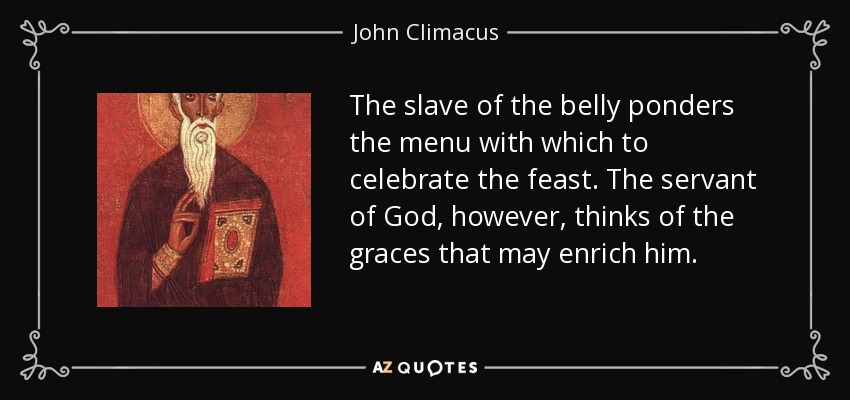
The slave of the belly ponders the menu with which to celebrate the feast. The servant of God, however, thinks of the graces that may enrich him.
God is inexhaustible in His gifts to men? Everywhere we see plenty and joy; only the greedy rich lay their hands on and keep in their treasuries too many of God's gifts, which might plentifully nourish hundreds and thousands of poor. Man! Believe firmly in God's inexhaustibility in His gifts, and willingly 'deal your bread to the hungry' (Isa. 58:7)?
... if a man prays God for some virtue, and at the same time gives himself up to negligence, acquiring no definite means to gain this virtue, and making no effort towards it, truly this man tempts God, rather than prays. Thus the divine James says: 'The effectual prayer of a righteous man avails much' (Jms. 5:16). What avails to make prayer effective? is when, besides begging a saint to pray for him about something, the man also prays about it himself and with all diligence does everything necessary for obtaining his request.
The fruits of the earth are not brought to perfection immediately, but by time, rain and care; similarly, the fruits of men ripen through ascetic practice, study, time, perseverance, self-control and patience.
The feelings which seek expression in words are mostly egotistical, since they seek to express what flatters our self-love and can show us, as we imagine, in the best light.
Every success in anything we should refer to the Lord and with the Prophet say: 'Not to us, O Lord, not to us, but to Your name give glory' (Ps. 113:9).
There is a single energy of God and the saints? they are living icons of Christ, being the same as He is, by grace rather than by assimilation.
For virtue is a light and buoyant thing, and all who live in her way fly like clouds as Isaiah says, and as doves with their young ones; but sin is a heavy affair, as another of the prophets says, sitting upon a talent of lead.
No just man suffices unto himself for the winning of justification. The divine mercy must always hold out a hand to his footsteps as they falter and almost stumble, and this is so because the weakness of his free will may cause him to lose balance, and if he falls he may perish forever.
It is like employing a small tool on big constructions, if we use human wisdom in the hunt for knowledge of reality.
Given that we desire long life, should we not take eternal life into account? If we long for a kingdom which, however enduring, has an end, and glory and joy which, great as they are, will fade, and wealth that will perish with this present life, and we labour for the sake of such things; ought we not to seek the kingdom, glory, joy and riches which, as well as being all-surpassing, are unfading and endless, and ought we not to endure a little constraint in order to inherit it?
When one has looked upon Jesus, though he be of little stature like Zacchaeus of old (cf. Lk. 19:3), and climb up on the top of the sycamore tree by mortifying his members which are upon the earth (cf. Col. 3:5), and having risen above the body of humiliation, then he shall receive the Word, and it shall be said to him, This day has salvation come to this house (cf. Lk. 19:9). Then let him lay hold on the salvation, and bring forth fruit more perfectly, scattering and pouring forth rightly that which as a publican he wrongly gathered.
We ask for what reason our Lord was unwilling to state the time of His coming (cf. Mk. 13:31-32). If we ask it, we shall not find it is owing to ignorance, but to wisdom. For it was not to our advantage to know; in order that we being ignorant of the actual moments of judgment to come, might ever be as it were on guard, and set on the watch-tower of virtue, and so avoid the habits of sin; lest the day of the Lord should come upon us in the midst of our wickedness.
'The long-suffering man abounds in understanding' (Prov. 14:29), because he endures everything to the end and, while awaiting that end, patiently bears his distress. The end, as St. Paul says, is everlasting life (cf. Rom. 6:22). 'And this is eternal life, that they might know You the only true God, and Jesus Christ whom You have sent' (Jn. 17:3).
The patient endurance of the saints exhausts the evil power that attacks them, since it makes them glory in sufferings undergone for the sake of the truth. It teaches those too much concerned with a life in the flesh to deepen themselves through such sufferings instead of pursuing ease and comfort; and it makes the flesh's natural weakness in the endurance of suffering a foundation for overwhelming spiritual power. For the natural weakness of the saints is precisely such a foundation, since the Lord has made their weakness stronger than the proud devil.
... for our sake loosing within Himself the bonds of bodily birth, He granted us through spiritual birth, according to our own volition, power to become children of God instead of children of flesh and blood if we have faith in His Name (cf. Jn. 1:12-13). For the Savior the sequence was, first of all, incarnation and bodily birth for my sake; and so thereupon the birth in the Spirit through baptism, originally spurned by Adam, for the sake of my salvation and restoration by grace, or, to describe it even more vividly, my very remaking.
He who is a beginner on the way must not be brought to practise the commandments by kindness alone, but must more often be induced to continue the struggle by being rigorously reminded of God's judgment. In this way he will not only be moved by love to desire what is divine, but will be moved by fear to avoid what is evil. For 'I will sing to Thee, O Lord, of mercy and judgment' (Ps. 101:1 LXX). He will sing to God charmed by love, and steeled by fear he will have strength for the song.
If we keep the path of virtue undefiled through devout and true knowledge, and do not deviate to either side, we will experience the advent of God revealed to us because of our dispassion. For 'I will sing a psalm and in a pure path I will understand when Thou wilt come to me' (cf. Ps. 101:1-2). The psalm stands for virtuous conduct; understanding indicates the spiritual knowledge, gained through virtue, by means of which we perceive God's advent, when we wait for the Lord vigilant in the virtues.
By His gracious condescension God became man and is called man for the sake of man and by exchanging His condition for ours revealed the power that elevates man to God through his love for God and brings God down to man because of His love for man. By this blessed inversion, man is made God by divinization and God is made man by hominization. For the Word of God and God wills always and in all things to accomplish the mystery of His embodiment.
In the mercy of God, the little thing done with humility will enable us to be found in the same place as the saints who have labored much and been true servants of God.
The name 'cherubim' means 'fullness of knowledge' or 'outpouring of wisdom'... The name cherubim signifies the power to know and to see God, to receive the greatest gifts of His light, to contemplate the divine splendor in primordial power, to be filled with the gifts that bring wisdom and to share these generously with subordinates as a part of the beneficent outpouring of His wisdom.
Before His visible advent in the flesh the Logos of God dwelt among the patriarchs and prophets in a spiritual manner, prefiguring the mysteries of His advent. After His incarnation He is present in a similar way not only to those who are still beginners, nourishing them spiritually and leading them toward the maturity of divine perfection, but also to the perfect, secretly pre-delineating in them the features of His future advent as if in an ikon.
It is not the self -critical who reveals his humility ( for does not everyone have some how to put up with himself? ). Rather, it is the man who continues to love the person who has criticized him.
He who has not yet attained divine knowledge energized by love is proud of his spiritual progress. But he who has been granted such knowledge repeats with deep conviction the words uttered by the patriarch Abraham when he was granted the manifestation of God: 'I am dust and ashes' (Gen. 18:27).
He who has realized love for God in his heart is tireless in his pursuit of the Lord his God, and bears every hardship, reproach and insult nobly, never thinking the least evil of anyone.
Follow AzQuotes on Facebook, Twitter and Google+. Every day we present the best quotes! Improve yourself, find your inspiration, share with friends
or simply: