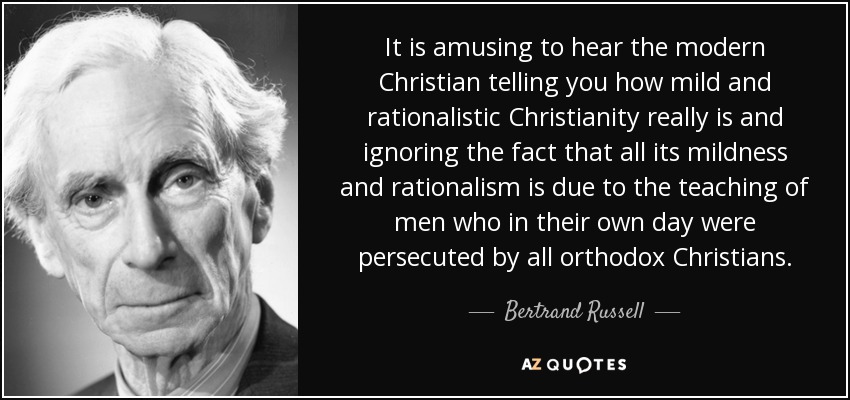
It is amusing to hear the modern Christian telling you how mild and rationalistic Christianity really is and ignoring the fact that all its mildness and rationalism is due to the teaching of men who in their own day were persecuted by all orthodox Christians.
I think that the influence towards suppression of minority views - towards orthodoxy in thinking about public issues - has been more subconscious than unconscious, stemming to a very great extent from the tendency of Americans to conform...not to deviate or depart from an orthodox point of view.
Judge not according to the orthodox standard of a system religious, philosophical, political, but according as things promote, or fail to promote the delicacy, integrity, and authority of Conscience.
When modernist poetry, or what not so long ago passed for modernist poetry, can reach the stage where the following piece by Mr. Ezra Pound is seriously offered as a poem, there is some justification for the plain reader and orthodox critic who shrinks from anything that may be labelled 'modernist' either in terms of condemnation or approbation. Better he thinks, that ten authentic poets should be left for posterity to discover than one charlatan should be allowed to steal into the Temple of Fame.
The greatest danger that threatens us is neither heterodox thought nor orthodox thought, but the absence of thought.
If one takes pleasure in calling the gold standard a "barbarous relic," one cannot object to the application of the same term to every historically determined institution. Then the fact that the British speak English - and not Danish, German, or French - is a barbarous relic too, and every Briton who opposes the substitution of Esperanto for English is no less dogmatic and orthodox than those who do not wax rapturous about the plans for a managed currency.
Self-pity is an ignoble emotion, but we all feel it, and the orthodox critical line that it represents some kind of artistic flaw is dubious, a form of emotional correctness.
I hate orthodox criticism. I don't mean great criticism, like that of Matthew Arnold and others, but the usual small niggling, fussy-mussy criticism, which thinks it can improve people by telling them where they are wrong, and results only in putting them in straitjackets of hesitancy and self-consciousness, and weazening all vision and bravery.
I have no fear of the Hereafter. An orthodox hell could hardly be more torture than my life has been.
It is in the nature of science that once a position becomes orthodox it should be suggested to criticism.... It does not follow that, because a position is orthodox, it is wrong.
According to the orthodox Christian's Bible, all religions do not lead to God.
The fundamental differences between Marxian and traditional orthodox economics are, first, that the orthodox economists accept the capitalist system as part of the eternal order of Nature, while Marx regards it as a passing phase in the transition from the feudal economy of the past to the socialist economy of the future.
The supernatural Christ of the New Testament, the god of orthodox Christianity, is dead. But priestcraft lives and conjures up the ghost of this dead god to frighten and enslave the masses of mankind. The name of Christ has caused more persecutions, wars, and miseries than any other name has caused. The darkest wrongs are still inspired by it. The wails of anguish that went up from Kishenev, Odessa, and Bialystok still vibrate in our ears.
Towards orthodox religion, father's own attitude remained one of tolerance. He looked upon the New Testament as the noble story of a human being which, because of ignorance and the lack of printing presses, had become exaggerated. He maintained that religions served their purpose; some people depended on them all their lives to make them honest. Others did not need to be so held in line. But subjection to any church was a reflection on strength and character. You should be able to get from yourself what you had to go go church for.
Agnostics are people who, like myself, confess themselves to be hopelessly ignorant concerning a variety of matters, about which metaphysicians and theologians, both orthodox and heterodox, dogmatize with the utmost confidence.
I'm not someone who can sing anything... And my favorite singers aren't people whose voice you would say is amazing. I'm a big Bob Dylan fan, a huge David Bowie fan... none of those people have orthodox, cabaret voices. These are people where what they're singing about is just as important as how they're singing it.
While we have the freedom to share our love for God with Him and His people in our own language, let's make sure that what we are writing about is orthodox and embraces the "whole counsel of Scripture."
Contemporary Christianity, diverse and complex as we find it, actually may show more unanimity than the Christian churches of the first and second centuries. For nearly all Christians since that time, Catholics, Protestants, or Orthodox, have shared three basic premises. First, they accept the canon of the New Testament; second, they confess the apostolic creed; and third, they affirm specific forms of church institution. But every one of these - the canon of Scripture, the creed, and the institutional structure - emerged in its present form only toward the end of the second century.
One of the main effects (I will not say purposes) of orthodox traditional economics was ... a plan for explaining to the privileged class that their position was morally right and was necessary for the welfare of society.
If a man has no worries about himself at all for the sake of love toward God and the working of good deeds, knowing that God is taking care of him, this is a true and wise hope. But if a man takes care of his own business and turns to God in prayer only when misfortunes come upon him which are beyond his power, and then he begins to hope in God, such a hope is vain and false. A true hope seeks only the Kingdom of God... the heart can have no peace until it obtains such a hope. This hope pacifies the heart and produces joy within it.
Do not say, "this happened by chance, while this came to be of itself." In all that exists there is nothing disorderly, nothing indefinite, nothing without purpose, nothing by chance ... How many hairs are on your head? God will not forget one of them. Do you see how nothing, even the smallest thing, escapes the gaze of God?
A man becomes spiritual insofar as he lives a spiritual life. He begins to see God in all things, to see His power and might in every manifestation. Always and everywhere he sees himself abiding in God and dependent on God for all things. But insofar as a man lives a bodily life, so much he does he do bodily things; He doesn't see God in anything, even in the the most wondrous manifestations of His Divine power. In all things he sees body, material, everywhere and always - "God is not before his eyes." (Ps. 35:2)
When the soul knows the love of God by the Holy Spirit, then he clearly feels that the Lord is our own Father, the closest, dearest Father, the best. And there is not greater happiness that to love God with all the mind and heart, and our neighbor as ourself. And when this love is in the soul, then all things bring joy to the soul.
Orthodox Christians have the habit of claiming all great men, all men who have held important positions, men of reputation, men of wealth. As soon as the funeral is over clergymen begin to relate imaginary conversations with the deceased, and in a very little while the great man is changed to a Christian - possibly to a saint.
Sin makes man a coward; but a life in the Truth of Christ makes Him bold.
Follow AzQuotes on Facebook, Twitter and Google+. Every day we present the best quotes! Improve yourself, find your inspiration, share with friends
or simply: