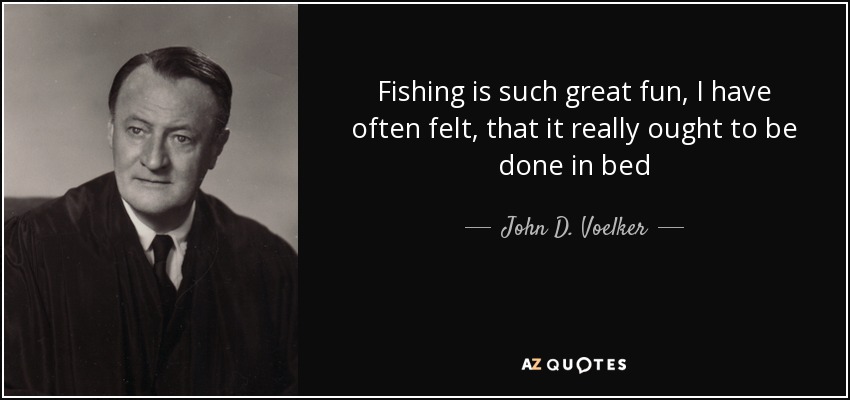
Fishing is such great fun, I have often felt, that it really ought to be done in bed
I simply feel that the frontier of angling is no longer either ethical or geographical. The Bible tells us to watch and listen. Something like this suggests what fishing ought to be about: using the ceremony of our sport and passion to arouse greater reverberations within ourselves.
As every writer has his use, every writer ought to have his patrons; and since no man, however high he may now stand, can be certain that he shall not be soon thrown down from his elevation by criticism or caprice, the common interest of learning requires that her sons should cease from intestine hostilities, and, instead of sacrificing each other to malice and contempt, endeavour to avert persecution from the meanest of their fraternity.
It ought to be the first endeavour of a writer to distinguish nature from custom; or that which is established because it is right, from that which is right only because it is established; that he may neither violate essential principles by a desire of novelty, nor debar himself from the attainment of beauties within his view, by a needless fear of breaking rules which no literary dictator had authority to enact.
Therefore those governing the State ought primarily to devote themselves to the service of individual groups and of the whole commonwealth, and through the entire scheme of laws and institutions to cause both public and individual well-being to develop spontaneously out of the very structure and administration of the state.
We ought to be very cautious and circumspect in the prosecution of magic and heresy. The attempt to put down these two crimes may be extremely perilous to liberty.
Monopolistic capitalism is to blame for this; it sunders the right to own property from responsibility that owning property involves. Those who own only a few stocks have no practical control of any industry. They vote by postcard proxy, but they have rarely even seen "their" company. The two elements which ought to be inextricably joined in any true conception of private property - ownership and responsibility - are separated. Those who own do not manage; those who manage; those who manage and work do not control or own.
It is accepted as an axiom by all Americans that the civil power ought to be not only neutral and impartial as between different forms of faith, but ought to leave these matters entirely on one side, regarding them no more than it regards the artistic or literary pursuits of the citizens.
It is wrong for a man to say that he is certain of the objective truth of any proposition unless he can produce evidence which logically justifies that certainty. This is what Agnosticism asserts; and, in my opinion, it is all that is essential to Agnosticism. That which Agnostics deny and repudiate, as immoral, is the contrary doctrine, that there are propositions which men ought to believe without logically satisfactory evidence; and that reprobation ought to attach to the profession of disbelief in such inadequately supported propositions.
They ought to create a new league for that guy.
Religious hatreds ought not to be propagated at all, but certainly not on a tax-exempt basis.
The liberty of conscience, which above all other things ought to be to all men dearest and most precious.
You need not value it yourself if you do not wish to; but you ought to allow it to us who do value it.
Nevertheless we have this curious spectacle: daily the trained parrot in the pulpit gravely delivers himself of these ironies, which he has acquired at second-hand and adopted without examination, to a trained congregation which accepts them without examination, and neither the speaker nor the hearer laughs at himself. It does seem as if we ought to be humble when we are at a bench-show, and not put on airs of intellectual superiority there.
I open the driving range and I close it. I thought you ought to know that I work hard. I like practising. I enjoy it. If I did not enjoy it I would not do it. What is the point of going back to the hotel, having a drink and talking a load of bull?
I think we can remember our past without valorizing parts of our past that we ought to see as wrong.
The whole of education should be designed so as to occupy a boy's free time in cultivation of his body. He has no right to loaf about idly; but after his day's work is done, he ought to harden his young body, so that life may not find him soft when he enters it. No one should be allowed to sin at the expense of posterity, that is, of the race.
Look to it that you do not try to do all of it, do not try to do too much, lest your spirit grow weary. Besides, a good prayer mustn't be too long. Do not draw it out. Prayer ought to be frequent and fervent.
What, then, do they want a government for? Not to regulate commerce; not to educate the people; not to teach religion, not to administer charity; not to make roads and railways; but simply to defend the natural rights of man -- to protect person and property -- to prevent the aggressions of the powerful upon the weak -- in a word, to administer justice. This is the natural, the original, office of a government. It was not intended to do less: it ought not to be allowed to do more.
Two things seemed pretty apparent to me. One was that in order to be a pilot a man had to learn more than any one man ought to learn; and the other was that he must learn it all over again in a different way every 24 hours.
Children ought to be led to honorable practices by means of encouragement and reasoning, and most certainly not by blows and ill treatment.
If you are capable of submitting to insult you ought to be insulted.
Now, to tell my story--if not as it ought to be told, at least as I can tell it,--I must go back sixteen years, to the days when Whitbury boasted of forty coaches per diem, instead of one railway, and set forth how in its southern suburb, there stood two pleasant house side by side, with their gardens sloping down to the Whit, and parted from each other only by the high brick fruit-wall, through which there used to be a door of communication; for the two occupiers were fast friends.
The man who is wantonly profuse of his promises ought to sink his credit as much as a tradesman would by uttering a great number of promissory notes payable at a distant day. The truest conclusion in both cases is, that neither intend or will be able to pay. And as the latter most probably intends to cheat you of your money, so the former at least designs to cheat you of your thanks.
An author ought to consider himself, not as a gentleman who gives a private or eleemosynary treat, but rather as one who keeps a public ordinary, at which all persons are welcome for their money.
Follow AzQuotes on Facebook, Twitter and Google+. Every day we present the best quotes! Improve yourself, find your inspiration, share with friends
or simply: