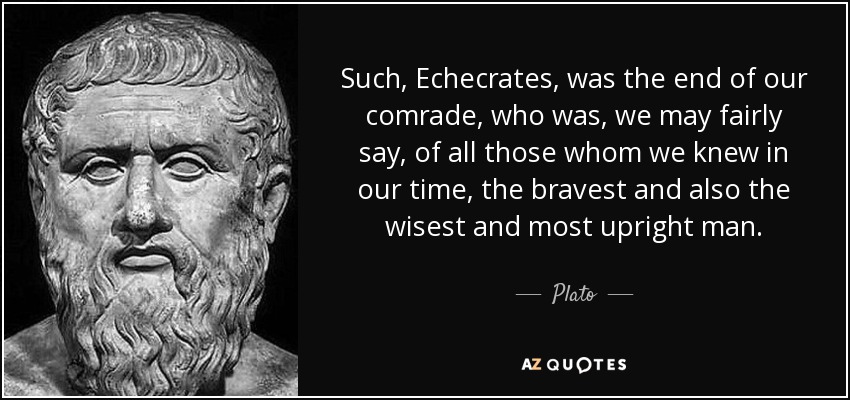
Such, Echecrates, was the end of our comrade, who was, we may fairly say, of all those whom we knew in our time, the bravest and also the wisest and most upright man.
We are here lounging our time away, doing nothing, and having nothing to do. It gives me great regret to be passing my time so uselessly when it could have been so importantly employed at home.
There has been in our time a lack of reliance on language and a lack of experimentation which are frightening to anyone who sees them as symptoms. We know the phenomenon of stage-fright: it holds the player shivering, incapable of speech or action. Perhaps there is an audience-fright which the play can feel, which leaves him with these incapacities.
The test is the sixty seconds of every minute, and the sixty minutes of every hour, not our times of prayer and devotional meetings.
The greater part of our best years has been passed for our generation in these two great worldconvulsions. All will be changed after this war, which spends in one month more than nations earned before in yearsthere is no more security in our time than in those of the Reformation or the fall of Rome.
Even in an advanced stage of civilization, there is always a tendency to prefer those parts of literature which favor ancient prejudices, rather than those which oppose them; and in cases where this tendency is very strong, the only effect of great learning will be to supply the materials which may corroborate old errors and confirm old superstitions. In our time such instances are not uncommon; and we frequently meet with men whose erudition ministers to their ignorance, and who, the more they read the less they know.
The laws of custom make our [returning a visit] necessary. O how I hate this vile custom which obliges us to make slaves of ourselves! to sell the most precious property we boast, our time;--and to sacrifice it to every prattling impertinent who chooses to demand it!
We will all, at some point in our lives, fall. Every single one of us. We shouldn't spend our time trying to avoid falling. We should spend it finding someone who will help us up!
Mathematics is the supreme nostalgia of our time.
The external appearance of any construction projects that are created during the time of the National Socialist Reich must take on the sensibility of our time. Factories are the workplaces of our National Socialist racial comrades. Streets and highways carry the name of the Führer. Settlements today are not isolated communities, but rather parts of greater city-construction plans. Every work site must be properly located within its neighborhood and surrounding setting (i.e., the natural world).
George Kennan and Paul Nitze were the Adams and Jefferson of the Cold War. They were there for the beginning, they witnessed its course over almost half a century, and they argued with each other constantly while it was going on. But they maintained throughout a remarkable friendship, demonstrating-as few others in our time have-that it is possible to differ with civility. Nicholas Thompson's is a fine account of that relationship, carefully researched, beautifully written, and evocatively suggestive of how much we have lost because such civility has become so rare.
the voluntary relinquishing of responsibility for our lives and our actions is one of the greatest enemies of our time.
The terrorism of the suicide bomber and the terrorism of aerial bombardment are indeed morally equivalent. To say otherwise (as either side might) is to give one moral superiority over the other, and thus serve to perpetuate the horrors of our time.
An unhurried mind brings the capacity to make wise choices every day - choices of how we use our time, of where we place our resources and our love. I am not just talking about avoiding the rat race, but about a life full of an artistic beauty - a life that has almost vanished from modern civilization, but is quite within the reach of everyone.
The majority of the books of our time give one the impression of having been manufactured in a day out of books read the day before.
Childhood is the one prison from which there's no escape, the one sentence from which there's no appeal. We all serve our time.
If our dreams could edit the news (and sometimes our nightmares) these poems are how they'd wake us up to the urgency of our times.
God, who is liberal in all his other gifts, shows us, by the wise economy of His providence, how circumspect we ought to be in the management of our time, for He never gives us two moments together.
There is nothing that we can properly call our own but our time, and yet everybody fools us out of it who has a mind to do it. If a man borrows a paltry sum of money, there must needs be bonds and securities, and every common civility is presently charged upon account. But he who has my time thinks he owes me nothing for it, though it be a debt that gratitude itself can never repay.
More than anything else, kindness is a way of life. It is a way of living and walking through life. It is a way of dealing with all that is-our selves, our bodies, our dreams and goals, our neighbors, our competitors, our enemies, our air, our earth, our animals, our space, our time, and our very consciousness. Do we treat all creation with kindness? Isn't all creation holy and divine?
The parent who loves his child dearly but asks for nothing in return might qualify as a saint, but he will not qualify as a parent. For a child who can claim love without meeting any of the obligations of love will be a self-centered child and many such children have grown up in our time to become petulant lovers and sullen marriage partners because the promise of unconditional love has not been fulfilled.
There is a close relationship between a house full of possessions and a heart full of desires, between a cluttered closet and a crowded schedule, between having no place to put possessions and having no priorities for our life. These are precious clues. They remind us to slow down, to live in the present, to reduce the desires that drain our vitality, to clarify priorities so we can give our time and attention to what matters most. Tragically, in the press of modern life, we have managed to get backwards one of life's most vital truths: people are to be loved; things are to be used.
We spend most of our time and energy in a kind of horizontal thinking. We move along the surface of things....but, there are times when we must stop. We sit still. We lose ourselves in a pile of leaves or in its memory. We listen, and breezes from a whole other world begin to whisper.
I consider Otto Rank to be one of the great spiritual giants of the twentieth century, a genius as a psychologist and a saint as a human being. Though vilified by his original community of Freudians, he never became bitter. He died a feminist and deeply committed to social justice, in 1939....His deep understanding of creativity makes him a mentor for all of us living in a postmodern world....I believe that Art and Artist, especially chapters 12 to 14, may well emerge as the most valuable psychoanalysis of the spiritual life in our time.
Canada is our country. It belongs to us and we belong to it. Let us join together, in our time, and make history once again.
Follow AzQuotes on Facebook, Twitter and Google+. Every day we present the best quotes! Improve yourself, find your inspiration, share with friends
or simply: