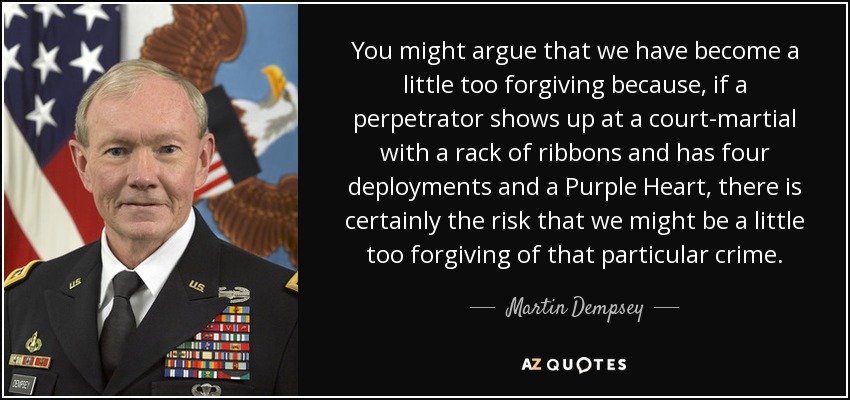
You might argue that we have become a little too forgiving because, if a perpetrator shows up at a court-martial with a rack of ribbons and has four deployments and a Purple Heart, there is certainly the risk that we might be a little too forgiving of that particular crime.
How often are the perpetrators of hate-crimes discovered to be self-loathing? Valued individuals do not strike out against strangers.
It is not possible to be truly balanced in one's views of an abuser and an abused woman. As Dr. Judith Herman explains eloquently in her masterwork Trauma and Recovery, “neutrality” actually serves the interests of the perpetrator much more than those of the victim and so is not neutral. Although an abuser prefers to have you wholeheartedly on his side, he will settle contentedly for your decision to take a middle stance. To him, that means you see the couple's problems as partly her fault and partly his fault, which means it isn't abuse.
There is no defence against an evil which only the victims and the perpetrators know exists.
Every American, to the last man, lays claim to a "sense" of humor and guards it as his most significant spiritual trait, yet rejects humor as a contaminating element wherever found. America is a nation of comics and comedians; nevertheless, humor has no stature and is accepted only after the death of the perpetrator.
When I talk of forgiveness I mean the belief that you can come out the other side ... a better person than the one being consumed by anger and hatred. Remaining in that state locks you in a state of victimhood, making you almost dependent on the perpetrator. If you can find it in yourself to forgive then you are no longer chained to the perpetrator. You can move on.
As the victim, you offer the gift of your forgiving to the perpetrator who may or may not appropriate the gift but it has been offered and thereby it liberates the victim.
Forgiving is a gift to the forgiver as well as to the perpetrator.
I come from a people who gave the Ten Commandments to the world. Time has come to strenghten them by three additional ones, which we ought to adopt and commit ourselves to: thou shall not be a perpetrator; thou shall not be a victim; and thou shall never, but never, be a bystander.
FAQ regarding my book were not about my use of commas or how the images went berserk, but about the political situation in Bosnia, about guilt and shame, about victims and perpetrators, about reasons, arguments and beliefs that led to the conflict in the first place, etc. All of this needed and still needs answering and ongoing discussions, but I mostly felt overwhelmed and unqualified to articulate anything worth more than personal experiences of the siege, of fear and refuge - all the things which I wrote about anyway.
I’m Armenian, and April 24th was another commemoration of the genocide of Armenia people by Turkey. The perpetrator never admitted the crime. I was raised with that, this question: how do you actually find the truth of such a traumatic event? I'm obsessed with that issue.
Let's not hate ourselves. We are all we have. We cannot change anything until we accept that. I cannot do this alone. I don't love myself enough to do it alone, but I can do it if we have a pact, if I am keeping up my end of the bargain. I have been a longtime perpetrator of hate crimes against myself, and I am turning myself in. I have had enough.
I think the first step is to understand that forgiveness does not exonerate the perpetrator. Forgiveness liberates the victim. It's a gift you give yourself.
I'm the strongest advocate you can imagine for doing things honestly and paying your taxes. Take advantage of every tax break you're legally entitled to. But I follow the letter of the law, because the consequences are severe if you're caught. I was a perpetrator at one time and suffered severe consequences. It is difficult in some places, but if you live in places like California, move somewhere else to save some money.
Let's say someone has experienced a violent trauma or betrayal: a child has been raped by a parent or has witnessed the destruction of someone he loves or has been so traumatized by the possibility of beatings and punishments that he's afraid to act. If the trauma is great enough, that person's life may become frozen, emotionally frozen even though he still gets up in the morning, is busy all day, and goes to bed at night. But there's this empty space that begins to fill with rage, rage toward everyone - the perpetrator, the people in the world who haven't suffered, even toward himself. (174)
Trapped on a planet of pain and perpetrators That you call 'Earth,' but I call 'Hell's Equator.'
No other work has more often been blamed for more heinous crimes by the perpetrators of such crimes. The Bible has been named as the instigating or justifying factor for many individual and mass crimes, ranging from the religious wars, inquisitions, witch burnings, and pogroms of earlier eras to systematic child abuse and ritual murders today.
If forgiving depended on the culprit owning up, then the victim would always be at the mercy of the perpetrator. The victim would be bound in the shackles of victimhood.
Defining men as the perpetrators of all violence is a viciously immoral judgment of an entire gender. And defining women as inherently nonviolent condemns us to the equally restrictive role of sweet, meek, and weak.
Abuse is always wrong. Some try to excuse it. Most perpetrators have a sense of entitlement, thinking their actions are justified. Ironically, their victims may also believe they deserve to be mistreated. Some will even defend their abuser, citing his or her earnest apologies afterward. But abuse in any form, for any reason, wounds both spouses. It's always sinful, and few things destroy trust in a marriage as quickly. Regardless of childhood pain or marital conflict, mature spouses learn to set limits so anger doesn't become abuse by frequency, degree, or duration.
Once the pain-body has taken you over, you want more pain. You become a victim or a perpetrator. You want to inflict pain, or you want to suffer pain, or both. There isn't really much difference between the two. You are not conscious of this, of course, and will vehemently claim that you do not want pain. But look closely and you will find that your thinking and behavior are designed to keep the pain going, for yourself and others. If you were truly conscious of it, the pattern would dissolve, for to want more pain is insanity, and nobody is consciously insane.
Theology reminded me that, however diabolical the act, it did not turn the perpetrator into a demon. We had to distinguish between the deed and the perpetrator, between the sinner and the sin, to hate and condemn the sin while being filled with compassion for the sinner.
Forgiveness is possible even when there is no restitution, no remorse on the part of the perpetrator.
I think I wanted to write a book about the relationship between the victim and perpetrator in which the victim agrees to remain silent.
Today, we come together to confess our need of God. Those perpetrators who took us on to tear us apart, it has worked the other way. It has backfired; it has brought us together.
Follow AzQuotes on Facebook, Twitter and Google+. Every day we present the best quotes! Improve yourself, find your inspiration, share with friends
or simply: