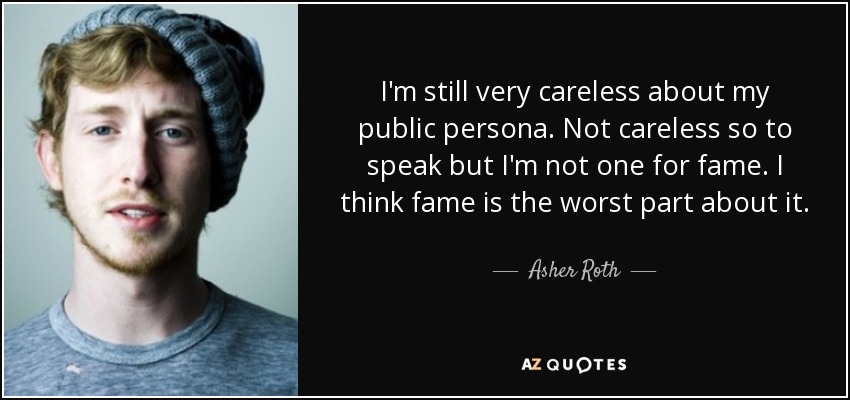
I'm still very careless about my public persona. Not careless so to speak but I'm not one for fame. I think fame is the worst part about it.
I think it's basically the same game, although with a public figure like [Donald] Trump I think you are bound to consider the public persona rather than the private one. At least that was the case with that piece of writing.
From Marilyn Monroe and beyond, that's a huge part of Hollywood, creating a persona that's mysterious and fairly simple, though it's interesting how that's changing: Now, you have fans who are like, "Um, yeah, I just emailed with Barack Obama and tweeted with Lady Gaga, so I'm kinda right there with you; give it to me."
You just want to love Tim Matheson and just cuddle him. He's really - and he's gorgeous. He has much in common with [Ronald Reagan] Reagan's outward persona.
[Bob Dylan] is a preacher but also a sinner; a poet but also a pitchman; authentic all-American but also invented persona.
There's the shared imagery between hip-hop and comics, with some producers and emcees taking on super hero personas.
[ Woody Allen] persona in the films are so iconic; it's like on par with Groucho Marx or something like that.
When you sing, you put on a persona. I hide behind that person on stage. You can feel like death, but you have to put it on. The audience wants to see someone smiley.
Everything I learned and didn't do in New York I would put into place here in the London West Hollywood. It's fascinating, when you look at the critics' reviews, and we had a great one in the New York Observer and all that, and then the New York Times came and it was a devastation; two stars out of four. They said that I played safe because it wasn't fireworks. Then they judged the persona over the substance that was on the plate.
The people who know the sort of personality or persona that I give across more on Twitter just realize that I'm just being messy and I'm just snatching wigs.
I'm persona non grata at the New Yorker.
My standup persona is like I'll heighten things, but I'm observing the world as it is in sort of a heightened emotional state.
I've learned that it's harder to try to put on this goody two-shoes persona when that's not me.
There's just something about me and my persona that's a little bit bigger than life and ridiculous at times.
I'm not like a persona. I'm not a caricature of myself.
We're being asked to continually be "authentic" and "honest" with the world through social media. There's a demand to post our wedding pictures, baby pictures (only minutes after the birth), our relationship status, and our grief and joys on Facebook and Instagram. Similarly, we construct persona through dating apps and networking sites. All of these social media networks exert pressure on us to share the personal details of our lives with unknown masses. So the pressure on the characters in "Openness" isn't merely romantic, but public/social as well.
I think I created my particular stage persona out of my dad's life. And perhaps I even built it to suit him to some degree. I was looking for - when I was looking for a voice to mix with my voice, I put on my father's work clothes, as I say in the book, and I went to work.
That was actually Lloyd Phillips who was a Kiwi film producer in L.A. And it was about Gorgeous George, not Haystacks Calhoun. I was in a couple of Lloyd's films and got approached to write the story. People don't realize it, but Gorgeous George had this flamboyant, camp stage persona that had a tremendous influence on other celebrities, like Elton John, Liberace, Elvis Presley, and Mohammed Ali, who all wanted to establish their own outlandish stage personas. The project died because Gorgeous George's wife refused to give up the rights.
There's such a grace and understanding in the female persona when women have really come into their own. Part of that is to have children, and to be caring for those children, and not only in the care for them, but also in the nurturing and raising of them, they have to pass on their souls and their intelligence. And all those things can't be taught. It's something that, that in the essence of a woman, the essence of a mother, a mother knows!
When I'm writing, especially when I'm writing in first person, I don't think about the characterization, or how they are going to express themselves, I just express my own approach to these things. I think most writers can never divorce themselves from their private lives and personas; they are the ones that are writing. And the more they remove themselves from their own persona, the more, perhaps, mechanical the work becomes.
When I used to teach writing, what I would tell my playwriting students is that while you're writing your plays, you're also writing the playwright. You're developing yourself as a persona, as a public persona. It's going to be partly exposed through the writing itself and partly created by all the paraphernalia that attaches itself to writing. But you aren't simply an invisible being or your own private being at work. You're kind of a public figure, as well.
I don't think you can separate a person's "style" and his persona. If you're writing or improvising honestly, you will inevitably reflect who you are.
It doesn't really even bother me about popularity. I live a spiritual life. I don't live a carnal life. If I was seeking to be big, I would do anything. I would go out there and do something crazy, be flashy, be a showboat, but that's not within my persona. If I did something like that, I would be a hypocrite because that's not part of who I am.
Trump provides a more direct and arrogant persona that produces the ugliness of a society ruled entirely by finance capital and savage market values, one that prides itself on the denigration of others as well as of justice, passion, and equality.
An artist is generally expected to stick to one motif, one persona. People get used to seeing someone put down a certain thing.
Follow AzQuotes on Facebook, Twitter and Google+. Every day we present the best quotes! Improve yourself, find your inspiration, share with friends
or simply: