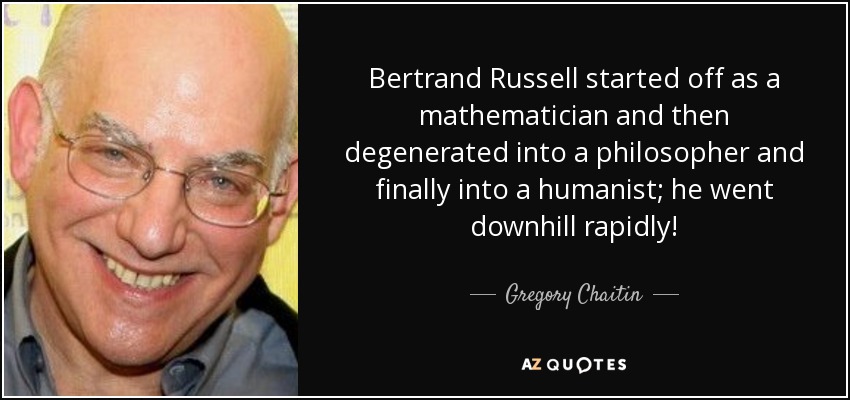
Bertrand Russell started off as a mathematician and then degenerated into a philosopher and finally into a humanist; he went downhill rapidly!
Alas, Islam turned against science in the twelfth century. The most influential figure was the philosopher Abu Hamid al-Ghazzali, who argued in The Incoherence of the Philosophers against the very idea of laws of nature, on the ground that any such laws would put God's hands in chains. According to al-Ghazzali, a piece of cotton placed in a flame does not darken and smoulder because of the heat, but because God wants it to darken and smoulder. After al-Ghazzali, there was no more science worth mentioning in Islamic countries.
The visible world was only an imperfect reflection of the Ideal, which the Philosopher sought to transcend.
A lot of our fellow liberals ... seem to me rather to doom themselves to futility in public affairs because the won't recognize that there's a zone of natural affection midway between the inner, or family one, and the outer, or all-humanity one. I suppose they are somehow short of a zone themselves and they seem to get vexed... The common man knows better, just as he'd know better if some philosopher told him he ought not to make invidious distinctions by feeding his own children in preference to others. But of course he can't explain; he just ... goes on feeding the kids.
I started asking the big questions that I had asked in college, that my compatriots the Greek philosophers had asked, like 'what is a good life?' Socrates famously said that 'The unexamined life is not worth living.' I started asking these questions from the starting point of 'what is success?'
There are certainly times in history where power associates itself closely with fields that we would call the humanities, like rulers surrounding themselves with philosophers and poets, or playwrights. We do not live in that moment, and the best way to gauge the proximity of an academic field to power is by salary.
Because the Western civilization is dominated by dualistic thinking, holistic scientists and philosophers don't get the recognition they deserve.
Most influential of all is the philosopher Stanley Cavell, and a younger generation of philosophers who have attempted to follow his pioneering work in thinking about literature philosophically.
As a kid you learn that there are thinkers and there are philosophers and there are theologian, and I'd hear little bits of the ideas that these people pursued or developed or created and I'd be really excited. Then I'll start to read it and I think, "Wait a minute, this is a rabbit hole. This isn't a gateway or a ticket to anything except itself."
Religious life is about something real in human experience that is not constrained by what Wittgenstein called 'all that is the case'. In this sense Heidegger is not simply 'mistaken' - he just asks us, as philosophers mostly do, to think more carefully about what we're saying.
But why should a religious person be interested in a work like Heidegger's that many regard as the epitome of nihilism? For a start, because Heidegger forces us in a way that few philosophers do to really think through the seriousness and all-encompassing nature of our mortality.
It's strange that in an age when we pride ourselves on our independence of thought we meekly submit without further question to the declaration of a clearly unbalanced nineteenth century philosopher that God is dead! That's cheeky, of course - and one rarely comes away from reading Nietzsche without learning something new and significant. He's certainly FAR more unsettling for faith than any contemporary atheist I know of.
So even these stages of progression, whether it's your career or whatever, you get somewhere, but then it always brings a new host of issues that are relative dissatisfactions to a certain degree. I think it was a great philosopher who once said, "Mo' money, mo' problems."
I had no idea what philosophy was until I went to college at UBC. I first read Hume and Plato, so naturally I was under the misapprehension that philosophers are trying to figure out what is true, and that contemporary philosophers are mainly trying to figure out what is true about the mind. Of course Hume and Plato were trying to do that, hence my misapprehension.
Eventually I realized that for contemporary philosophers conceptual analysis per se was an end in itself. For some, it was somehow supposed to lead to the truth about these phenomena, not just to tidy things up a bit.
Analyzing a concept can (perhaps) tell you what the concept means (at least means to some philosophers), but it does not tell you anything about whether the concept is true of anything in the world.
Many philosophers in the second half of the 20th century really seemed to think that they were laying the foundations for science by laying down the conceptual (necessary) truths.
My first degree was in mathematics. That was great, but it didn't help with many of the things that puzzled me. I became a philosopher because I wanted to understand everything, especially those things that didn't make sense. And that has continued to be my philosophical motivation. That's one reason I have such a roving philosophical eye - once I have figured out a philosophical topic to my satisfaction, I find myself moving on to new problems.
A century ago mainstream science was still quite happy to countenance vital and mental powers which had a 'downwards' causal influence on the physical realm in a straightforwardly interactionist way. It was only in the middle of the last century that science finally concluded that there are no such non-physical forces. At which point a whole pile of smart philosophers (Feigl, Smart, Putnam, Davidson, Lewis) quickly pointed out that mental, biological and social phenomena must themselves be physical, in order to produce the physical effects that they do.
Schiller is an important philosopher because he shows just how integral the idea of beauty is in normal life.
Of course, there remains the question of why we should find mind-brain identities so persistently counter-intuitive, if they are true. But this is a simple psychological question, and there are a number of plausible explanations. Indeed this is a topic that is quite extensively discussed outside philosophy, by developmental psychologists and theorists of religion among others, under the heading of 'intuitive dualism'. It is rather shocking that so few of the many philosophers working on 'the explanatory gap' are familiar with this empirical literature.
Western philosophers gained access to Asian and African traditions initially by noting similarities and differences. But that, as A.C. Mukerji, of Allahabad, was to note in 1932, is not to do philosophy, but is at best a preparation.
Of course, I strongly sympathized with Habermas and the philosophers representing the Frankfurt school, but I also saw the lack of conceptual clarity, and perceived the not-so-revolutionary self-importance in the epigones of Horkheimer, Adorno, and Habermas.
When philosophers try to understand consciousness, much of what they claim is not conceptual analysis at all, though it may be shopped under that description.
Given how long philosophers have been at conceptual analysis (I mean the 20th century stuff), and how many have been doing it, what can we say are the two most important concept results of all that effort?
Follow AzQuotes on Facebook, Twitter and Google+. Every day we present the best quotes! Improve yourself, find your inspiration, share with friends
or simply: