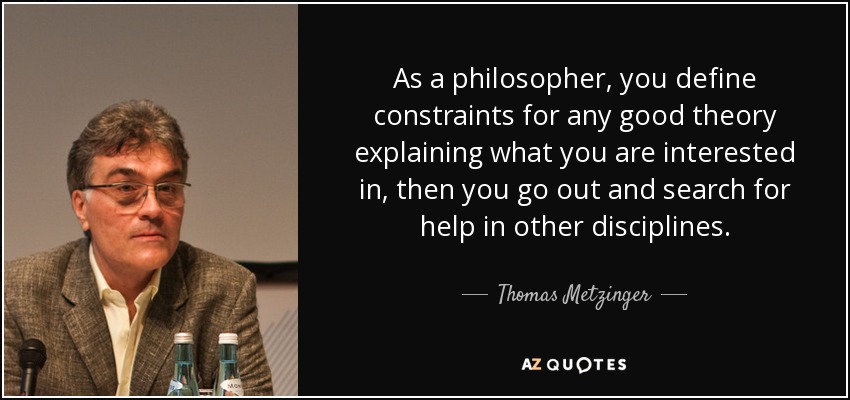
As a philosopher, you define constraints for any good theory explaining what you are interested in, then you go out and search for help in other disciplines.
One of the interesting characteristics of the Ego Tunnel is that it creates (as Finnish philosopher Antti Revonsuo called it) a robust "out-of-the brain experience", a highly realistic experience of not operating on internal models, but of effortlessly being in direct and immediate contact with the external world - and oneself.
Most influential of all is the philosopher Stanley Cavell, and a younger generation of philosophers who have attempted to follow his pioneering work in thinking about literature philosophically.
So this is my attempt to give a preliminary - probably far too crude - account of how philosophy by showing can really teach us. The attempts we make to work through problems by reasoning always presuppose starting points, and even the most self-critical philosophers adopt some of those starting points simply by picking them up from the social environments in which they grow up.
There are actually two separate issues here. The first is whether (as ancient philosophers and Nietzsche assume) only the privileged elite can live a worthwhile life. The second is whether it's possible to fulfill the roles of both serious artist and upstanding citizen. It seems to me that philosophy can dissect both questions, by delineating clearly the anatomy of the good life and the structural conditions of the roles.
The kind of approach I take is different from much of experimental philosophy. Although the experimental philosophers and I are certainly in agreement about the relevance of empirical work to philosophy, a good deal of their work is devoted to understanding features of our folk concepts, and in this respect, at least, I see them as making the same mistake as those armchair philosophers who are interested in conceptual analysis.
17th century philosophers were not in a position to understand the mind as well as we can today, since the advent of experimental methods in psychology. It shows no disrespect for the brilliance of Descartes or Kant to acknowledge that the psychology which they worked with was primitive by comparison with what is available today in the cognitive sciences, any more than it shows disrespect for the brilliance of Aristotle to acknowledge that the physics he worked with does not compare with that of Newton or Einstein.
I largely defer to the cognitive ethologists. I believe that the arguments that they make on this score are extremely persuasive. More than this, I do think as well that a priori objections by philosophers to successful research programs in the sciences have a very bad track record.
I argue is that philosophers have had a tendency to present a kind of mystical view of the powers of reflection. Unreflective belief acquisition is seen in mechanistic terms, but when philosophers talk about reflection, it is as if reflective processes are not bound by the kinds of limitations which inevitably arise from being embedded within the same causal structure which governs unreflective belief acquisition.
I do realise that talk of natural kinds dates back to Aristotle, but I'd better not say too much about ancient philosophers lest I be convicted of practicing history of philosophy without a license.
For one thing, I think that there are questions which philosophers raise which, although science bears on them, are not typically the central focus of those who work in the sciences. At the same time, I don't have a view of philosophy which marks it out as different in kind from scientific work
When I think about discussions at the Society for Philosophy and Psychology, a group which includes not only philosophers and psychologists, but also computer scientists and linguists, it is noteworthy that one can't always tell just from the content of particular contributions from the audience, whether a given questioner is a philosopher or an empirical scientist.
I do think that metaphysical exploration is like scientific exploration, in the sense that philosophers and scientists are both developing models of reality, and furthermore that we all rely to a significant extent on the idea that models which provide elegant, simple and satisfying explanations are more likely to be true.
I have a general moral: great philosophers may be great, but that is not a reason to follow them. Don't be a follower. Work it out for yourself.
I don't think that anything of any consequence is known a priori: all our knowledge is built up by modifying the lore passed on to us by our ancestors in light of our experiences, and the best a philosopher can do is to learn as much about what has been discovered in various empirical fields, and use it to try to craft an improved synthesis.
Philosophers, especially metaphysicians, explore features of reality and of our mental life that are different from those explored by scientists.
There has certainly been a great deal of work addressing the relationship between naturalism and the first-person perspective. Quite a number of philosophers have suggested that there are features of the first-person perspective that naturalism just cannot accommodate, whether it be qualitative character, or consciousness, or simply the ability we have to think of ourselves in a distinctively first-person manner.
The experimentalists think that we can only get at our concepts by way of empirical investigation, while the armchair philosophers think that we can skip the experiments and figure things out from our armchairs. What they have in common, however, is regarding our concepts as the targets of philosophical theorising, and I just don't think that, in the vast majority of cases, the subject matter of philosophy has our concepts as its target.
Fuzzy thinking is, after all, just one step above not thinking at all. But to take the ideas of serious transformational thinkers and philosophers and throw the "new age" label at them is also abhorrent.
One of the reasons why architects are often attracted to philosophers, partially, has to do with making sense of the world around us as well as the making of worlds.
It is easy for men to write and talk like philosophers, but to act with wisdom, there is the rub!
I love Osho. I don't know if you would call him a philosopher; I would just call him a really cool dude. Osho really changed my life. Because the way that he spoke about emotion and the male and female energies in the world and how people react to the world around them, it's so simple, yet it has such a depth.
Liberalism is a creation of the seventeenth century, fathered by British philosopher John Locke (1632-1704). For Locke, liberalism means limited government, the rule of law, due process, liberty, freedom of religion, freedom of speech, freedom of the press, freedom of assembly, separation of church and state, and separation of government powers into branches that oversee each other's authority.
Everyone is a philosopher. Not everyone is good at it.
In my acquaintance with John Rawls, I found him to be a simple and honest man, who just by chance also happened to be the greatest moral philosopher of the twentieth century. I would like to think that I could emulate at least his modesty - his refusal to exaggerate his perception of himself and his place in the larger scheme of things - even if my work never compares with his in its importance.
Follow AzQuotes on Facebook, Twitter and Google+. Every day we present the best quotes! Improve yourself, find your inspiration, share with friends
or simply: