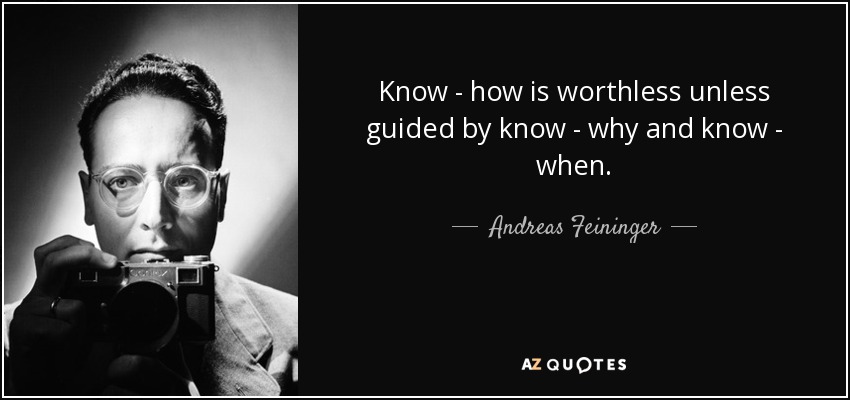
Know - how is worthless unless guided by know - why and know - when.
Every successful photograph, except for lucky shots, begins with an idea and a plan. The more precisely a photographer knows what it is he wishes to do, the better the chances are that he will do it.
I can be an artist a posteriori, not a priori. If my pictures tell the story, our story, human story, then in a hundred years, then they can be considered an art reference, but now they are not made as art. I'm a journalist. My life's on the road, my studio is the planet.
I'm not an artist. An artist makes an object. Me, it's not an object, I work in history, I'm a storyteller.
If you accept the idea that photographers, or some of them, are actually artists, then you have to look at their work less as a document of something than as a personal vision of the world.
Technique isn't important. Technique is in the blood. Events and mood are more important than good light and the happening is what is important
Anything is an art if you do it at the level of an art.
I wanted to combine science and photography in a sensible, unemotional way. Some people’s ideas of scientific photography is just arty design, something pretty. That was not the idea. The idea was to interpret science sensibly, with good proportion, good balance and good lighting, so we could understand it.
Photography must seize upon this moment and hold immobile the equilibrium of it. The photographers eye is perpetually evaluating. A photographer can bring coincidence of line simply by moving his head a fraction of a millimeter. He can modify perspectives by a slight bending of the knees. By placing the camera closer to or farther from the subject, he draws a detail — and it can be subordinated, or he can be tyrannized by it.
You scientists are the worst photographers in the world and you need the best photographers in the world and I'm the one to do it.
I'm not a nice girl. I'm a photographer.
What I want is the world to remember the problems and the people I photograph. What I want is to create a discussion about what is happening around the world and to provoke some debate with these pictures. Nothing more than this. I don't want people to look at them and appreciate the light and the palate of tones. I want them to look inside and see what the pictures represent, and the kind of people I photograph.
Books on scientific photography with such beauty, breadth, and insight are rare. Felice Frankel's Envisioning Science is chock full of mind-boggling images and valuable information--not only for curious artists, students, and lay people, but also for seasoned researchers and photographers. The eclectic Frankel is both a scientist and photographer, and with the cold logic of the one and the inspired vision of the other, she covers an array of topics sure to stimulate your imagination and sense of wonder at the incredible vastness of the physical world.
Today, I count myself blessed to have become a photographer. To be able to articulate the experiences of the voiceless, to bring their identity to the forefront, gives meaning and purpose to my own life.
Photography is a tool to negotiate our idea of reality. Thus it is the responsibility of photographers to not contribute with anaesthetic images but rather to provide images that shake consciousness.
I have been a photographer all my life....and have made photographs of many things and for many reasons. But one thing that becomes more and more apparent is that I am simply only as good as my next photograph. That's the one that counts the most....For this reason I find it a delight to face a new day, and to develop that new roll of film. It's a great way to live.
When people call me a photographer, I always feel like something of a charlatan—at least in Japanese. The word shashin, for photograph, combines the characters sha, meaning to reflect or copy, and shin, meaning truth, hence the photographer seems to entertain grand delusions of portraying truth.
Take pictures of what you fear.
Art is technique: a means by which to materialize the invisible realm of the mind.
The reason I call myself a documentary photographer is the idea of how photographs contain and participate in history.
Photography has an amazing ability to capture the fine detail of surface textures. But far too often these intricate patterns are loved by the photographer for their own sake. The richness of texture fascinates the eye and the photographer falls easy prey to such quickly-caught complexities. The designs mean nothing in themselves and are merely pictorially attractive abstractions. A central problem in contemporary photography is to bring about a wider significance in purely textural imagery.
It is a great honor for me to be compared to Henri Cartier-BressonBut I believe there is a very big difference in the way we put ourselves inside the stories we photograph. He always strove for the decisive moment as being the most important. I always work for a group of pictures, to tell a story. If you ask which picture in a story I like most, it is impossible for me to tell you this. I don't work for an individual picture. If I must select one individual picture for a client, it is very difficult for me.
When I revealed the campaign, some lady in the front row, a photographer, asked "is that airbrushed?" So I just lifted my shirt up and my stomach was the exact same thing as in the ads. It was actually kinda nice that she said that, because I'm sure plenty of people probably thought that. That's one of the reasons I did it - especially when you work so hard to get your body to look like that - it's frustrating.
A picture is like a prayer.
Actually, documentary pictures include every subject in the world - good, bad, indifferent. I have yet to see a fine photograph which is not a good document.
Follow AzQuotes on Facebook, Twitter and Google+. Every day we present the best quotes! Improve yourself, find your inspiration, share with friends
or simply: