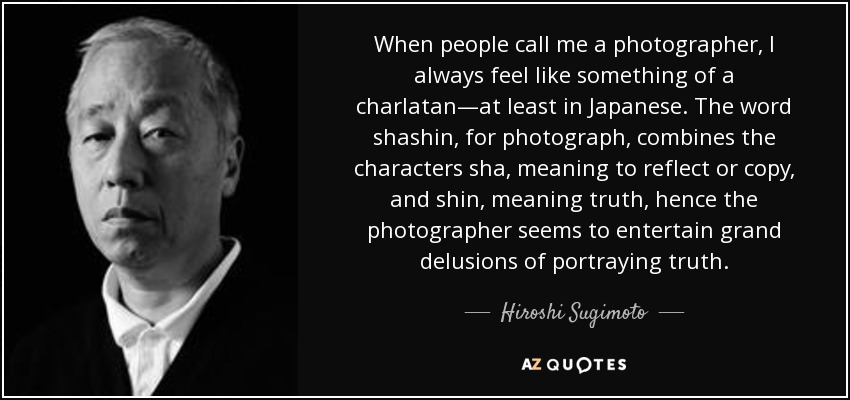
When people call me a photographer, I always feel like something of a charlatan—at least in Japanese. The word shashin, for photograph, combines the characters sha, meaning to reflect or copy, and shin, meaning truth, hence the photographer seems to entertain grand delusions of portraying truth.
Fossils work almost the same way as photography as a record of history. The accumulation of time and history becomes a negative of the image. And this negative comes off, and the fossil is the positive side. This is the same as the action of photography.
Photography is like a found object. A photographer never makes an actual subject; they just steal the image from the world... Photography is a system of saving memories. It's a time machine, in a way, to preserve the memory, to preserve time.
Books on scientific photography with such beauty, breadth, and insight are rare. Felice Frankel's Envisioning Science is chock full of mind-boggling images and valuable information--not only for curious artists, students, and lay people, but also for seasoned researchers and photographers. The eclectic Frankel is both a scientist and photographer, and with the cold logic of the one and the inspired vision of the other, she covers an array of topics sure to stimulate your imagination and sense of wonder at the incredible vastness of the physical world.
Few photographers have ever considered the photography of wild animals, as distinctly opposed to the genre of Wildlife Photography, as an art form. The emphasis has generally been on capturing the drama of wild animals IN ACTION, on capturing that dramatic single moment, as opposed to simply animals in the state of being.
Thirty-six satisfactory exposures on a roll means a photographer is not trying anything new
The photographer has almost as much control over his subject matter as a painter. He can control light and shade, form and space, pattern and texture, motion and mood, everything except composition.
Photography has an amazing ability to capture the fine detail of surface textures. But far too often these intricate patterns are loved by the photographer for their own sake. The richness of texture fascinates the eye and the photographer falls easy prey to such quickly-caught complexities. The designs mean nothing in themselves and are merely pictorially attractive abstractions. A central problem in contemporary photography is to bring about a wider significance in purely textural imagery.
The reason I call myself a documentary photographer is the idea of how photographs contain and participate in history.
A photograph is worth a thousand words, provided it is accompanied by only ten words.
To make good photographs, to express something, to contribute something to the world he lives in, and to contribute something to the art of photography besides imitations of the best photographers on the market today, that is basic training, the understanding of self.
I do not photograph for ulterior purposes. I photograph for the thing itself - for the photograph - without consideration of how it may be used.
My style hasn't changed much in all these sixty years. I still use, most of the time, existing light and try not to push people around. I have to be as much a diplomat as a photographer. People don't often take me seriously because I carry so little equipment and make so little fuss... I never carried a lot of equipment. My motto has always been, "Keep it simple".
Photography is art when it's used by an artist.
What the human eye sees is an illusion of what is real. The black and white image transforms illusions into another reality.
You have to follow your instinct all the time. Otherwise you don't make it.
I do have strong convictions and political opinions, but I don't think it's necessary to imbue my photographic work with them. I use photography as a vessel for visual material to flow through, to encourage conversation with the viewer. I try to present a catalyst and invite viewers to tell their own stories.
It's possible to think of photography as an act of editing, a matter of where you put your rectangle pull it out or take it away. Sometimes people ask me about films, cameras and development times in order to find out how to do landscape photography. The first thing I do in landscape photography is go out there and talk to the land - form a relationship, ask permission, it's not about going out there like some paparazzi with a Leica and snapping a few pictures, before running off to print them.
The first time, I usually skim off the outer layer and end up with photographs that are fairly obvious. The second time, I have to look a little deeper. The images get more interesting. The third time it is even more challenging and on each subsequent occasion, the images should get stronger, but it takes more effort to get them.
Getting photographs is not the most important thing. For me it's the act of photographing. It's enlightening, therapeutic and satisfying, because the very process forces me to connect with the world. When you make four-hour exposures in the middle of the night, you inevitably slow down and begin to observe and appreciate more what's going on around you. In our fast-paced, modern world, it's a luxury to be able to watch the stars move across the sky.
I gravitate towards places where humans have been and are no more, to the edge of man's influence, where the elements are taking over or covering man's traces.
Perhaps most intriguing of all is that it is possible to photograph what is impossible for the human eye to see - cumulative time.
Nothing is ever the same twice because everything is always gone forever, and yet each moment has infinite photographic possibilities.
As a good picture would come, I would never know exactly what I had done. When you did see it, it would strike you as a great surprise - who did that? How did it happen? Being surprised by your own work makes you both less serious and have serious reverence.
The picture is like a prayer, an offering, and hopefully an opening through which to seek what we don't know, or already know and should take seriously.
Follow AzQuotes on Facebook, Twitter and Google+. Every day we present the best quotes! Improve yourself, find your inspiration, share with friends
or simply: