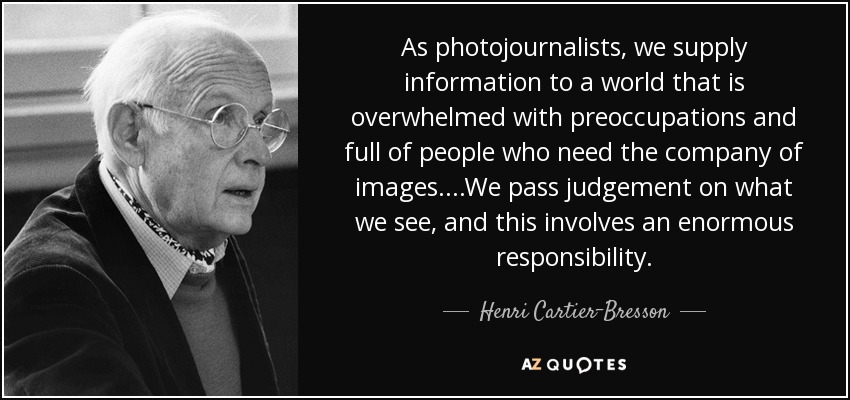
As photojournalists, we supply information to a world that is overwhelmed with preoccupations and full of people who need the company of images....We pass judgement on what we see, and this involves an enormous responsibility.
If it makes you laugh, if it makes you cry, if it rips out your heart, that's a good picture.
It is an illusion that photos are made with the camera... they are made with the eye, heart and head.
You are not just a photojournalist, you're a historian.
If you want to be a photographer, particularly a photojournalist , you want to learn about the world. You want to learn about yourself. And you want to find things that you genuinely care about, because that will be the source of your greatest work.
To be a photojournalist takes experience, skill, endurance, energy, salesmanship, organization, wheedling, climbing, gatecrashing, etc. - plus an eye and patience.
The pictures are there, and you just take them.
I am an idealist. I often feel I would like to be an artist in an ivory tower. Yet it is imperative that I speak to people, so I must desert that ivory tower. To do this, I am a journalist - a photojournalist. But I am always torn between the attitude of the journalist, who is a recorder of facts, and the artist, who is often necessarily at odds with the facts. My principle concern is for honesty, above all honesty with myself.
Nothing came easy. I was just born with a need to explore every part of my mind. And with long searching and hard work, I became devoted to my restlessness.
Taking pictures is savoring life intensely, every hundredth of a second.
I do love acting. But to work as a photojournalist would have been extraordinary.
If you photograph for a long time, you get to understand such things as body language. I often do not look at people I photograph, especially afterwards. Also when I want a photo, I become somewhat fearless, and this helps a lot. There will always be someone who objects to being photographed, and when this happens you move on.
Photojournalists know the horrors of war can only be exposed at close range. Kodak Film.
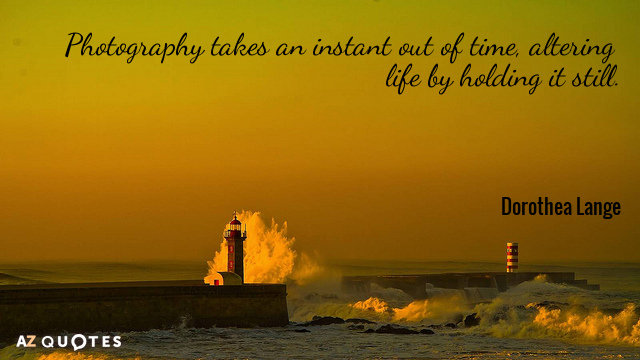
Photography takes an instant out of time, altering life by holding it still.
Whether he is an artist or not, the photographer is a joyous sensualist, for the simple reason that the eye traffics in feelings, not in thoughts.
The pain of life overrides the joy to the point that joy does not exist.
Photography is a small voice, at best, but sometimes one photograph, or a group of them, can lure our sense of awareness.
As we all know, the objective and mission of the photojournalist is to show us the reality of the world. And in order to capture that reality, they go to dangerous and tragic places at the expense of their lives. I see them as the conscience of our humanity; they represent for me what is left of our humanity.
I only use a camera like I use a toothbrush. It does the job.
Be yourself. I much prefer seeing something, even it is clumsy, that doesn't look like somebody else's work.
F8 And Be There! For years, this was the cry of the photojournalist. It meant that 90% of a great photo was being in the right place at the right time. True, it was simplistic, but in the Age of Photoshop, this maxim is too often forgotten. No matter how much you play with the bits and bytes, the best images always start out with a great vision, clearly and cleanly seen.
I don't want you to understand the details. To feel how it feels, you just have to be on the ground with the people. That's where photojournalists have a lot of magic.
As an emerging photojournalist in the early 70s, my focus was on trying to create stories for magazines to the exclusion of almost everything else. I wish someone had told me then that the most personally important pictures you’ll ever make are those about you and your life. I’m glad I had the chance to work for some great magazines, but I really miss those little everyday images, the ones that take place in and around your own life, which will never make the news. Don’t sell yourself short: photograph your own life, not just everyone else’s.
What does a professional photojournalist do that others cannot? Depicting photo opportunities as if they are authentic, covering press conferences, or making subjects play their assigned roles (the poor as passive victims, celebrities as glamorous) are hardly adequate responses. In fact, these might be reasons to ask for the help of amateurs who do not know how to stylize their imagery and are not interested in making a publication seem more palatable to its potential consumers.
Unfortunately, conflicts have always been there and they don't seem to be stopping. I'm a journalist and a photojournalist at heart, and I think that we have to be there always to cover it.
Follow AzQuotes on Facebook, Twitter and Google+. Every day we present the best quotes! Improve yourself, find your inspiration, share with friends
or simply: