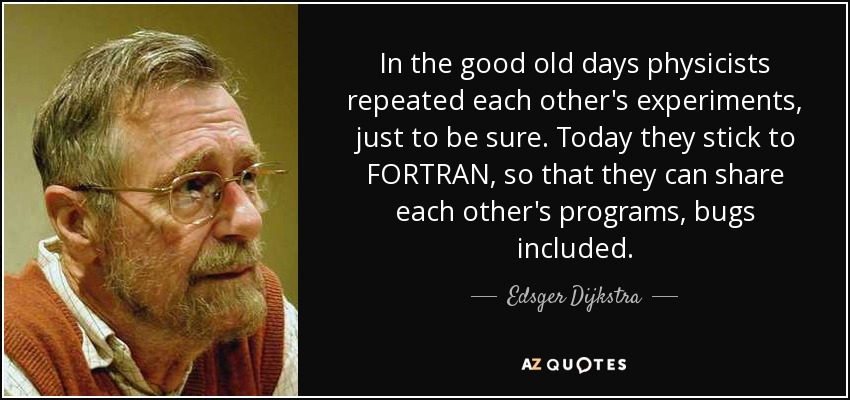
In the good old days physicists repeated each other's experiments, just to be sure. Today they stick to FORTRAN, so that they can share each other's programs, bugs included.
Said to physicist John Bahcall. I don't believe in natural science.
...The entire preoccupation of the physicist is with things that contain within themselves a principle of movement and rest.
The total disorder in the universe, as measured by the quantity that physicists call entropy, increases steadily over time. Also, the total order in the universe, as measured by the complexity and permanence of organized structures, also increases steadily over time.
In Paris, friend of Bequerel’s, a young physicist-chemist couple named Pierre and Marie Curie, began to scour the natural world for even more powerful chemical sources of X-rays. Pierre and Marie (then Maria Sklodowska, a penniless Polish immigrant living in a garret in Paris) had met at the Sorbonne and been drawn to each other because of a common interest in magnetism.
Ancient wisdom and quantum physicists make unlikely bedfellows: In quantum mechanics the observer determines (or even brings into being) what is observed, and so, too, for the Tiwis, who dissolve the distinction between themselves and the cosmos. In quantum physics, subatomic particles influence each other from a distance, and this tallies with the aboriginal view, in which people, animals, rocks, and trees all weave together in the same interwoven fabric.
Trying to capture the physicists' precise mathematical description of the quantum world with our crude words and mental images is like playing Chopin with a boxing glove on one hand and a catcher's mitt on the other.
There are no physicists in the hottest parts of hell, because the existence of a hottest part implies a temperature difference, and any marginally competent physicist would immediately use this to run a heat engine and make some other part of hell comfortably cool. This is obviously impossible.
To produce a really good biological theory one must try to see through the clutter produced by evolution to the basic mechanisms lying beneath them, realizing that they are likely to be overlaid by other, secondary mechanisms. What seems to physicists to be a hopelessly complicated process may have been what nature found simplest, because nature could only build on what was already there.
If you really want to know about the future, don't ask a technologist, a scientist, a physicist. No! Don't ask somebody who's writing code. No, if you want to know what society's going to be like in 20 years, ask a kindergarten teacher.
Can a physicist visualize an electron? The electron is materially inconceivable and yet, it is so perfectly known through its effects that we use it to illuminate our cities, guide our airlines through the night skies and take the most accurate measurements. What strange rationale makes some physicists accept the inconceivable electrons as real while refusing to accept the reality of a Designer on the ground that they cannot conceive Him?
The mathematical framework of quantum theory has passed countless successful tests and is now universally accepted as a consistent and accurate description of all atomic phenomena. The verbal interpretation, on the other hand - i.e., the metaphysics of quantum theory - is on far less solid ground. In fact, in more than forty years physicists have not been able to provide a clear metaphysical model.
Reality is what kicks back when you kick it. This is just what physicists do with their particle accelerators. We kick reality and feel it kick back. From the intensity and duration of thousands of those kicks over many years, we have formed a coherent theory of matter and forces, called the standard model, that currently agrees with all observations.
The physicist is like someone who's watching people playing chess and, after watching a few games, he may have worked out what the moves in the game are. But understanding the rules is just a trivial preliminary on the long route from being a novice to being a grand master. So even if we understand all the laws of physics, then exploring their consequences in the everyday world where complex structures can exist is a far more daunting task, and that's an inexhaustible one I'm sure.
Nothing in physics seems so hopeful to as the idea that it is possible for a theory to have a high degree of symmetry was hidden from us in everyday life. The physicist's task is to find this deeper symmetry.
There is now a feeling that the pieces of physics are falling into place, not because of any single revolutionary idea or because of the efforts of any one physicist, but because of a flowering of many seeds of theory, most of them planted long ago.
Physics is becoming too difficult for the physicists.
I now want to tell three stories about advances in twentieth-century physics. A curious fact emerges in these tales: time and again physicists have been guided by their sense of beauty not only in developing new theories but even in judging the validity of physical theories once they are developed. Simplicity is part of what I mean by beauty, but it is a simplicity of ideas, not simplicity of a mechanical sort that can be measured by counting equations or symbols.
The modern physicist is a quantum theorist on Monday, Wednesday, and Friday, and a student of gravitational relativity on Tuesday, Thursday, and Saturday. On Sunday, he is praying... that someone will find the reconciliation between the two views.
Modern physics had shown that the rhythm of creation and destruction is not only manifest in the turn of the seasons and in the birth and death of living creatures, but is also the very essence of inorganic matter. For modern physicists...Shiva's dance is the dance of subatomic matter.
Gradually, physicists began to realise that nature, at the atomic level, does not appear as a mechanical universe composed of fundamental building blocks, but rather as a network of relations, and that, ultimately, there are no parts at all in this interconnected web. Whatever we call a part is merely a pattern that has some stability and therefore captures our attention.
[on what characteristics Nobel prize winning physicists had in common] I cannot think of a single one, not even intelligence.
Many people, improperly, lump together libertarians and the Tea Parties. That's really wrong. Many of the libertarians are physicists, and many of the Tea Party people don't bathe. There's really not much in common there!
Physicists now say there is no such thing as time: everything co-exists. Chronology is entirely artificial and essentially determined by emotion. Contiguity suggests layers of things, the past and present somehow coalescing or co-existing.
Energy is a concept that has been coined by physicists. There is no observable thing known as energy anywhere.
Follow AzQuotes on Facebook, Twitter and Google+. Every day we present the best quotes! Improve yourself, find your inspiration, share with friends
or simply: