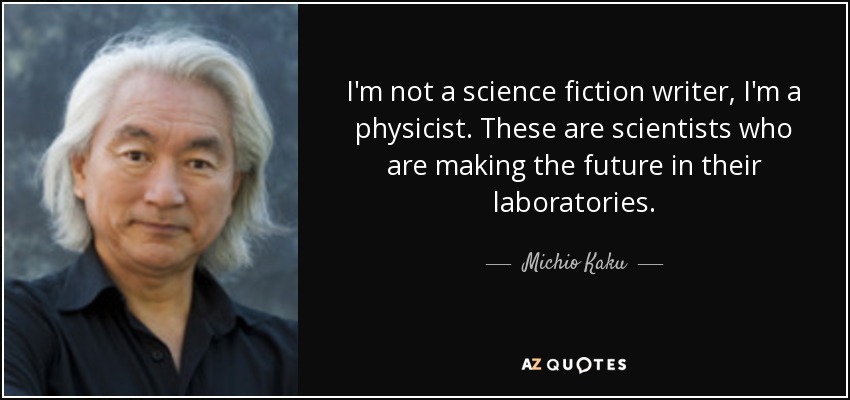
I'm not a science fiction writer, I'm a physicist. These are scientists who are making the future in their laboratories.
I'm really fascinated by the parallels between quantum theory and the teachings of some of these ancient texts. So many of the things that quantum physicists are talking about today, like non-locality and the observer effect, are things the yogis have been saying for thousands of years.
Without perceiving things through the old filter of past conditioning and conceptualization, one can sense the universe is intensely alive. Even so-called inanimate objects - I often pick up little objects and just look at them and sense that they are alive. Physicists actually confirm that what we perceive as dead matter is not dead at all. Everything is an intensely alive energy field. That aliveness is only an aspect of the aliveness or life that I am.
I was raised on technology. I grew up in Livermore, California, a town of physicists and cowboys. My parents worked at the government laboratories there. So technology was very normal for me.
You can pay attention to the fact, in which case you'll probably become a mathematician, or you can ignore it, in which case you'll probably become a physicist.
Observation and theory get on best when they are mixed together, both helping one another in the pursuit of truth. It is a good rule not to put overmuch confidence in a theory until it has been confirmed by observation. I hope I shall not shock the experimental physicists too much if I add that it is also a good rule not to put overmuch confidence in the observational results that are put forward until they have been confirmed by theory.
I happened to read recently a remark by the American nuclear physicist W. Davidson, who noted that the explosion of one hydrogen bomb releases a greater amount of energy than all the explosions set off by all countries in all wars known in the entire history of mankind. And he, apparently, is right.
There is not a physicist in the world who can perceive when a parlor magician palms off playing-cards.
Even for the physicist the description in plain language will be a criterion of the degree of understanding that has been reached.
In mysticism, knowledge cannot be separated from a certain way of life which becomes its living manifestation. To acquire mystical knowledge means to undergo a transformation; one could even say that the knowledge is the transformation. Scientific knowledge, on the other hand, can often stay abstract and theoretical. Thus most of today’s physicists do not seem to realize the philosophical, cultural and spiritual implications of their theories.
Quantum mechanics is so counter-intuitive, physicists have never been able to come up with a comfortable picture of how it works.
Physicists use 'God' as a metaphor more often than other scientists-- especially in popular writing, but in the technical literature as well. Of course, this is just a metaphor for order at the heart of confusion. A rational or aesthetic pattern underlying reality is far from a theistic God.
By having simplified what is known, physicists have been led into realms which as yet are anything but simple. That at some time, they, too, will appear as simple consequences of a theory of which no one has yet dreamed is not a statement of fact.It is a statement of faith.
If you want to get an interesting perspective do not think of Hugh as a traditional 20th century physicist but more of a Renaissance man with interests and skills in many different areas. He was smart and lots of things interested him and he brought the same general conceptual methodology to solve them. The subject matter was not so important as the solution ideas.
Since the death of Nikola Tesla in 1943, his life has deserved a worthy biography. Bernard Carlson has delivered that in Tesla: Inventor of the Electrical Age, which portrays Tesla as intensely human. . . . Anyone, whether simply an interested reader or a professional historian, engineer, or physicist, will finish Tesla with a deepened understanding of his world, character, and accomplishments.
The highest court is in the end one's own conscience and conviction-that goes for you and for Einstein and every other physicist-and before any science there is first of all belief. For me, it is belief in a complete lawfulness in everything that happens.
No atomic physicist has to worry, people will always want to kill other people on a mass scale. Sure, he's got the fridge full of sausages and spring water.
...contemporary physicists come in two varieties. Type 1 physicists are bothered by EPR and Bell's Theorem. Type 2 (the majority) are not, but one has to distinguish two subvarieties. Type 2a physicists explain why they are not bothered. Their explanations tend either to miss the point entirely (like Born's to Einstein) or to contain physical assertions that can be shown to be false. Type 2b are not bothered and refuse to explain why.
You might argue that my example is bad because Einstein is dead. But according to physicist Erwin Schrodinger, Einstein is neither dead nor alive until we dig him up and open the casket. If he's alive, he might want his brain back, which I understand is in a Ziplock bag in some guy's freezer. And this is a perfect example of why examples always distract from the main point.
The epithet beautiful is used by surgeons to describe operations which their patients describe as ghastly, by physicists to describe methods of measurement which leave sentimentalists cold, by lawyers to describe cases which ruin all the parties to them, and by lovers to describe the objects of their infatuation, however unattractive they may appear to the unaffected spectators.
A physicist looks for causes; that does not necessarily imply that there are causes everywhere. A man may look for gold without assuming that there is gold everywhere; if he finds gold, well and good, if he doesn't he's had bad luck. The same is true when the physicists look for causes.
We want no dictatorship of physicists, as physicists. If our democracy is to realize its full promise, we want no dictatorship at all - of any species. What we want and need is the enlightened and active interest of all men of intelligence and goodwill in their government, and their participation in its functions.
I thought I wanted to be a physicist in high school until I learned that there was much more math than philosophy in it. I assumed I would just sit around all day and think.
When I was younger, I read a book by Frank Barnaby, this wonderful nuclear physicist. He said that media had a responsibility, that all sectors of society had a responsibility to try and move things forward. And that fascinated me... I'd been messing around with a camera most of my life...
Whenever I want to represent or depict the official version, I will refer to them as 'mathematicians' or 'mathematical physicists' or idiots or something like that. There are no physicists in mainstream 'Physics.' From Newton to Einstein to Hawking, they are all just mathematicians as far as Science and Physics are concerned.
Follow AzQuotes on Facebook, Twitter and Google+. Every day we present the best quotes! Improve yourself, find your inspiration, share with friends
or simply: