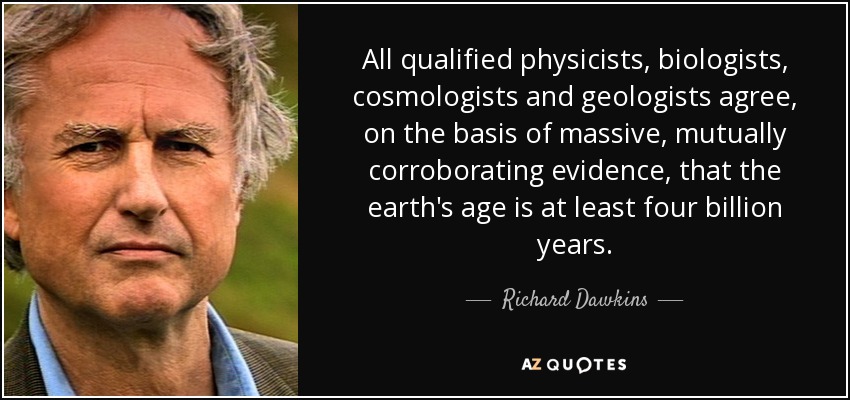
All qualified physicists, biologists, cosmologists and geologists agree, on the basis of massive, mutually corroborating evidence, that the earth's age is at least four billion years.
The goal is nothing other than the coherence and completeness of the system not only in respect of all details, but also in respect of all physicists of all places, all times, all peoples, and all cultures.
The highest court is in the end one's own conscience and conviction-that goes for you and for Einstein and every other physicist-and before any science there is first of all belief. For me, it is belief in a complete lawfulness in everything that happens.
There is not a physicist in the world who can perceive when a parlor magician palms off playing-cards.
...contemporary physicists come in two varieties. Type 1 physicists are bothered by EPR and Bell's Theorem. Type 2 (the majority) are not, but one has to distinguish two subvarieties. Type 2a physicists explain why they are not bothered. Their explanations tend either to miss the point entirely (like Born's to Einstein) or to contain physical assertions that can be shown to be false. Type 2b are not bothered and refuse to explain why.
The epithet beautiful is used by surgeons to describe operations which their patients describe as ghastly, by physicists to describe methods of measurement which leave sentimentalists cold, by lawyers to describe cases which ruin all the parties to them, and by lovers to describe the objects of their infatuation, however unattractive they may appear to the unaffected spectators.
When I was younger, I read a book by Frank Barnaby, this wonderful nuclear physicist. He said that media had a responsibility, that all sectors of society had a responsibility to try and move things forward. And that fascinated me... I'd been messing around with a camera most of my life...
Whenever I want to represent or depict the official version, I will refer to them as 'mathematicians' or 'mathematical physicists' or idiots or something like that. There are no physicists in mainstream 'Physics.' From Newton to Einstein to Hawking, they are all just mathematicians as far as Science and Physics are concerned.
A physicist looks for causes; that does not necessarily imply that there are causes everywhere. A man may look for gold without assuming that there is gold everywhere; if he finds gold, well and good, if he doesn't he's had bad luck. The same is true when the physicists look for causes.
By having simplified what is known, physicists have been led into realms which as yet are anything but simple. That at some time, they, too, will appear as simple consequences of a theory of which no one has yet dreamed is not a statement of fact.It is a statement of faith.
To make a discovery is not necessarily the same as to understand a discovery. Not only Planck but also other physicists were intially at a loss as to what the proper context of the new postulate really was.
Wisdom is not mathematical, nor astronomical, nor zoological; when it talks too much of any one thing it ceases to be itself. There are wise physicists, but wisdom is not physical; there are wise physicians, but wisdom is not medical.
The mathematical forms of order which the mind of a physicist manipulates coincides "miraculously" with experimental measurements.
Nature is not personal. She is the compound of all these processes which move through the universe to effect the results we know as Life and of all the ordinances which govern that universe and that make Life continuous. She is no more the Hebrew's Jehovah than she is the Physicist's Force; she is as much Providence as she is Electricity; she is not the Great Pattern any more than she is the Blind Chance.
People will listen to sophisticated physicists, using God as a kind of metaphor for the deep constants, the deep problems, the deep principles of physics, and say that in that sense I believe in God. The reaction is, "Oh, this great physicist believes in God - that means I'm free to believe in the trinity and in the crucifixion and in the reincarnation of Christ" - and all that stuff, which of course has nothing whatever to do with the fundamental constants of physics, which is what these physicists are talking about.
What of course I would like to be writing is the story of the Red and White Dwarves and their Remembering Mirror, their space rocket (powered by anti-gravity), their attendant entities Hadron, Gluon, Pion, Lepton, and Muon, and the Charmed Quarks and the Coloured Quarks. But we can't all be physicists.
Self-confidence is an important ingredient that makes for a successful physicist.
If you want to get an interesting perspective do not think of Hugh as a traditional 20th century physicist but more of a Renaissance man with interests and skills in many different areas. He was smart and lots of things interested him and he brought the same general conceptual methodology to solve them. The subject matter was not so important as the solution ideas.
Since the death of Nikola Tesla in 1943, his life has deserved a worthy biography. Bernard Carlson has delivered that in Tesla: Inventor of the Electrical Age, which portrays Tesla as intensely human. . . . Anyone, whether simply an interested reader or a professional historian, engineer, or physicist, will finish Tesla with a deepened understanding of his world, character, and accomplishments.
Even for the physicist the description in plain language will be a criterion of the degree of understanding that has been reached.
The sensation of colour cannot be accounted for by the physicist's objective picture of light-waves.
Somebody once asked Niels Bohr why he had a horseshoe hanging above the front door of his house. Surely you, a world famous physicist, can't really believe that hanging a horseshoe above your door brings you luck? Of course not, Bohr replied, but I have been reliably informed that it will bring me luck whether I believe in it or not.
Quantum mechanics is so counter-intuitive, physicists have never been able to come up with a comfortable picture of how it works.
Physicists use 'God' as a metaphor more often than other scientists-- especially in popular writing, but in the technical literature as well. Of course, this is just a metaphor for order at the heart of confusion. A rational or aesthetic pattern underlying reality is far from a theistic God.
We form cities in order to enhance interaction, to facilitate growth, wealth creation, ideas, innovation, but in so doing, we create from - from a physicist's viewpoint, entropy, meaning all of those bad things that we feel are engulfing us.
Follow AzQuotes on Facebook, Twitter and Google+. Every day we present the best quotes! Improve yourself, find your inspiration, share with friends
or simply: