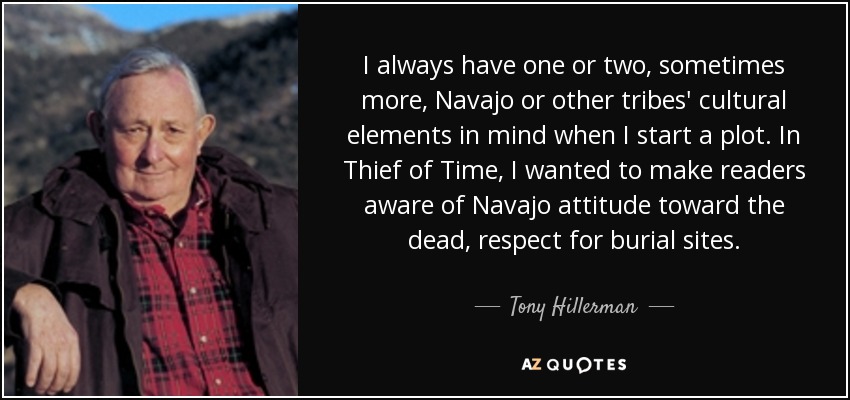
I always have one or two, sometimes more, Navajo or other tribes' cultural elements in mind when I start a plot. In Thief of Time, I wanted to make readers aware of Navajo attitude toward the dead, respect for burial sites.
It's one of the most liberating things I experience in writing - letting yourself get rid of a gesture or character or plot point that always nagged, even if you couldn't admit to yourself that it did.
Every so often you want to map out your plot mythology but never so specifically that you can’t let a story surprise you. You want to allow the type of action of the writer’s room so that you have the ability to take a left turn.
I can't stop watching 'Pan Am.' When I was growing up, my father worked as an engineer in Turkey, and we always flew Pan Am. The stewardesses were so glamorous! When they gave me a set of those golden wings, I felt very grown-up. Not only is the show's plot full of mystery and infidelity, they get the period details just right.
I shy away from plot structure that depends on the characters behaving in ways that are going to eventually be explained by their childhood, or by some recent trauma or event. People are incredibly complicated. Who knows why they are the way they are?
If you stop one terror attack in the U.S., it may be connected to multiple other plots out there that are connected. If you reveal that you stopped one plot, it may tip our hand.
The time has mainly gone on getting Inform into a decent shape for public use. I suppose the plot of 'Curses' makes a sequel conceivable when compared with, say, the plot of 'Hamlet' but none is planned.
I'm just an entertainer. In a way crime stories are boring. A crime's been committed and at the end you know it will be solved. So you've got to make the story interesting besides it just being a plot. And that's why character matters, why you've got to make the characters interesting.
When I hit a block, regardless of what I am writing, what the subject matter is, or what's going on in the plot, I go back and I read Pablo Neruda's poetry. I don't actually speak Spanish, so I read it translation. But I always go back to Neruda. I don't know why, but it calms me, calms my brain.
A plot without action is like pasta without garlic, like Dolly Parton without cleavage, and like a writer without his similes.
The same way that some people can play the piano, I can do plots! They just come!
Once you have invented a character with three dimensions and a voice, you begin to realize that some of the things you'd like him to do to further your plot are things that such a person wouldn't, or couldn't, do.
The craft of writing is all the stuff that you can learn through school; go to workshops and read books. Learn characterization, plot and dialogue and pacing and word choice and point of view. Then there's also the art of it which is sort of the unknown, the inspiration, the stuff that is noncerebral.
In the preface to his great History of Europe, H. A. L. Fisher wrote: "Men wiser than and more learned than I have discerned in history a plot, a rhythm, a predetermined pattern. These harmonies are concealed from me. I can see only one emergency following upon another as wave follows upon wave ..." It seems to me that the same is true of the much older [geological stratigraphical] history of Europe.
In 'Law & Order,' your main job is to stay out of the way of the plot. On another show you'd receive your script and see stuff that seems challenging and feel excited that the writers thought highly enough of you to write it for you.
I can tell you that as a writer and as a reader, I regard character as king. Or queen. No matter how riveting the action or interesting the plot twists, if I don't feel like I'm meeting someone who feels real, I'm not going to be compelled to read further.
I read Claire Messud's 'The Emperor's Children,' I read Joseph O'Neill's 'Netherland' - but to me, they're not 9/11 novels. In 'The Emperor's Children,' 9/11 felt to me like a piece of the plot; the novel wasn't wrestling with what 9/11 meant. And 'Netherland' felt the same way. I liked both books a lot but I don't see them as 9/11 novels.
To me, it all comes down to things being character-driven. It's hard for me to look beyond that. CG and all this cool stuff - so be it. But to me, it pretty much begins and ends with character-driven plots rather than technologically-driven plots.
I feel like I know how to write plot.
My advice to aspiring writers of fantasy trilogies or series is that each book needs two main plots. There's the 'big story', the over-arching grand plot of the entire series, and there is the complete-in-itself, one-book plot.
There are two generic and invariable features that characterize utopias. One is the content: the authors of utopias paint what they consider to be ideal societies; translating this into the language of mathematics, we might say that utopias bear a + sign. The other feature, organically growing out of the content, is to be found in the form: a utopia is always static; it is always descriptive and has no, of almost no, plot dynamics.
Welcome to the real world, she said to me. Condescendingly. Take a seat. Take your life. Plot it out in black and white.
I began to write fiction on the assumption that the true enemies of the novel were plot, character, setting and theme, and having once abandoned these familiar ways of thinking about fiction, totality of vision or structure was really all that remained.
In Endless Quest books, you start the plot, and the character has to make choices. Then you have to write one choice over here, one choice over there. The author might get one or two choices out.
I calculated the total time that humans have waited for web pages to load. It cancels out all the productivity gains of the information age. Sometimes I think the web is a big plot to keep people like me away from normal society.
Follow AzQuotes on Facebook, Twitter and Google+. Every day we present the best quotes! Improve yourself, find your inspiration, share with friends
or simply: