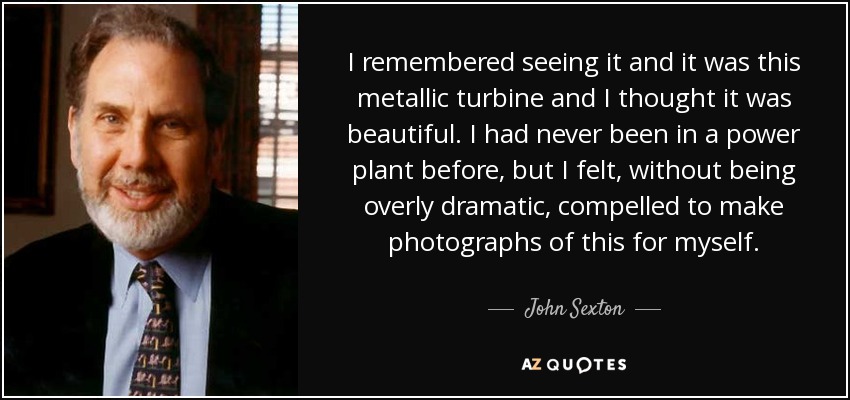
I remembered seeing it and it was this metallic turbine and I thought it was beautiful. I had never been in a power plant before, but I felt, without being overly dramatic, compelled to make photographs of this for myself.
The first day at the power plant I found myself photographing some steam vents on the roof of the structure. And I remember consciously thinking that they were just like trees but they were metal.
Ozone and climate are global issues, and it's hard to find a way in which the benefits of shutting down carbon emissions are going to pay for themselves for any given power-plant, say.
Any first-generation technology will. But we are looking at carbon the same way we look at every pollutant under the Clean Air Act; we look for the new technologies that are available. We recognize that these power plants are going to be around for decades.
Imposing excessive new regulations, or closing coal-fired power plants, would produce few health or environmental benefits. But it would exact huge costs on society - and bring factories, offices and economies to a screeching halt in states that are 80-98% dependent on coal: Indiana, Kentucky, Missouri, North Dakota, Ohio, Utah, West Virginia and Wyoming.
There are consequences to our insatiable demands for energy and there are no easy answers for how to capture that energy safely. But even more pressing, since we are currently using nuclear power across the country and the globe, nuclear power plants must be regulated, and we need to be certain that our regulatory bodies are not compromised by their relationships with industry.
... laws governing pollution tend to move pollutants from one medium to another. So, for example, we scrub SO2 from power plants only to dispose toxic sludge on land. We "clean" water only to disperse toxic-laced solids on farmland or landfills. Pollution control becomes a kind of giant shell game by which we move pollutants between air, water, groundwater, and land.
Ideal government would be a very boring job - it would be a matter of organizing a lot of utilities and keeping the wires together and the power plant and all that kind of stuff. It's not a matter of telling people how to live, it's a matter of making it pleasant for them to live. Government should be in the position of distributing food, stuff like that.
Centralization of society's vital services in giant computer centers, reservoirs, nuclear power plants, air- traffic control centers, 100-story skyscrapers, and government compounds increases its vulnerability. ... choosing his targets, today's saboteur could pollute a city's water supply, dynamite power transmission towers, cripple an airport control center, destroy a corporate or government computer center.
Sometimes I feel like a beetle crawling through a fusion power plant. I can feel a certain amount, see a certain amount, but I sure as hell don't understand everything.
We experimented and we experienced many altered states of awareness. We used the power plants. I did that for a year or two.
We look at the Web as being our basic power plant, kind of like electricity, so the Web and communicating in this fashion is second nature to us now. It's not like we go brochure, television, mail. It's Web, and then everything else. It's social media first, and everything else.
The waste from power plants is essentially what is left over when you burn coal. And as we all know, coal is a relatively dirty mineral.
I'm tired of being scared, and I know you are too. Not that there isn't alot to be scared of in this world today, between the non-stop headlines about wars and nuclear power plants and terrorists and assasinations and civil unrest and economic uncertainty and political doublespeak and insane weather and an environment that's becoming unhealthier by the day. But a point comes when it's too much to deal with, and thinking about it accomplishes nothing more than sending you to bed with a cold cloth on your head.
A nuclear-power plant is infinitely safer than eating, because 300 people choke to death on food every year.
When people conceptualize a cyber-attack, they do tend to think about parts of the critical infrastructure like power plants, water supplies, and similar sort of heavy infrastructure, critical infrastructure areas. And they could be hit, as long as they're network connected, as long as they have some kind of systems that interact with them that could be manipulated from internet connection.
If an adversary didn't target our power plants but they did target the core routers, the backbones that tie our internet connections together, entire parts of the United States could be cut off. That would have a tremendous impact on us as a society and it would have a policy backlash.
When the lights go out at a power plant sometime in the future, we're going to know that that's a consequence of deprioritizing defense for the sake of an advantage in terms of offense.
We reject techniques like torture regardless of whether they're effective or ineffective because they are barbaric and harmful on a broad scale. It's the same thing with cyber warfare. We should never be attacking hospitals. We should never be taking down power plants unless that is absolutely necessary to ensure our continued existence as a free people.
Each suburban housewife spends her time presiding over a power plant sufficient to have staffed the palace of a Roman emperor with a hundred slaves.
The president's come out with rules that say 'no new coal-fired power plants.’
t century, hundreds of millions - and eventually billions - of human beings will transform their buildings into power plants to harvest renewable energies on site, store those energies in the form of hydrogen and share electricity, peer-to-peer, across local, regional, national and continental inter-grids that act much like the Internet.
The 1,230 gigawatts (GW) of renewable power generating capacity in place at the end of 2009 now constitutes just over 25 percent of total generating capacity worldwide. This is over three times nuclear generating capacity and roughly 38 percent of the capacity of fossil fuel-burning power plants worldwide.
Why should people be afraid that we use a few small pellets of uranium at the nuclear power plant in Bataan? Don't they know that we're surrounded by uranium? We have the world's fourth largest deposits of uranium. Yes, we're all radioactive -- must be the reason why we have so many faith healers!
While many technological measures can be taken to secure safety at nuclear power plants, such measures on their own cannot cover great risks.
Follow AzQuotes on Facebook, Twitter and Google+. Every day we present the best quotes! Improve yourself, find your inspiration, share with friends
or simply: