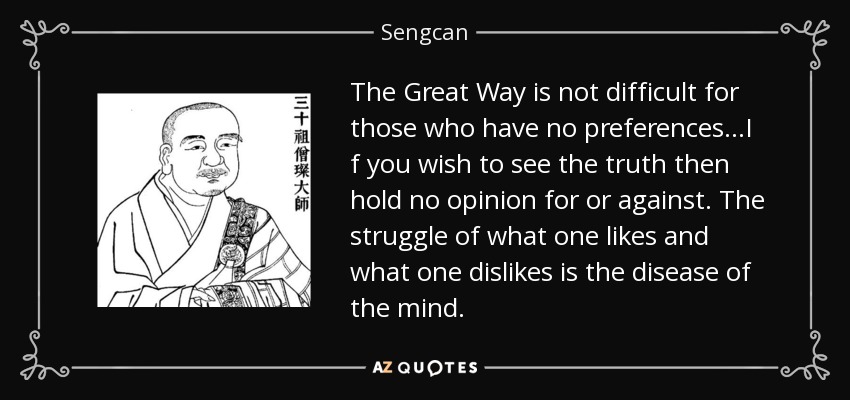
The Great Way is not difficult for those who have no preferences...I f you wish to see the truth then hold no opinion for or against. The struggle of what one likes and what one dislikes is the disease of the mind.
We will never find joy in church membership when we are constantly seeking things our way. But paradoxically, we will find the greatest joy when we choose to be last. That's what Jesus meant when He said the last will be first. True joy means giving up our rights and preferences and serving everyone else.
A true gentleman doesn’t prefer blondes. A true gentleman doesn’t have any preferences whatsoever.
... the smaller the domain where choices among alternatives are made collectively, the smaller will be the probability that any individual's preference gets overruled.
People who live in states have as a rule never experienced the state of nature and vice-versa, and have no practical possibility of moving from the one to the other ... On what grounds, then, do people form hypotheses about the relative merits of state and state of nature? ... My contention here is that preferences for political arrangements of society are to a large extent produced by these very arrangements, so that political institutions are either addictive like some drugs, or allergy-inducing like some others, or both, for they may be one thing for some people and the other for others.
A garden full of sweet odours is a garden full of charm, a most precious kind of charm not to be implanted by mere skill in horticulture or power of purse, and which is beyond explaining. It is born of sensitive and very personal preferences yet its appeal is almost universal.
Objectivity cannot be equated with mental blankness; rather, objectivity resides in recognizing your preferences and then subjecting them to especially harsh scrutiny - and also in a willingness to revise or abandon your theories when the tests fail (as they usually do).
It is not contrary to reason to prefer the destruction of the whole world to the scratching of my finger. It is not contrary to reason for me to choose my total ruin, to prevent the least uneasiness of an Indian, or person wholly unknown to me. It is as little contrary to reason to prefer even my own acknowledged lesser good to my greater, and have a more ardent affection for the former than the latter.
It iscrucial that we understand lesbian/feminism in the deepest, most radical sense: as that love for ourselves and other women, that commitment to the freedom of all of us, which transcends the category of "sexual preference" and the issue of civil rights, to become a politics of asking women's questions, demanding a world in which the integrity of all women--not a chosen few--shall be honored and validated in every respect of culture.
Motherhood is the second oldest profession in the world. It never questions age, height, religious preference, health, political affiliation, citizenship, morality, ethnic background, marital status, economic level, convenience, or previous experience.
The confusion between temperament and character has had serious consequences for ethical theory. Preferences with regard to differences in temperament are mere matters of subjective taste. But differences in character are ethically of the most fundamental importance.
The rates of soda consumption in our poorest communities cannot be explained by individual consumer preferences alone, but rather are linked to broader issues of access and affordability of healthy foods in low-income neighborhoods, and to the marketing efforts of soda companies themselves.
Certainly I had my preference, and I very much hoped that George W. Bush would be our next president.
Along with others, I have tried to pry economists away from narrow assumptions about self interest. Behavior is driven by a much richer set of values and preferences.
Sometimes it helps to begin our prayers by confessing we don't feel like praying-and ask God to help us with our preference to be doing something else.
Egoic consciousness is the one we all normally operate with, until we are told there is something else! Every culture teaches egoic consciousness in different ways. At that level it is all about me, my preferences, my choices, my needs, my desires and me and my group as the central reference point.
When we turn the Bible into an adjective and stick it in front of another loaded word, we tend to ignore or downplay the parts of the Bible that don’t quite fit our preferences and presuppositions. In an attempt to simplify, we force the Bible’s cacophony of voices into a single tone and turn a complicated, beautiful, and diverse holy text into a list of bullet points we can put in a manifesto or creed. More often than not, we end up more committed to what we want the Bible to say than what it actually says.
When social forces press for the rejection of age-old Truth, then those who reject it will seek meaning in their own truth. These truths will rarely be Truth at all; they will be only collections of personal preferences and prejudices.
Nature is objective, and nature is knowable, but we can only view her through a glass darkly and many clouds upon our vision are of our own making: social and cultural biases, psychological preferences, and mental limitations (in universal modes of thought, not just individualized stupidity).
People are always talking about the first church. The real first church was that gaggle of people who followed Jesus around. We don't know anything about them. But he apparently didn't ask them what creed they subscribed to, or what their sexual preference was, or any of that. He fed them. He healed them. He forgave them. He is clear about sin, but he was also for forgiveness.
In truth, politeness is artificial good humor, it covers the natural want of it, and ends by rendering habitual a substitute nearly equivalent to the real virtue. It is the practice of sacrificing to those whom we meet in society, all the little inconveniences and preferences which will gratify them, and deprive us of nothing worth a moment's consideration; it is the giving a pleasing and flattering turn to our expressions, which will conciliate others, and make them pleased with us as well as themselves. How cheap a price for the good will of another!
The inherent preferences of organizations are clarity, certainty and perfection. The inherent nature of human relationships involves ambiguity, uncertainty, and imperfection. How one honors, balances, and integrates the needs of both is the real trick of feedback.
I don't listen to anybody's full record anymore and when I did, I don't think I listened to the whole record. I'm sorry, and I don't care who it is, if it's the Beatles, I can't listen to an hour and a half of anybody straight so I guess that's just my personal preference.
Looking back on the long-stretched-out body of one's work, it is interesting to mark the endless duel fought within a man between the emotional and critical sides of his nature, first one, then the other, getting the upper hand, and too seldom fusing till the result has the mellowness of full achievement. One can even tell the nature of one's readers, by their preference for the work which reveals more of this side than of that.
Give me the judgment of balanced minds in preference to laws every time. Codes and manuals create patterned behavior. All patterned behavior tends to go unquestioned, gathering destructive momentum.
Follow AzQuotes on Facebook, Twitter and Google+. Every day we present the best quotes! Improve yourself, find your inspiration, share with friends
or simply: