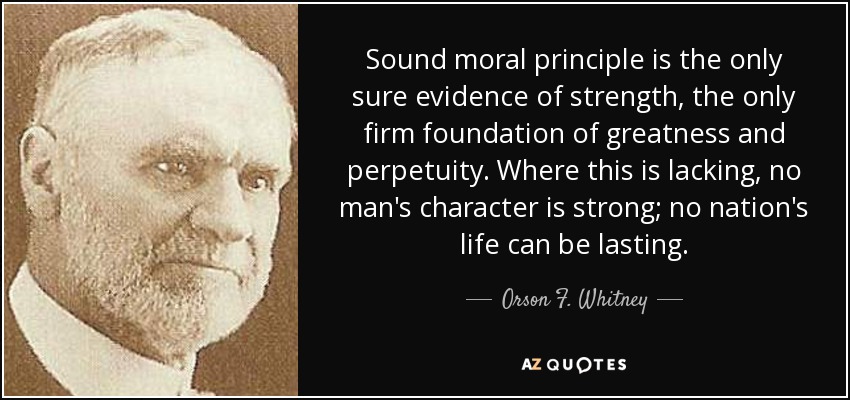
Sound moral principle is the only sure evidence of strength, the only firm foundation of greatness and perpetuity. Where this is lacking, no man's character is strong; no nation's life can be lasting.
Man is nothing else but what he makes of himself. [It is a matter of choice, not chance.] Such is the first principle of existentialism.
Conservatives came to office to reduce the size of government and enlarge the sphere of free and private initiative. But lately we have increased government in order to stay in office. And, soon, if we don't remember why we were elected we will have lost our office along with our principles, and leave a mountain of debt that our children's grandchildren will suffer from long after we have departed this earth. Because, my friends, hypocrisy is the most obvious of sins, and the people will punish it.
You would better educate ten women into the practice of liberal principles than to organize a thousand on a platform of intolerance and bigotry.
Leadership is about having principles. A leader must have a vision and principles that will endure for all time and must always be true to these principles, applying them to changing circumstances
Being proactive is more than taking initiative. It is recognizing that we are responsible for our own choices and have the freedom to choose based on principles and values rather than on moods or condition. Proactive people are agents of change and choose not to be victims, to be reactive, or to blame others.
The very moment you understand that being a Muslim and being American or European are not mutually exclusive, you enrich your society. Promote the universal principles of justice and freedom, and leave the societies elsewhere to find their model of democracy based on their collective psychology and cultural heritage.
Albertans were looking for change. And so I think that we're staying true to our principles by working to deliver on that change. And I think that is what people were looking for
Religious liberty must be protected in this country. It's a principle upon which we were founded.
I'm not sure I can articulate any principles behind the decisions about what to cut and what to keep.
The most basic organizing principle was pretty straightforward, and is frankly pretty common: the shorter of what are by my lights the two most engaging stories goes first, the longer of the two goes at the end, and everything else goes in the middle.
Hansel is certainly about comfort, while still sort of having a peacock principle of wanting to attract attention.
If we don't hold fast to our moral principles, nobody's going to. We don't have to have a majority, but once ten, fifteen, twenty million people start voting left, we'll scare the piss out of the Democrats, and they'll have to respond. But they're not going to respond to us until that happens.
There's also a part of me that's self-destructive, and another part that's a hero who's going to stand up for a principle.
By sticking to my principles and what I firmly believe in - I always have my own attitude towards everything in life. I wish to create trends rather than follow them. My daily routine at the moment is really just a combination of work and family.
don't think I should be in the business of making big pronouncements about where we are now, but I would say that dissatisfaction is as acute now as it was then. What's different, and what I think we can learn from these people, despite their abundant folly, is that we're not using the future as the organizing principle for our critique.
We cannot treat people with a right to asylum the same way as people from a safe country. They need to be sent back. That is, from our perspective, completely clear. On the other hand, we should scrutinize the now completely outdated principle that only the migrants' first country of arrival should be burdened with their registration as well as with the process of sorting out who has the right to asylum and who needs to be deported.
I've been a faithful reader of the great classical documents of economics, or tried to be. The first book in the field that I ever read was Principles of Economics by Alfred Marshall. I suppose subsequently I would have to pick out Keynes, Adam Smith, Marx.
Criticism is concerned with evaluation. There may be evaluative principles implicit in this or that form of theory, but theory in and of itself is not prescriptive.
Free speech is one of our fundamental principles and it's pretty hard to speak freely when people are yelling at you when it's your turn. That would never be allowed in a classroom or in any other kind of meeting.
The final principle of natural farming is NO PESTICIDES. Nature is in perfect balance when left alone.
When I was eleven or twelve years old, I became for a while fixated on the question whether there could be two 'identical' stones. This is, of course, the question whether the principle of identity of indiscernibles is true and, as I formulated it then, I was bound to fall into confusion about it.
At one point I took a copy of Berkeley's Principles from my father's library. That was the first philosophy book I read. I found it fascinating and wanted to read more philosophy.
For bundles of universals can be in more than one place at the same time; so a bundle can have more than one instance; so there can be numerically distinct particulars sharing the same universals; so the principle of identity of indiscernibles is false.
I wanted to see what it means to think about taking responsibility for one's own desires and choosing to foreground desire as an ethical principle. I also wanted to find ways of asking what the limits of agency are for subjectivities that are not unmarked or hegemonic.
Follow AzQuotes on Facebook, Twitter and Google+. Every day we present the best quotes! Improve yourself, find your inspiration, share with friends
or simply: